Caselet Problems | DI | WHO survey | Reasoning | Part - 06 | Bharath Kumar
TL;DR
Learn to interpret and analyze malaria survey data effectively.
Transcript
hi everyone welcome to the session in this session I'm continuing uh casel data interpretation first of all we need to read the information which is provided in the given passage according to the given passage whatever the information is given we need to uh solve uh we need to get the values according to the given information once you got all the v... Read More
Key Insights
- ❓ Thorough comprehension of provided data is crucial for accurate problem-solving in data interpretation.
- ☠️ The yearly variations in malaria infection rates highlight trends and inform health interventions.
- 🧑⚕️ Understanding demographic divisions helps identify which groups are more significantly affected by health issues.
- 🤩 Statistical calculations derived from percentage data are key to assessing the overall impact of diseases like malaria.
- 🦻 Maintaining a clear structure while calculating values aids in minimizing errors in data interpretation.
- 🧑⚕️ The ability to analyze categorical data provides deeper insight into public health dynamics.
- 🧑⚕️ The methods discussed can be applied to analyze various other health-related datasets, enhancing analytical skills.
Install to Summarize YouTube Videos and Get Transcripts
Explore YouTube Video Summarizer or Get YouTube Transcript Extractor
Questions & Answers
Q: What percentage of people were found to be affected by malaria in 2006?
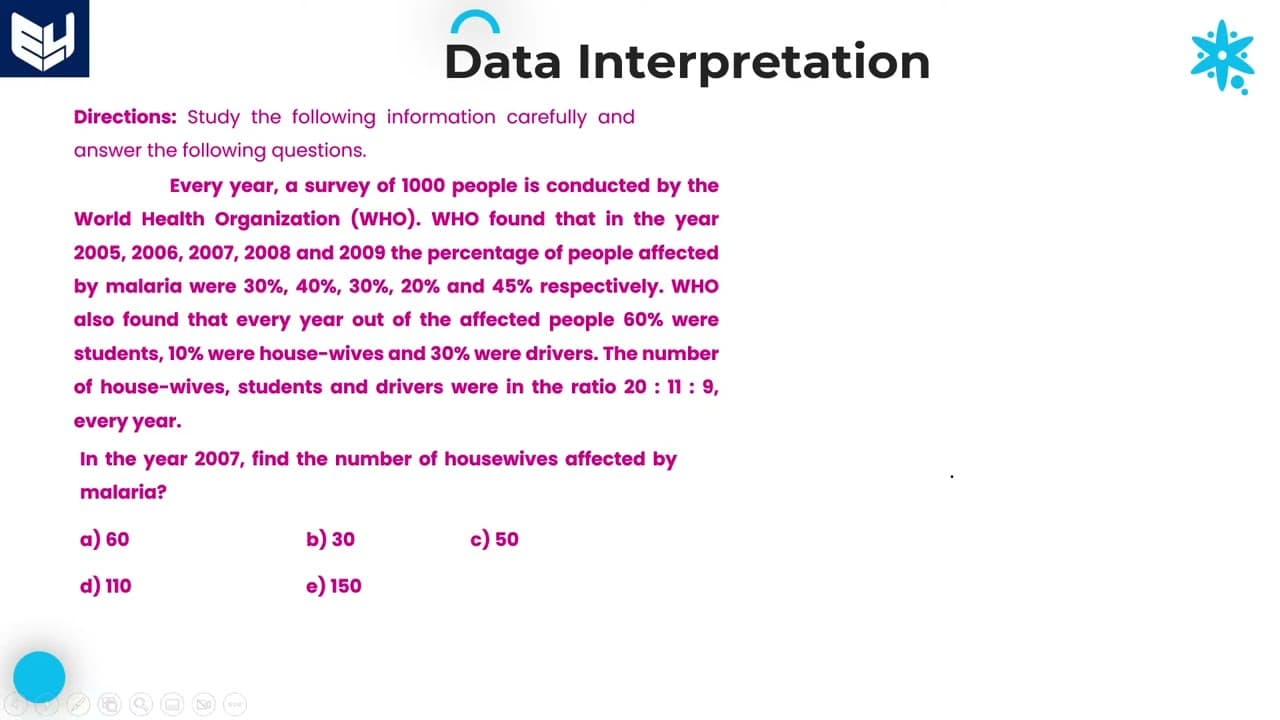
In 2006, the World Health Organization found that 40% of the surveyed population was affected by malaria. Since the survey was conducted on 1,000 people, this implies that 400 individuals were diagnosed with the disease that year. The percentage serves as a crucial indicator of the malaria impact during that time.
Q: How were the affected people categorized in terms of demographics?
The affected population was categorized into three main groups: students (60%), housewives (10%), and drivers (30%). This division allows for a clearer understanding of how malaria afflicts different sectors of the population, providing insight into specific risk factors associated with each demographic.
Q: How is the number of drivers not affected by malaria calculated for 2009?
To find the number of drivers not affected by malaria in 2009, the total number of drivers (225) is subtracted from the number who were affected that year (135). Therefore, 225 - 135 equals 90 drivers who were not affected, showcasing a significant statistic for understanding driver health in the context of the malaria epidemic.
Q: What was the difference between the number of affected and non-affected students in 2006?
In 2006, a total of 275 students were surveyed. Among them, 240 were affected by malaria. Consequently, the number of non-affected students was 275 - 240, equating to 35. Thus, the difference between affected (240) and non-affected (35) students amounts to 205.
Summary & Key Takeaways
-
The session emphasizes the importance of comprehensively understanding data before solving related problems, using statistical examples from malaria survey data by the World Health Organization.
-
Detailed calculation examples illustrate how to determine affected individuals across different demographics, emphasizing the significance of percentages in deriving accurate values.
-
The content also covers problem-solving techniques for interpreting data trends over five years, including solutions to specific queries related to demographic impact from the malaria data.
Read in Other Languages (beta)
Share This Summary 📚
Summarize YouTube Videos and Get Video Transcripts with 1-Click
Try YouTube Summary with ChatGPT & Claude or YouTube Transcript Generator