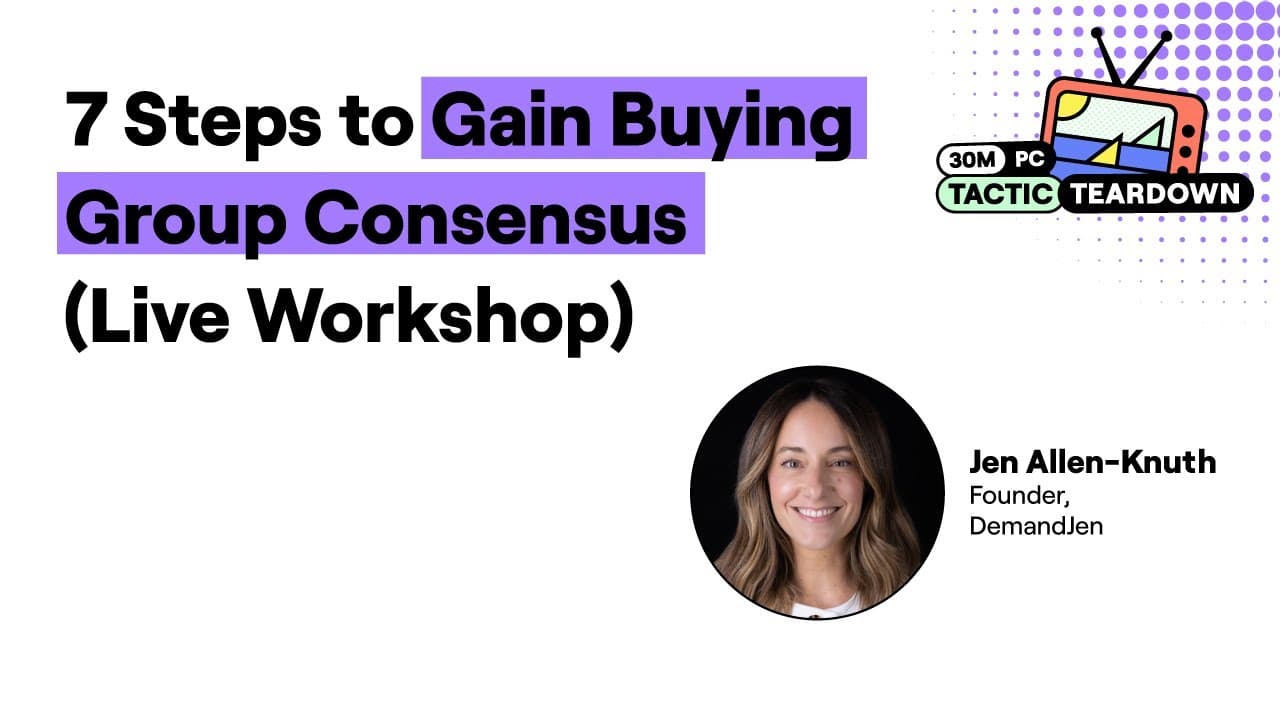
7 Steps to Gain Buying Consensus (Live Workshop)
TL;DR
Jen Allen-Knuth shares a 7-step plan for buying consensus.
Transcript
let's talk about what we're here for and what we're going to do today so if you haven't been on a 30 minutes to president Club webinar before what you need to know is these guys have a very high bar for what they make us do which is you got to be tactical you got to talk about the job you can't talk about The... Read More
Key Insights
- The main goal is to align the buying group on the problem, not just the solution, ensuring everyone agrees it's worth solving now.
- Understanding the cost of inaction is crucial; it's about the unintended consequences of maintaining the status quo.
- Decision-making by committee is a major challenge; the more stakeholders involved, the lower the likelihood of a purchase.
- Building trust and credibility requires focusing on the buyer's business challenges rather than pitching your solution immediately.
- Facilitating a problem-focused discussion helps uncover different perspectives and promotes healthy disagreement within the buying group.
- It's important to identify and engage skeptics early to address potential objections before they become deal-breakers.
- Effective communication with the champion involves ghostwriting emails and providing them with tools to advocate internally.
- Closing meetings with specific questions about the problem's priority can provide clarity on whether the deal will move forward.
Install to Summarize YouTube Videos and Get Transcripts
Explore YouTube Video Summarizer or Get YouTube Transcript Extractor
Questions & Answers
Q: How can understanding the cost of inaction help in sales?
Understanding the cost of inaction helps salespeople focus on the unintended consequences of a buyer maintaining the status quo. This approach shifts the conversation from pitching a solution to highlighting the risks and costs associated with not addressing a problem, making the need for change more compelling.
Q: What challenges are associated with decision-making by committee?
Decision-making by committee presents challenges such as decreased likelihood of purchase as more stakeholders get involved. Each additional stakeholder can introduce differing opinions and priorities, making it harder to reach consensus. This complexity requires strategic engagement and alignment of all parties involved.
Q: How can salespeople build trust and credibility with buyers?
Salespeople can build trust and credibility by focusing on the buyer's business challenges rather than immediately pitching their solution. By understanding and discussing the buyer's problems, salespeople demonstrate empathy and knowledge, positioning themselves as partners rather than just vendors.
Q: Why is it important to engage skeptics early in the sales process?
Engaging skeptics early is important because it allows salespeople to address potential objections before they become significant barriers to closing a deal. By understanding and resolving skeptics' concerns, salespeople can prevent last-minute objections that could derail the sales process.
Q: What role does effective communication with the champion play in the sales process?
Effective communication with the champion is crucial as it involves equipping them with the right tools and messages to advocate internally. By ghostwriting emails and providing clear, concise materials, salespeople can ensure the champion effectively communicates the value proposition to other stakeholders.
Q: How can facilitating a problem-focused discussion benefit the sales process?
Facilitating a problem-focused discussion benefits the sales process by uncovering different perspectives and promoting healthy disagreement within the buying group. This approach helps align stakeholders on the problem and its priority, making it easier to later introduce and gain consensus on a solution.
Q: What should salespeople focus on when closing meetings?
When closing meetings, salespeople should focus on asking specific questions about whether the group feels the problem is worth solving and if it should be prioritized now. This helps clarify the deal's status and competing priorities, providing insights into the likelihood of moving forward.
Q: Why is it important to identify all relevant stakeholders in the sales process?
Identifying all relevant stakeholders is important to prevent unexpected objections from individuals who were not initially involved. Ensuring all key decision-makers are part of the discussion helps avoid last-minute disruptions and ensures a smoother path to consensus and closing the deal.
Summary & Key Takeaways
-
Jen Allen-Knuth presents a comprehensive 7-step approach to achieving buying consensus within large groups. The focus is on aligning the group around the problem rather than the solution, which involves understanding the cost of inaction and promoting healthy disagreement.
-
The session highlights the challenges of decision-making by committee, where more stakeholders often mean a lower chance of closing. The strategy involves engaging skeptics early and facilitating discussions that focus on the buyer's business challenges.
-
Jen emphasizes the importance of building trust and credibility through problem-focused discussions and effective communication with champions. The session concludes with techniques for closing meetings and ensuring all relevant stakeholders are involved.
Read in Other Languages (beta)
Share This Summary 📚
Summarize YouTube Videos and Get Video Transcripts with 1-Click
Try YouTube Summary with ChatGPT & Claude or YouTube Transcript Generator
Explore More Summaries from 30 Minutes to President’s Club 📚


Summarize YouTube Videos and Get Video Transcripts with 1-Click
Try YouTube Summary with ChatGPT & Claude or YouTube Transcript Generator