NASA Warns: “There Are Two Universes” James Webb Telescope Discovers First Terrifying Object Beyond
TL;DR
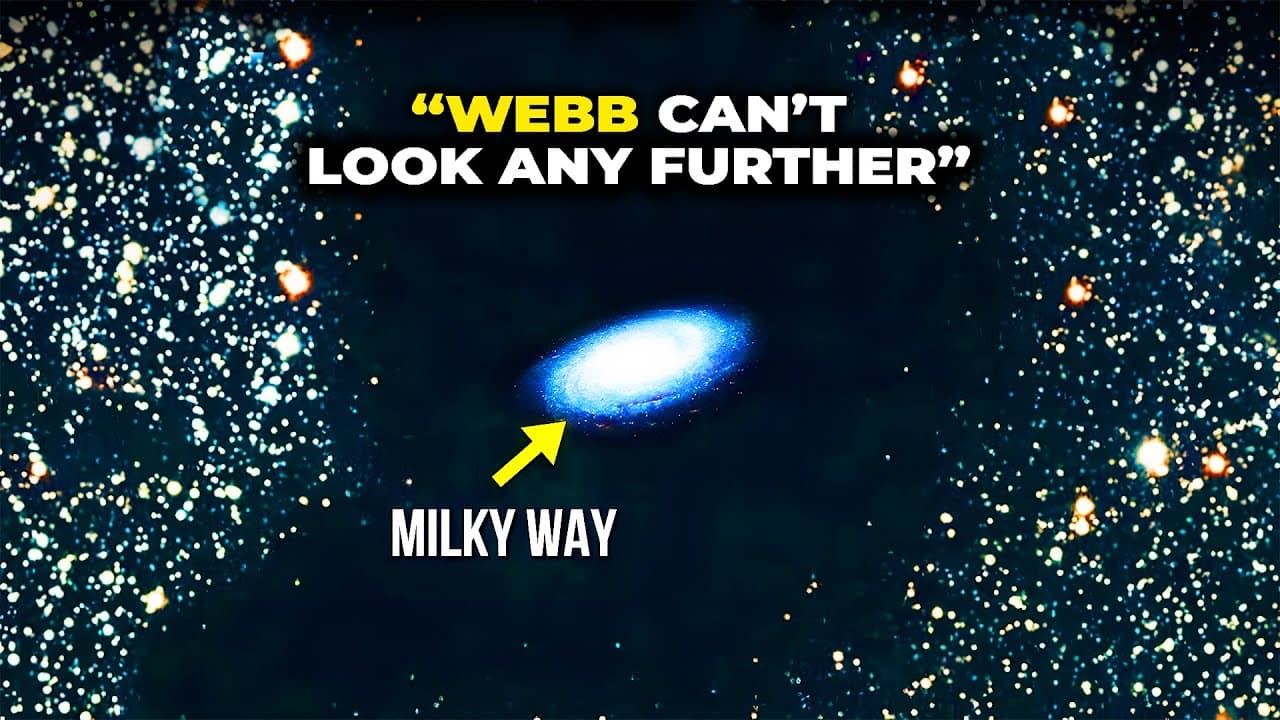
James Webb Telescope suggests existence of parallel universes.
Transcript
what if our universe isn't the full picture but just one fragment of a much vaster cosmic reality the latest mind-bending discoveries from the James Web Space Telescope are throwing serious doubt on everything we thought we knew about how the universe evolved time and again web captures ancient mysterious objects that based on current models simply... Read More
Key Insights
- The James Webb Space Telescope's discoveries challenge current cosmological models, suggesting the existence of parallel universes and other realities.
- Ultra-early galaxies discovered by the telescope existed much earlier than current models can explain, indicating possible alternate galaxy formation processes.
- A massive black hole found by the telescope challenges existing theories about black hole formation soon after the Big Bang.
- The Hubble constant discrepancy suggests that our understanding of the universe's expansion may be flawed, hinting at deeper cosmic mysteries.
- Roger Penrose's theory of conformal cyclic cosmology proposes that the universe undergoes endless cycles of death and rebirth.
- Hawking points are theorized to be remnants of black holes from previous universes, potentially supporting the idea of cosmic rebirth.
- The mirror universe hypothesis suggests a twin cosmos with reversed properties, potentially explaining certain cosmic anomalies.
- The chaotic inflation model proposes an infinite multiverse, with each universe having unique physical laws and characteristics.
Install to Summarize YouTube Videos and Get Transcripts
Explore YouTube Video Summarizer or Get YouTube Transcript Extractor
Questions & Answers
Q: What is the significance of the ultra-early galaxies discovered by the James Webb Space Telescope?
The discovery of ultra-early galaxies by the James Webb Space Telescope is significant because they existed far earlier than current cosmological models can account for. These galaxies challenge our understanding of galaxy formation processes, suggesting that conditions in the early universe may have been different than previously thought or that alternate growth processes for galaxies exist.
Q: How does the Hubble constant discrepancy affect our understanding of the universe?
The Hubble constant discrepancy affects our understanding of the universe by suggesting that our models of cosmic expansion may be flawed. The James Webb Space Telescope confirmed a different expansion rate than predicted, known as the Hubble tension. This discrepancy raises questions about the accuracy of our current cosmological models and suggests that there may be deeper cosmic mysteries to uncover.
Q: What is Roger Penrose's conformal cyclic cosmology theory?
Roger Penrose's conformal cyclic cosmology theory proposes that the universe undergoes endless cycles of death and rebirth. According to this theory, once all matter decays into light and radiation, space and time lose meaning, priming the universe for a new Big Bang. This cycle repeats indefinitely, suggesting that our universe is just one phase in an eternal cosmic loop.
Q: What are Hawking points, and how do they support the idea of cosmic rebirth?
Hawking points are theorized to be remnants of black holes from a previous cosmic era. As these black holes evaporated into Hawking radiation, they would have imprinted energy into the next universe's early stages, appearing as faint circular discs on the cosmic microwave background. Their existence supports the idea of cosmic rebirth, suggesting evidence of previous universes.
Q: What is the mirror universe hypothesis?
The mirror universe hypothesis suggests the existence of a twin cosmos born at the same moment as ours during the Big Bang, but with reversed properties. In this mirror universe, time runs backward, antimatter dominates, and spatial dimensions are inverted. This hypothesis could potentially explain certain cosmic anomalies, such as the dominance of matter over antimatter and the behavior of elusive particles.
Q: What is the chaotic inflation model, and how does it relate to the multiverse?
The chaotic inflation model, proposed by Russian cosmologist Andre Linda, suggests that after the Big Bang, the universe expanded faster than light but not evenly. This resulted in an infinite sea of bubble universes, each with its own laws of physics. According to this model, our universe is just one bubble in a limitless multiverse, with endless possibilities for different realities.
Q: How does the James Webb Space Telescope's discovery impact our understanding of black holes?
The James Webb Space Telescope's discovery of a massive black hole soon after the Big Bang challenges existing theories about black hole formation. The black hole's existence and growth process defy expectations, suggesting that early black holes may have formed like today's. This discovery prompts a reevaluation of our understanding of black hole evolution and cosmic history.
Q: What are the implications of the James Webb Space Telescope's findings for our understanding of the universe?
The James Webb Space Telescope's findings have significant implications for our understanding of the universe. By challenging current cosmological models and suggesting the existence of parallel universes and alternate realities, these discoveries prompt a reevaluation of our understanding of cosmic history, galaxy formation, black hole evolution, and the fundamental nature of space and time.
Summary & Key Takeaways
-
The James Webb Space Telescope's findings are challenging our understanding of the universe, suggesting the existence of parallel universes and alternate realities. Discoveries include ultra-early galaxies and massive black holes that defy current cosmological models, raising questions about galaxy formation and black hole growth processes.
-
The Hubble constant discrepancy highlights potential flaws in our understanding of the universe's expansion, with the telescope confirming a different expansion rate than predicted. This discrepancy, known as the Hubble tension, suggests that our cosmic models may need reevaluation.
-
Theories like Roger Penrose's conformal cyclic cosmology and the chaotic inflation model propose that our universe is part of a multiverse, with endless cycles of cosmic rebirth and infinite parallel universes. These ideas challenge traditional views of the Big Bang and cosmic evolution.
Read in Other Languages (beta)
Share This Summary 📚
Summarize YouTube Videos and Get Video Transcripts with 1-Click
Try YouTube Summary with ChatGPT & Claude or YouTube Transcript Generator