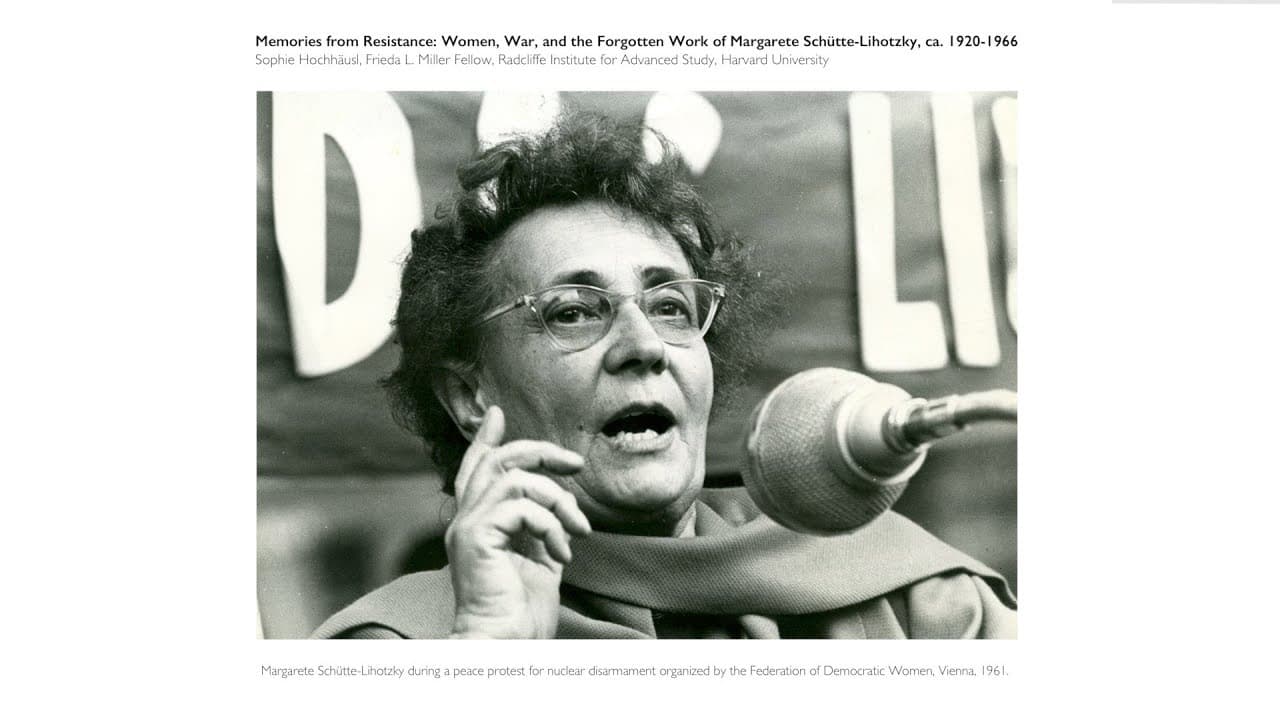
“Memories from Resistance” | Sophie Hochhäusl || Radcliffe Institute
TL;DR
Schutte-Lihotzky's work in architecture and activism focused on resistance against totalitarianism, including her involvement with the Communist Party and her experiences in internment camps.
Transcript
[MUSIC PLAYING] Thank you Judy for his generous introduction. Because today I actually have for the first time the opportunity to talk about all of the things that you flagged you will see Neurath up here. We will talk about current settlements, and we'll also talk about resistance. And of course, the narrative and the lens through which I will tel... Read More
Key Insights
- 🤪 Schutte-Lihotzky's work went beyond her famous design of the Frankfurt kitchen and included activism, writing, and collaboration with other architects and organizations.
- 🫵 Her experiences in internment shaped her views on resistance and solidarity, and her book provided valuable insights into collective opposition during the Holocaust.
- 💦 Schutte-Lihotzky's resistance work challenges traditional notions of modern architecture and highlights the importance of community and cooperation in fighting oppression.
- 👥 Her involvement in designing kindergartens and housing for marginalized groups demonstrated a commitment to improving everyday life and challenging gender boundaries.
Install to Summarize YouTube Videos and Get Transcripts
Explore YouTube Video Summarizer or Get YouTube Transcript Extractor
Questions & Answers
Q: What was Margarete Schutte-Lihotzky's role during World War II?
Schutte-Lihotzky joined the communist resistance against the Nazi regime and actively worked against the regime until she was captured by the Gestapo. She spent over four years interned in Vienna and Germany before being liberated by American troops.
Q: What did Schutte-Lihotzky's book, Erinnerungen aus dem Widerstand, focus on?
The book focused on her experiences during internment and provided a critical perspective on collective opposition and resistance during the Holocaust. It sheds light on the everyday life and practices of resistance within internment camps.
Q: What insights can we gain from Schutte-Lihotzky's resistance work?
Schutte-Lihotzky's resistance work highlights the need to confront and resist totalitarian regimes. It emphasizes the importance of collective opposition and solidarity in the face of oppression. Her work also challenges traditional narratives of modern architecture as solely aesthetically driven.
Q: How did Schutte-Lihotzky's work extend to other areas beyond architecture?
Schutte-Lihotzky's work extended to designing kindergartens, community centers, and housing for migrant women. She was also involved in the women's and peace movement and used her position within the Communist Party to advocate for fair wages and peace in Europe.
Summary & Key Takeaways
-
Margarete Schutte-Lihotzky was an Austrian architect known for her design of the Frankfurt kitchen, but her work spanned over eight decades and included activism and writing.
-
She joined the communist resistance against the Nazi regime during World War II and was detained by the Gestapo for over four years.
-
Memories from her internment, recorded in her book Erinnerungen aus dem Widerstand, provide insight into resistance practices and collective opposition during the Holocaust.
Read in Other Languages (beta)
Share This Summary 📚
Summarize YouTube Videos and Get Video Transcripts with 1-Click
Try YouTube Summary with ChatGPT & Claude or YouTube Transcript Generator
Explore More Summaries from Harvard University 📚



Summarize YouTube Videos and Get Video Transcripts with 1-Click
Try YouTube Summary with ChatGPT & Claude or YouTube Transcript Generator