What is Social Exchange Theory? | From A Business Professor
TL;DR
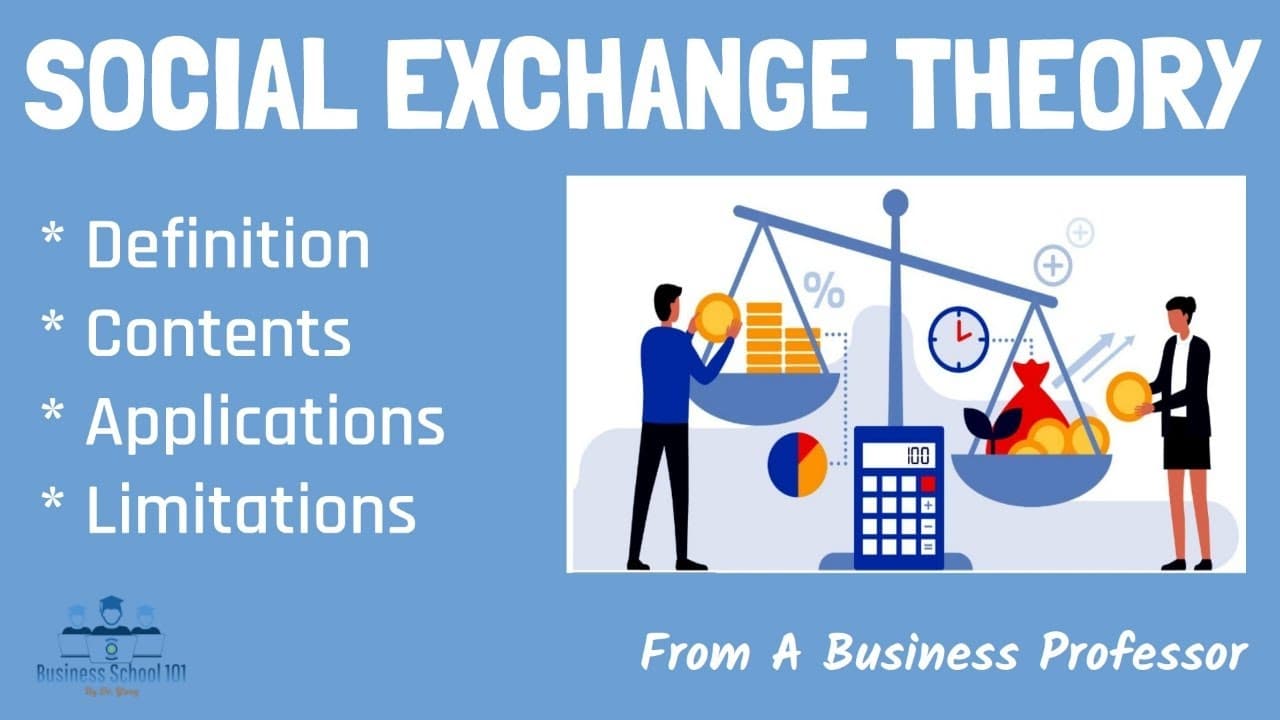
Social Exchange Theory maximizes benefits and minimizes costs in relationships.
Transcript
hello everyone welcome to business school 101 imagine every interaction you have at work whether it's with a colleague a customer or a manager as a transaction where both parties aim to gain more than they give this concept is at the heart of social exchange theory which explores how individuals seek to maximize benefits and minimize costs ... Read More
Key Insights
- Social Exchange Theory is rooted in maximizing benefits and minimizing costs in relationships, impacting both business and psychology fields significantly.
- The theory was introduced by George Homans in 1958 and focuses on reciprocity, cost-benefit analysis, social rewards, trust, and equity.
- Reciprocity in the workplace can lead to higher productivity and loyalty when employees feel valued and recognized by their employers.
- Cost-benefit analysis helps employees decide whether to stay with an organization based on perceived rewards versus the effort and resources required.
- Social rewards, such as recognition and belonging, are crucial motivators of human behavior, influencing workplace satisfaction and engagement.
- Trust and commitment are foundational to social exchanges, fostering long-term relationships when exchanges are consistent and beneficial.
- Social Exchange Theory is applied in business for employee motivation, leadership, customer relationship management, conflict resolution, and organizational commitment.
- The theory has limitations, including overemphasis on rationality, oversimplification of social interactions, cultural bias, and neglect of power imbalances.
Install to Summarize YouTube Videos and Get Transcripts
Explore YouTube Video Summarizer or Get YouTube Transcript Extractor
Questions & Answers
Q: What is the core concept of Social Exchange Theory?
The core concept of Social Exchange Theory is that individuals engage in social interactions by weighing the costs and benefits of their actions, aiming to maximize rewards and minimize costs. This theory suggests that people seek to receive equal or greater benefits in return for their contributions, influencing their decisions and behaviors in relationships.
Q: How does Social Exchange Theory apply to employee motivation?
Social Exchange Theory applies to employee motivation by emphasizing the importance of creating positive exchanges between employers and employees. By providing fair compensation, recognition, and career development opportunities, businesses can increase employee motivation and engagement, as employees are more likely to reciprocate with higher productivity and loyalty when they perceive their contributions are valued.
Q: What role does trust play in Social Exchange Theory?
Trust plays a critical role in Social Exchange Theory as it underpins the belief that the other party will act in a beneficial manner. Trust is essential for developing commitment and fostering long-term relationships. When exchanges are consistent and favorable, trust is strengthened, leading to more stable and productive interactions in both personal and professional settings.
Q: Can you give an example of Social Exchange Theory in practice?
An example of Social Exchange Theory in practice is Google's approach to employee benefits. Google provides extensive benefits like healthcare, wellness programs, and on-site amenities to maximize employee satisfaction and loyalty. In return, employees reciprocate with higher productivity and creativity, demonstrating a strong commitment to the company, which aligns with the principles of Social Exchange Theory.
Q: What are some limitations of Social Exchange Theory?
Some limitations of Social Exchange Theory include its overemphasis on rational behavior, which may not account for emotional or altruistic actions. It also oversimplifies complex social interactions, may be culturally biased towards Western norms, and inadequately addresses power imbalances, particularly in employer-employee relationships, where the weaker party may struggle to negotiate or reciprocate effectively.
Q: How does Social Exchange Theory influence customer relationship management?
Social Exchange Theory influences customer relationship management by encouraging businesses to provide more benefits than costs in customer interactions. This can be achieved through personalized service, loyalty programs, and consistent value delivery. By ensuring that customers perceive a favorable exchange, businesses can enhance customer loyalty and encourage repeat purchases, leading to long-term customer relationships.
Q: What is the significance of reciprocity in Social Exchange Theory?
Reciprocity is a significant concept in Social Exchange Theory, as it involves the expectation that individuals will respond to each other in kind. In a workplace context, if employees perceive fair treatment and support from their employers, they are likely to reciprocate with positive behaviors such as increased productivity and loyalty, thereby strengthening the employer-employee relationship.
Q: How does Social Exchange Theory address conflict resolution?
Social Exchange Theory addresses conflict resolution by promoting fair and balanced exchanges between parties involved in a conflict. By acknowledging and valuing each party's needs and contributions, the theory encourages resolutions that satisfy all parties, fostering a more harmonious and cooperative work environment, ultimately leading to more effective conflict management and resolution.
Summary & Key Takeaways
-
Social Exchange Theory is a framework that explores how individuals aim to maximize benefits and minimize costs in their social interactions. It plays a significant role in business and psychology, focusing on key concepts like reciprocity, cost-benefit analysis, social rewards, trust, and equity.
-
In business applications, Social Exchange Theory is used to enhance employee motivation, build effective leadership, improve customer loyalty, resolve conflicts, and increase organizational commitment. Companies like Google, Starbucks, and Amazon apply this theory to foster engagement and loyalty.
-
Despite its usefulness, Social Exchange Theory has limitations, such as an overemphasis on rational behavior, simplification of social interactions, cultural bias, and inadequate addressing of power imbalances. These factors may affect its applicability in diverse cultural and organizational contexts.
Read in Other Languages (beta)
Share This Summary 📚
Summarize YouTube Videos and Get Video Transcripts with 1-Click
Try YouTube Summary with ChatGPT & Claude or YouTube Transcript Generator
Explore More Summaries from Business School 101 📚



Summarize YouTube Videos and Get Video Transcripts with 1-Click
Try YouTube Summary with ChatGPT & Claude or YouTube Transcript Generator