Running our Network - Deep Learning with Neural Networks and TensorFlow
TL;DR
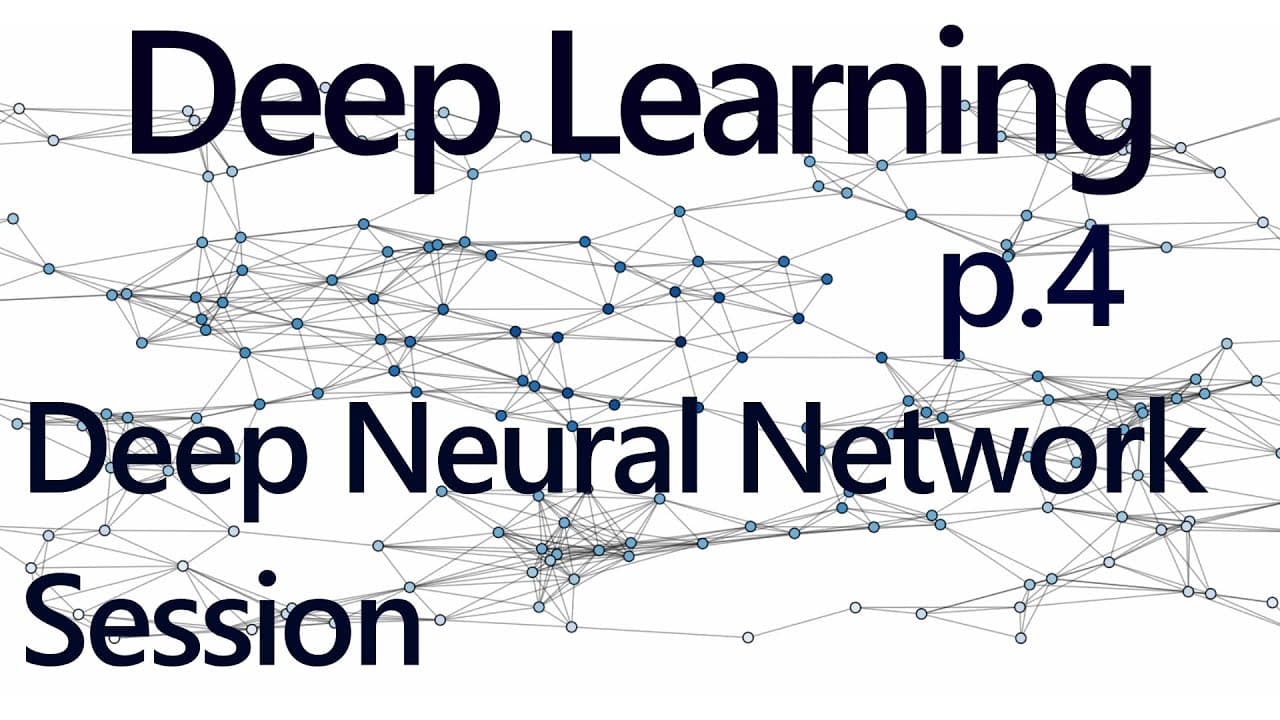
This tutorial explains how to train a neural network model using TensorFlow and Python, with a focus on specifying the computation graph and optimizing the cost function.
Transcript
what is going on everybody and welcome to part four of our deep learning with neural networks tensorflow and Python tutorial in the last tutorial what we did was we basically built up the computation graph for our tensorflow model and also basically we built up the neural network model so those two are very synonymous as far as uh what they are so ... Read More
Key Insights
- 🚄 TensorFlow provides a high-level API for building and training neural networks, making it easier to implement complex models.
- 😵 Cross-entropy with logits is a common cost function used in classification tasks, such as image recognition.
- ❓ The choice of optimizer can have an impact on the training performance and convergence of the model.
- 🏋️ Training a neural network involves iterating through the data in batches and updating the weights based on the cost function.
Install to Summarize YouTube Videos and Get Transcripts
Explore YouTube Video Summarizer or Get YouTube Transcript Extractor
Questions & Answers
Q: What is the relationship between the computation graph and the neural network model?
The computation graph represents the structure of the neural network, including the layers and connections between them. It is built up while constructing the neural network model.
Q: How is the cost function calculated?
The cost function is calculated using cross-entropy with logits, which measures the difference between the predicted output and the known label. This is done using the tf.nn.softmax_cross_entropy_with_logits function.
Q: What is the purpose of the optimizer?
The optimizer is used to minimize the cost function by adjusting the weights of the neural network. In this tutorial, the Adam optimizer is used, which is a variant of stochastic gradient descent.
Q: How is the model trained in epochs?
The model is trained by iterating through the training data in batches. Each iteration consists of a forward pass to compute the predictions and a backward pass to update the weights based on the cost function.
Summary & Key Takeaways
-
The tutorial covers the process of setting up the computation graph and building the neural network model using TensorFlow and Python.
-
The cost function is defined using cross-entropy with logits, and an Adam optimizer is used to minimize the cost.
-
The model is trained by running data through the computation graph in epochs.
Read in Other Languages (beta)
Share This Summary 📚
Summarize YouTube Videos and Get Video Transcripts with 1-Click
Try YouTube Summary with ChatGPT & Claude or YouTube Transcript Generator
Explore More Summaries from sentdex 📚
Summarize YouTube Videos and Get Video Transcripts with 1-Click
Try YouTube Summary with ChatGPT & Claude or YouTube Transcript Generator