State space analysis | Solution of state equations | Example | CS | Control Systems | Lec-128
TL;DR
This content covers solving state space equations using matrices and Laplace transforms.
Transcript
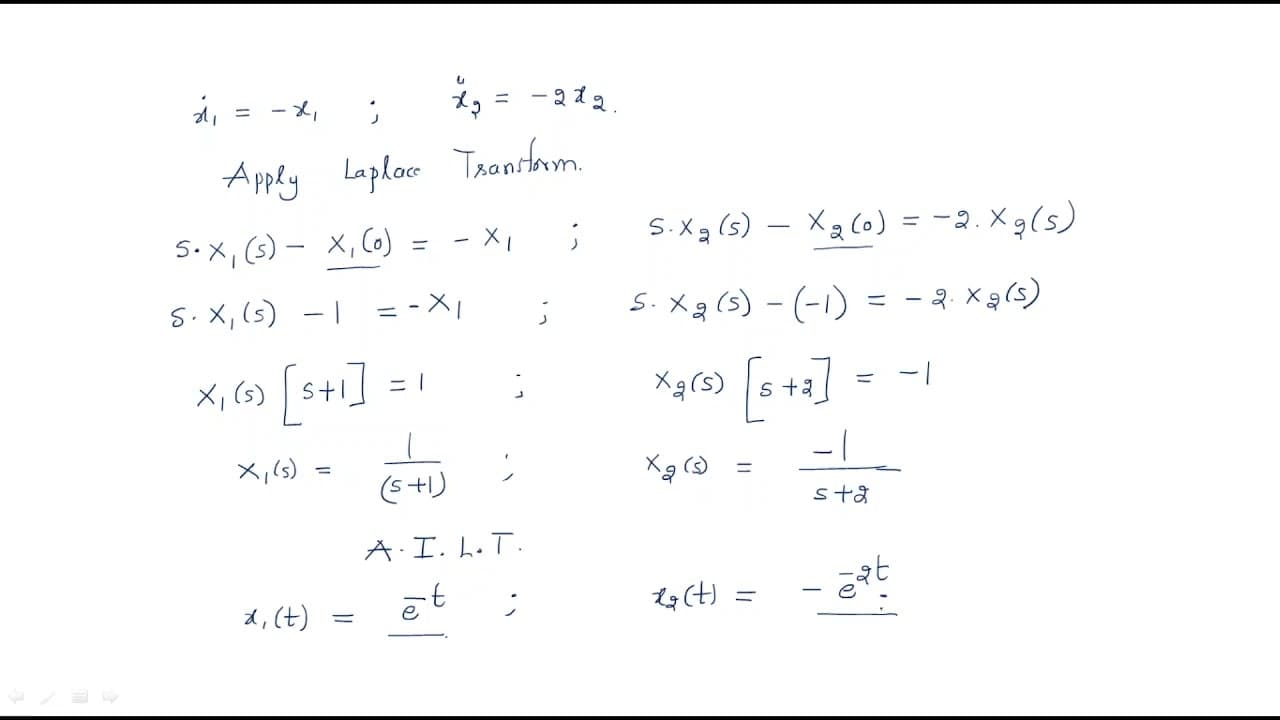
hello everyone in this session we will discuss some more problems regarding the state space analysis here look at the problem the problem is given a matrix equal -1 0 0 -2 if the initial conditions are X1 of 0 = 1 X2 of 0 = -1 that means X1 at time 0 X2 at time 0 the solution of State equations is so he's asking to find out the solution that means ... Read More
Key Insights
- 😑 State space analysis is a powerful tool in control systems, wherein a system's behavior can be expressed using matrix equations.
- 🖐️ Both state variables and initial conditions play a vital role in formulating accurate state equations, affecting the solutions significantly.
- 🈸 The application of the Laplace transform is essential for solving ordinary differential equations arising from state equations, as it facilitates algebraic manipulation.
- ⚾ Systems with zero inputs can yield specific outputs based on differential state equations, revealing system behavior purely based on inherent properties.
- 🥺 The content emphasizes iterative problem-solving, showcasing how transitioning from the time domain to the s-domain leads to more straightforward calculations.
- 👾 Step functions, like the unit step function, are common in inputs for state space systems and significantly impact the resulting state equations.
- ⌛ The analysis demonstrates how to derive final outcomes using limit processes as time approaches infinity, crucial for assessing system performance.
Install to Summarize YouTube Videos and Get Transcripts
Explore YouTube Video Summarizer or Get YouTube Transcript Extractor
Questions & Answers
Q: What is the main procedure presented for solving state equations?
The primary procedure involves defining the state equations based on a given matrix and initial conditions, applying Laplace transforms to switch from the time domain to the s-domain, and then solving for state variables before returning to the time domain. This structured method ensures clarity and accuracy in deriving solutions.
Q: How are the initial conditions important in finding the state space solutions?
Initial conditions are crucial as they provide specific starting values for the variables at time zero, allowing for accurate calculation during the Laplace transformation. They influence the constants that arise in the solutions and ensure that the model reflects the true behavior of the system being analyzed.
Q: Can you explain the significance of the Laplace transform in this context?
The Laplace transform simplifies the process of solving differential equations by transforming them into algebraic equations, which are easier to manipulate. It allows for the direct incorporation of initial conditions, ultimately leading to solutions in a more manageable form for dynamic systems analysis.
Q: What does the maximum power transfer theorem imply in the context of state space analysis?
The maximum power transfer theorem indicates that as time approaches infinity, the steady-state or final values of system outputs can be derived from the s-domain representation. It simplifies the evaluation of limits in the time domain by converting them into manageable expressions in the s-domain.
Summary & Key Takeaways
-
The content explains how to solve state space equations defined by a given matrix and initial conditions using a systematic approach.
-
It details the application of Laplace transforms to derive time domain solutions for state variables, providing step-by-step equations and substitutions.
-
The session concludes with the demonstration of limit calculations for state variables, emphasizing methods like maximum power transfer theorem for finding results at infinity.
Read in Other Languages (beta)
Share This Summary 📚
Summarize YouTube Videos and Get Video Transcripts with 1-Click
Try YouTube Summary with ChatGPT & Claude or YouTube Transcript Generator