Phase velocity | Derivation | Wave Guide | Microwave Engineering | Lec-21
TL;DR
This video derives the expression for phase velocity in waveguides concerning cutoff wavelengths.
Transcript
hi everyone in this video I am going to derive the expressions for phase velocity in the previous video I have given you the definition of phase velocity and group velocity now in this video we are going to see what is the expression for phase velocity in terms of cutoff wavelength under free space wavelength so now the phase velocity we know the p... Read More
Key Insights
- 👋 Phase velocity in waveguides is essential for understanding wave propagation and is derived from fundamental frequency relationships.
- 💱 The rectangular waveguide's geometry influences phase velocity, which can vary with changes in operational frequencies and boundary conditions.
- 😑 The derived mathematical expressions combine to show the interdependence between phase velocity, wavelength, and cutoff frequency.
- 🖐️ Attenuation constants play a critical role in waveguide calculations, specifically in ensuring that signals remain strong throughout propagation.
- 👋 Understanding terms like gamma, alpha, and beta is crucial for accurately depicting wave properties in waveguides.
- 🎮 The video provides a step-by-step mathematical approach that highlights the importance of theoretical foundations in practical applications, such as communication systems.
- 🥶 The relationship between free space and guide wavelengths illustrates critical principles necessary for optimizing waveguide performance.
Install to Summarize YouTube Videos and Get Transcripts
Explore YouTube Video Summarizer or Get YouTube Transcript Extractor
Questions & Answers
Q: What is phase velocity, and how is it expressed in waveguides?
Phase velocity is the speed at which a wave phase propagates through a waveguide. In this context, it is derived to be VP = C / √(1 - (FC / F)²), where C is the speed of light, FC is the cutoff frequency, and F is the operating frequency.
Q: What is the significance of the cutoff wavelength in the context of phase velocity?
The cutoff wavelength is essential as it determines the conditions under which waves can propagate within a waveguide. The derived expression for phase velocity indicates how the wave's speed changes as a function of this critical frequency, impacting waveguide design and functionality.
Q: How does the video illustrate the calculation of propagation constants in the waveguide?
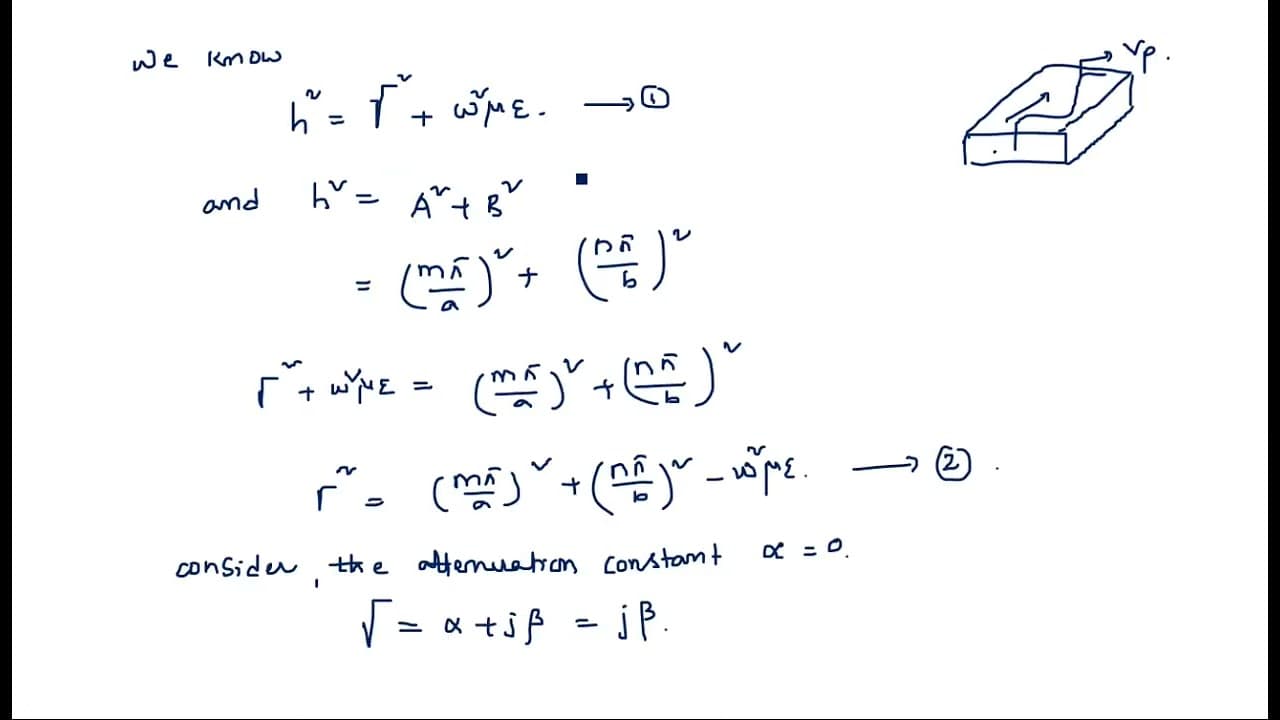
The presenter explains using the relation H² = gamma² + Omega²μEpsilon, where gamma is the propagation constant. The calculation shows how to derive values for alpha, beta, and gamma considering specific boundary conditions in rectangular waveguides.
Q: What role do attenuation constants play in phase velocity calculations?
In the video, it’s stated that if the attenuation constant (alpha) is zero, the waves maintain their signal strength from input to output in the waveguide. This assumption simplifies calculations because gamma then equates to J beta, affecting derived expressions for phase velocity.
Q: How is phase velocity related to the wavelength and cutoff frequency?
Phase velocity is fundamentally linked to both wavelength and cutoff frequency through the derived expression. The equation VP illustrates how these quantities interact, and they are crucial for determining wave propagation characteristics in waveguides.
Q: Can the phase velocity expression be rewritten in terms of wavelengths?
Yes, the expression for phase velocity can be rephrased using wavelengths, referencing the relationships between the free space wavelength and cutoff wavelength. The presenter reveals that VP can also be expressed as VP = C / √(1 - (λC / λ)²).
Summary & Key Takeaways
-
The video explains the definition and derivation of phase velocity and group velocity in waveguides, specifically focusing on rectangular waveguides.
-
Using mathematical equations, the presenter illustrates how to express phase velocity in terms of cutoff wavelength and free space wavelength, factoring in propagation constants.
-
The relationship between frequency, wavelength, and phase velocity is established, highlighting the various parameters involved in wave propagation analysis.
Read in Other Languages (beta)
Share This Summary 📚
Summarize YouTube Videos and Get Video Transcripts with 1-Click
Try YouTube Summary with ChatGPT & Claude or YouTube Transcript Generator