Pie chart | Distribution & Expenditure | Data Interpretation | Reasoning | Part - 16 | Bharath Kumar
TL;DR
A detailed discussion on interpreting pie charts for organizational expenditures and employee distribution.
Transcript
hi everyone welcome to the session in this session I am continuing fighter date and predation first of all we need to read the given information carefully after that according to the given information we need to solve the questions see this uh this pie chart is little bit of difficult as compared to the previous sessions by your data interpretation... Read More
Key Insights
- 🥧 Understanding pie charts is essential for interpreting organizational finances; careful data analysis avoids calculation errors.
- 🏬 The session highlights various expenditures within an organization, which helps in grasping budget allocations for departments.
- 🧑🏭 Knowledge of conversion factors between crores, lakhs, and millions is crucial for accurate financial analysis.
- 🏬 Calculation methods for department-specific expenditures promote a deeper understanding of financial distribution practices.
- ❓ The importance of meticulous reading of the data prevents oversights in financial assessments and answer accuracy.
- 🛟 Practical examples serve to strengthen problem-solving skills, essential for academic and professional exam settings.
- 😀 Familiarity with parsing complex financial data imparts confidence when facing similar real-world challenges or assessments.
Install to Summarize YouTube Videos and Get Transcripts
Explore YouTube Video Summarizer or Get YouTube Transcript Extractor
Questions & Answers
Q: How does one calculate the total expenditure for the Accounts Department?
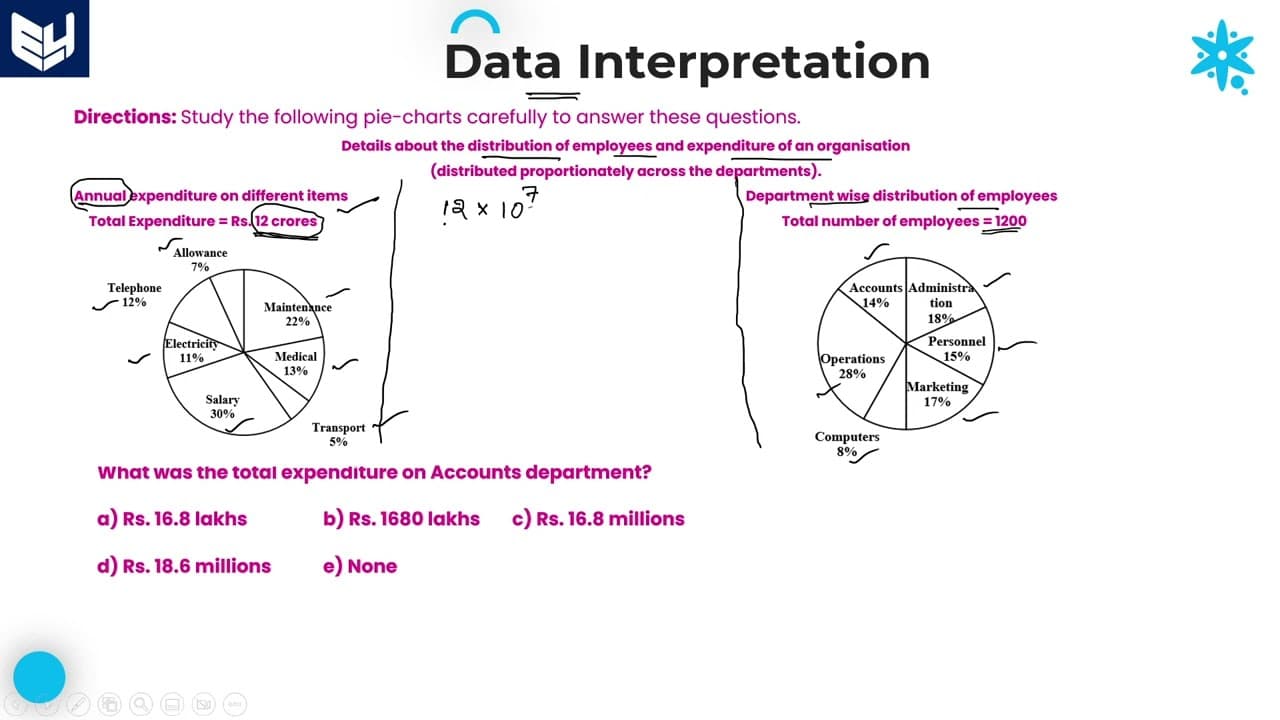
To find the total expenditure for the Accounts Department, first determine its percentage of the overall expenditure, which is 14%. Given the total expenditure of 12 crores, this converts to 1200 lakhs. By calculating 14% of 1200 lakhs (1200 x 0.14), you get 168 lakhs. Therefore, the expenditure for the Accounts Department is either 168 lakhs or 16.8 million.
Q: What is the process for finding per-employee medical expenditure?
The total medical expenditure is 13% of the total spending. With 12 crores equating to 1200 lakhs, calculating 13% yields 156 lakhs. To find the per-employee expenditure, divide 156 lakhs by the total number of employees, which is 1200. This results in an expenditure of 13,000 per employee.
Q: How is the total salary expenditure calculated?
To calculate the total salary expenditure, determine the percentage allocated for salaries, which is 30%. From the total 12 crores (or 1200 lakhs), calculate 30% to reach 360 lakhs. Subsequent calculations will distribute this amount based on department-specific percentages, such as the marketing department's 17% share to find their specific salary expenditure.
Q: What is the expenditure on electricity for the organization?
Electricity expenditure accounts for 11% of total company spending. With the total expenditure at 12 crores, or 1200 lakhs, multiplying 11% with 1200 lakhs gives you 132 lakhs. In millions, this amounts to 13.2 million.
Q: How do you calculate the telephone expense for the Computer Department?
First, calculate the total telephone expenditure, which is 12% of the total 12 crores, resulting in 144 lakhs. For the Computer Department specifically, which takes up 8% of that total, calculate 8% of 144 lakhs, resulting in 11.52 lakhs.
Q: Why is it important to convert between different financial units like crores, lakhs, and millions?
Understanding financial conversions is crucial when analyzing organizational expenditure data. It ensures accuracy in calculations, especially when given options for answers in various forms. For instance, recognizing that 1 crore equals 100 lakhs and 10 million helps prevent errors in interpreting financial data and answering related questions correctly.
Q: How can presentations like these help in exam preparations?
Presentations on data interpretation enhance understanding of various financial concepts and practices. They provide practical examples that are essential for solving real-world problems or exam questions, particularly in quant topics. Such models sharpen analytical skills and improve data representation comprehension.
Q: What is the main takeaway regarding pie charts and expenditure analysis?
The main takeaway is the significance of detailed examination of pie charts in understanding financial distributions within an organization. Correctly interpreting these charts is key to accurately answering related questions and making informed decisions based on expenditure and employee distribution data.
Summary & Key Takeaways
-
The session focuses on interpreting two pie charts that detail the annual expenditure of an organization and the distribution of employees across various departments.
-
It emphasizes understanding the importance of careful reading of provided data for solving related questions, especially when converting between different financial units like crores, lakhs, and millions.
-
Example questions are used to illustrate how to calculate specific expenses, including total expenditure for various departments and per-employee costs based on the organizational data.
Read in Other Languages (beta)
Share This Summary 📚
Summarize YouTube Videos and Get Video Transcripts with 1-Click
Try YouTube Summary with ChatGPT & Claude or YouTube Transcript Generator