Current Dividers Explained!
TL;DR
This video explains how to calculate the current flowing through each resistor in a parallel circuit using formulas and intuitive reasoning.
Transcript
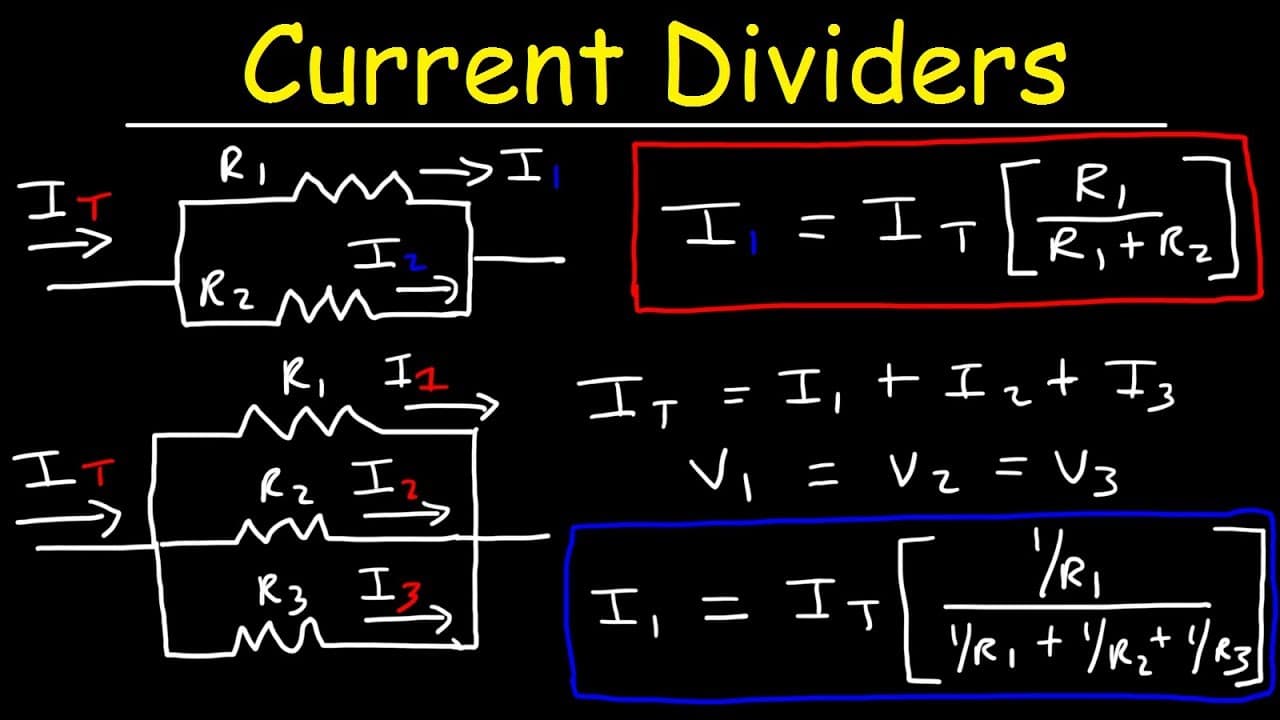
now let's say if we have the following circuit let's say we have two resistors parallel to each other and let's call this one let's say it's r1 and this is r2 now let's say that r1 is 4 ohms and r2 is 8 ohms and let's say the current that enters this part is 6 amps how can we calculate the current that flows through r1 and r2 now before using the f... Read More
Key Insights
- 💐 The current flowing through each resistor in a parallel circuit is determined by their resistance values.
- ⚡ The voltage across each resistor in a parallel circuit is constant.
- ❓ Intuitive reasoning can be used to estimate the current in each branch of a parallel circuit.
Install to Summarize YouTube Videos and Get Transcripts
Explore YouTube Video Summarizer or Get YouTube Transcript Extractor
Questions & Answers
Q: How can you intuitively determine the current flowing through each resistor in a parallel circuit?
In a parallel circuit, the current in each branch is inversely proportional to the resistance. If one resistor has twice the resistance of the other, the current in that branch will be half of the other branch. This rule can be used to estimate the current intuitively.
Q: What is the relationship between the voltage across each resistor in a parallel circuit?
In a parallel circuit, the voltage across each resistor is the same. This is a result of the fact that the voltage is constant throughout a parallel circuit.
Q: What is the formula for calculating current in a two-resistor parallel circuit?
The formula for calculating current in a two-resistor parallel circuit is I1 = (I_total * R2) / (R1 + R2) and I2 = (I_total * R1) / (R1 + R2), where I1 and I2 are the currents in the two branches, I_total is the total current entering the circuit, R1 and R2 are the resistance values of the resistors in each branch.
Q: How can you calculate the current in a parallel circuit with more than two resistors?
In a parallel circuit with more than two resistors, the currents can be calculated using the formula I1 = (I_total/(1/R1 + 1/R2 + 1/R3 + 1/R4)) and so on, where I1 is the current in the first branch, I_total is the total current entering the circuit, and R1, R2, R3, R4, etc. are the resistance values of the resistors in each branch.
Summary & Key Takeaways
-
The video explains that in a parallel circuit with two resistors, the current flowing through each resistor is determined by their resistance values. The current in each branch is proportional to the resistance.
-
The voltage across each resistor in a parallel circuit is the same.
-
The formula for calculating current in a two-resistor parallel circuit is derived and demonstrated, and then extended to a three-resistor and four-resistor parallel circuit.
Read in Other Languages (beta)
Share This Summary 📚
Summarize YouTube Videos and Get Video Transcripts with 1-Click
Try YouTube Summary with ChatGPT & Claude or YouTube Transcript Generator
Explore More Summaries from The Organic Chemistry Tutor 📚




Summarize YouTube Videos and Get Video Transcripts with 1-Click
Try YouTube Summary with ChatGPT & Claude or YouTube Transcript Generator