How to Calculate Digits of Pi Using Elastic Collisions
TL;DR
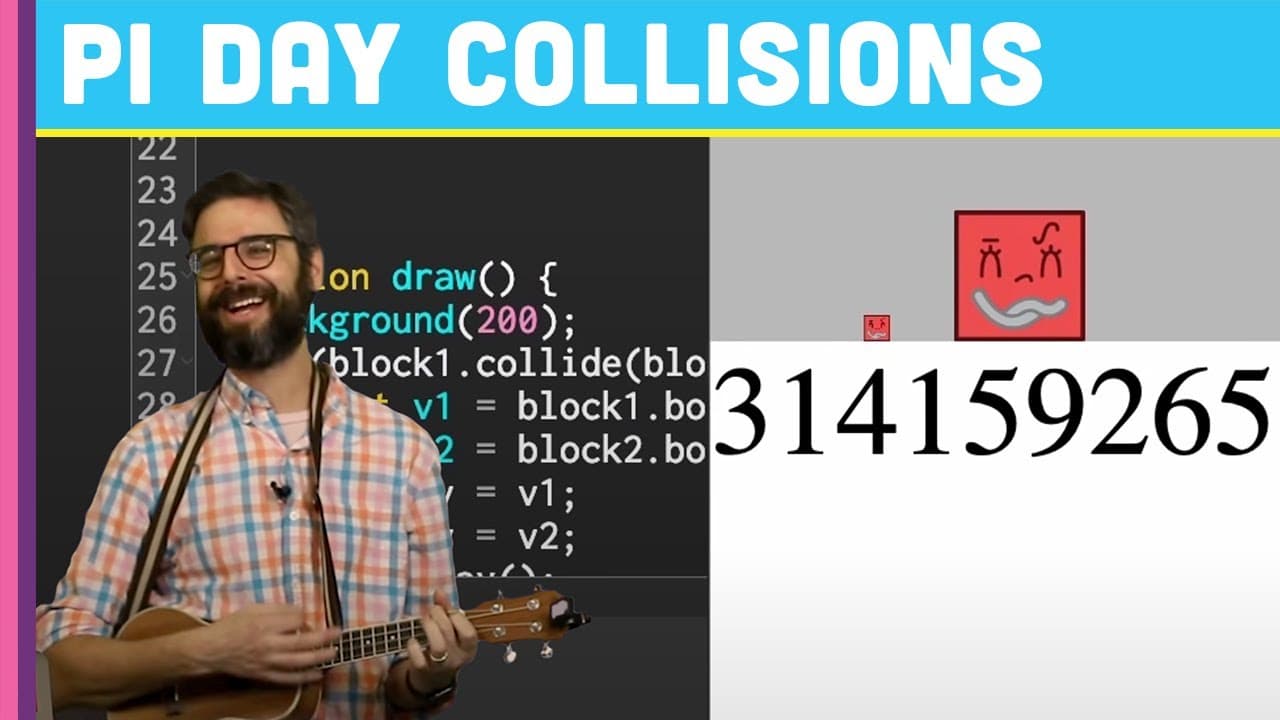
You can calculate the digits of Pi using elastic collisions by simulating the movement of two blocks. The number of collisions that occur between the blocks approximates Pi with increasing accuracy as you decrease the time steps in the simulation. For instance, using 10 million time steps can yield up to ten digits of Pi.
Transcript
- I remember January 2019. Do you remember January 2019? Oh, it was a simpler time. Something happened that month. A video came out on the Internet. This video was called, The most unexpected answer, I'm looking it up, The most unexpected answer to a counting puzzle. And this video was from one of my favorite YouTube channels, 3Blue1Brown, where I ... Read More
Key Insights
- 💥 Elastic collisions can be used in coding challenges to approximate mathematical constants like Pi.
- ⌛ Adjusting time steps in physics simulations can increase the accuracy of calculations.
- 💥 Constraints on block movement and sound effects can enhance the visualization of elastic collisions in coding challenges.
- 😥 Understanding the limitations of floating-point numbers and exploring alternative data types for high-precision calculations.
Install to Summarize YouTube Videos and Get Transcripts
Explore YouTube Video Summarizer or Get YouTube Transcript Extractor
Questions & Answers
Q: How is the value of Pi calculated in this coding challenge?
The value of Pi is calculated by simulating elastic collisions between blocks and counting the number of collisions to approximate the digits of Pi.
Q: What optimization techniques were used to increase the precision of Pi calculation?
Smaller time steps were employed in the physics simulation to achieve higher precision in calculating the value of Pi through elastic collisions.
Q: What challenges were faced in modeling the elastic collisions accurately?
Challenges included maintaining accuracy in the simulation using Euler integration and ensuring constraints for block movement to prevent errors in the Pi calculation.
Q: How did the implementation of sound effects contribute to the coding challenge?
Sound effects such as clacks were used to signify collisions and added an auditory element to the visual simulation of elastic collisions in calculating Pi.
Summary & Key Takeaways
-
A coding challenge using elastic collisions to calculate the value of Pi with increasing accuracy.
-
Implementing physics simulation to model collisions between blocks and count the resulting digits of Pi.
-
Utilizing smaller time steps in the simulation to achieve higher precision in the Pi calculation.
Read in Other Languages (beta)
Share This Summary 📚
Summarize YouTube Videos and Get Video Transcripts with 1-Click
Try YouTube Summary with ChatGPT & Claude or YouTube Transcript Generator
Explore More Summaries from The Coding Train 📚




Summarize YouTube Videos and Get Video Transcripts with 1-Click
Try YouTube Summary with ChatGPT & Claude or YouTube Transcript Generator