Products
Features
YouTube Video Summarizer
Summarize YouTube videos
Web & PDF Highlighter
Highlight web pages & PDFs
Chat with PDF
Ask any PDF questions with AI
Ask AI Clone
Chat with your highlights & memories
Audio Transcriber
Transcribe audio files to text
Glasp Reader
Read and highlight articles
Kindle Highlight Export
Export your Kindle highlights
Idea Hatch
Hatch ideas from your highlights
Integrations
Obsidian Plugin
Notion Integration
Pocket Integration
Instapaper Integration
Medium Integration
Readwise Integration
Snipd Integration
Hypothesis Integration
Apps & Extensions
Chrome Extension
Safari Extension
Edge Add-ons
Firefox Add-ons
iOS App
Android App
Discover
Discover
Ideas
Discover new ideas and insights
Articles
Curated articles and insights
Books
Book recommendations by great minds
Posts
Essays and notes from readers
Quotes
Inspiring quotes collection
Videos
Curated videos and summaries
Explore Glasp
Glasp Newsletter
Weekly insights and updates
Glasp Talk
Interview series with great minds
Glasp Blog
Latest news and articles
Glasp Use Cases
Learn how others use Glasp
Build & Support
Glasp API
Access Glasp's API for developers
MCP Connector
Connect Glasp to Claude & ChatGPT
Community
Glasp Reddit Community
Students
Student discount and benefits
FAQs
Frequently Asked Questions
AboutPricing
DashboardLog inSign up

Viscosity of Fluids & Velocity Gradient - Fluid Mechanics, Physics Problems
November 16, 2017
by
The Organic Chemistry Tutor
YouTube video player
Viscosity of Fluids & Velocity Gradient - Fluid Mechanics, Physics Problems

TL;DR

Viscosity is the internal friction within a fluid, and it determines how easily the fluid flows.

Transcript

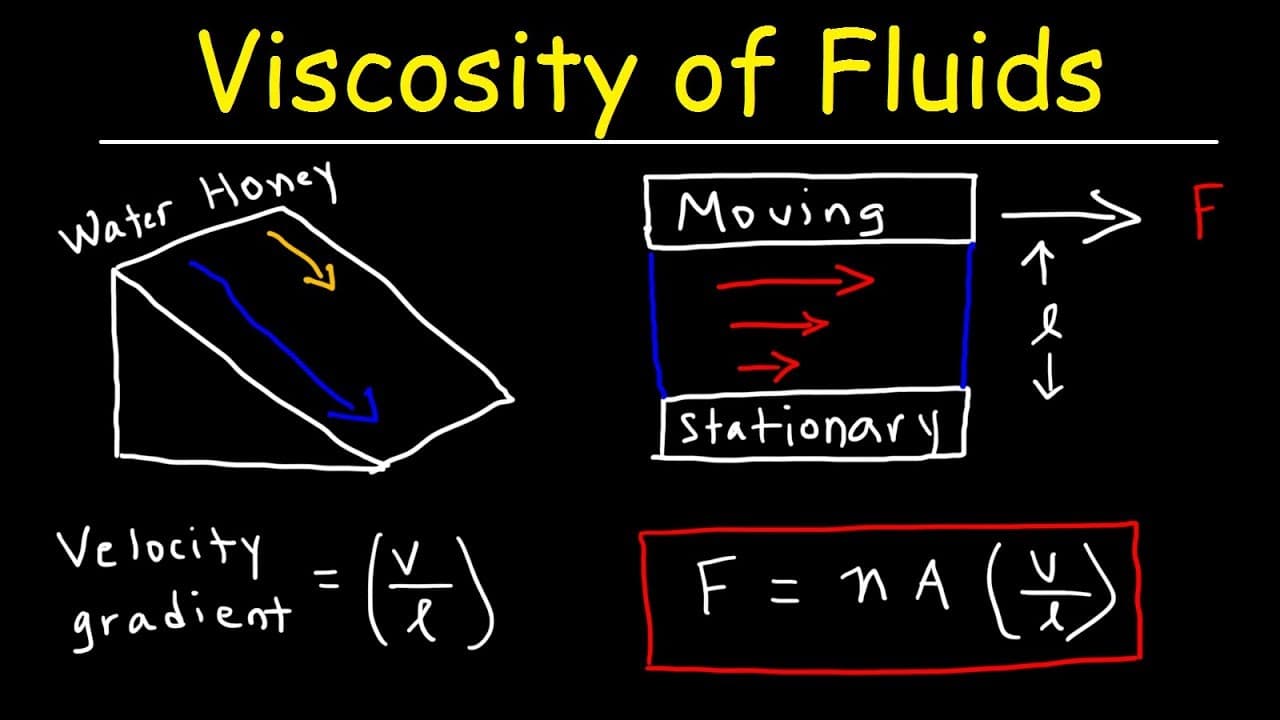
in this video we're going to talk about something called viscosity so what exactly is viscosity viscosity is the internal friction within the fluid so good example to illustrate this is if you think of honey and water so let's say if we have an inclined plane if we pour water at the top of the surface the water is going to quickly slide down the in... Read More

Key Insights

  • ☠️ Viscosity is the internal friction within a fluid, determining its flow rate.
  • 💐 Water has low viscosity and flows quickly, while honey has high viscosity and flows slowly.
  • 🤬 Viscosity can be quantified using the coefficient of viscosity, denoted by the symbol eta.
  • 🐎 The coefficient of viscosity affects the force required to keep a plate moving at a constant speed.
  • ❓ Increasing temperature decreases viscosity by weakening the cohesive forces between molecules.
  • ☠️ The viscosity of a fluid is inversely related to its flow rate.
  • ⌛ Viscosity is measured in pascals times seconds.

Install to Summarize YouTube Videos and Get Transcripts

Explore YouTube Video Summarizer or Get YouTube Transcript Extractor

Questions & Answers

Q: What is viscosity?

Viscosity is the internal friction within a fluid, determining how easily the fluid flows. It is measured by the coefficient of viscosity.

Q: How does viscosity affect the flow rate of fluids?

High-viscosity fluids like honey flow slowly, while low-viscosity fluids like water flow quickly. Viscosity determines the resistance a fluid experiences when flowing.

Q: How can viscosity be quantified?

Viscosity is quantified using the coefficient of viscosity, denoted by the Greek symbol eta. It can be calculated using the formula: required force = coefficient of viscosity * area * velocity / distance.

Q: How does temperature affect viscosity?

Increasing the temperature of a liquid decreases its viscosity. This happens because higher temperatures cause molecules to move apart, weakening the cohesive forces within the liquid.

Summary & Key Takeaways

  • Viscosity is the measure of internal friction within a fluid, determining its flow rate.

  • Water has low viscosity and flows quickly, while honey has high viscosity and flows slowly.

  • The viscosity of a fluid can be quantified using the coefficient of viscosity, represented by the Greek symbol eta.


Read in Other Languages (beta)

English

Share This Summary 📚

Summarize YouTube Videos and Get Video Transcripts with 1-Click

Download browser extensions on:

Try YouTube Summary with ChatGPT & Claude or YouTube Transcript Generator

Explore More Summaries from The Organic Chemistry Tutor 📚
How Long Does It Take Light To Travel From The Sun to The Earth thumbnail
How Long Does It Take Light To Travel From The Sun to The Earth
The Organic Chemistry Tutor
How to Add and Subtract Square Roots and Cube Roots thumbnail
How to Add and Subtract Square Roots and Cube Roots
The Organic Chemistry Tutor
Accuracy and Precision thumbnail
Accuracy and Precision
The Organic Chemistry Tutor
Distance, Displacement, Average Speed, Average Velocity - Physics thumbnail
Distance, Displacement, Average Speed, Average Velocity - Physics
The Organic Chemistry Tutor
What Is the Difference Between Homolytic and Heterolytic Bond Cleavage? thumbnail
What Is the Difference Between Homolytic and Heterolytic Bond Cleavage?
The Organic Chemistry Tutor
SN1 Carbocation Rearrangements - Ring Expansion Problems thumbnail
SN1 Carbocation Rearrangements - Ring Expansion Problems
The Organic Chemistry Tutor

Summarize YouTube Videos and Get Video Transcripts with 1-Click

Download browser extensions on:

Try YouTube Summary with ChatGPT & Claude or YouTube Transcript Generator

Apps & Extensions

  • Chrome Extension
  • Safari Extension
  • Edge Add-ons
  • Firefox Add-ons
  • iOS App
  • Android App

Key Features

  • YouTube Video Summarizer
  • Web & PDF Summarizer
  • Web & PDF Highlighter
  • Chat with PDF
  • Ask AI Clone
  • Audio Transcriber
  • Glasp Reader
  • Kindle Highlight Export
  • Idea Hatch

Integrations

  • Obsidian Plugin
  • Notion Integration
  • Pocket Integration
  • Instapaper Integration
  • Medium Integration
  • Readwise Integration
  • Snipd Integration
  • Hypothesis Integration

More Features

  • APIs
  • MCP Connector
  • Blog & Post
  • Embed Links
  • Image Highlight
  • Personality Test
  • Quote Shots

Company

  • About us
  • Blog
  • Community
  • FAQs
  • Job Board
  • Newsletter
  • Pricing
Terms

•

Privacy

•

Guidelines

© 2026 Glasp Inc. All rights reserved.