18.2.6 Strong Priorities
TL;DR
Weak priority systems may not meet tight deadlines for tasks, while a strong priority system allows tasks with higher priority to preempt lower-priority tasks, guaranteeing deadlines are met.
Transcript
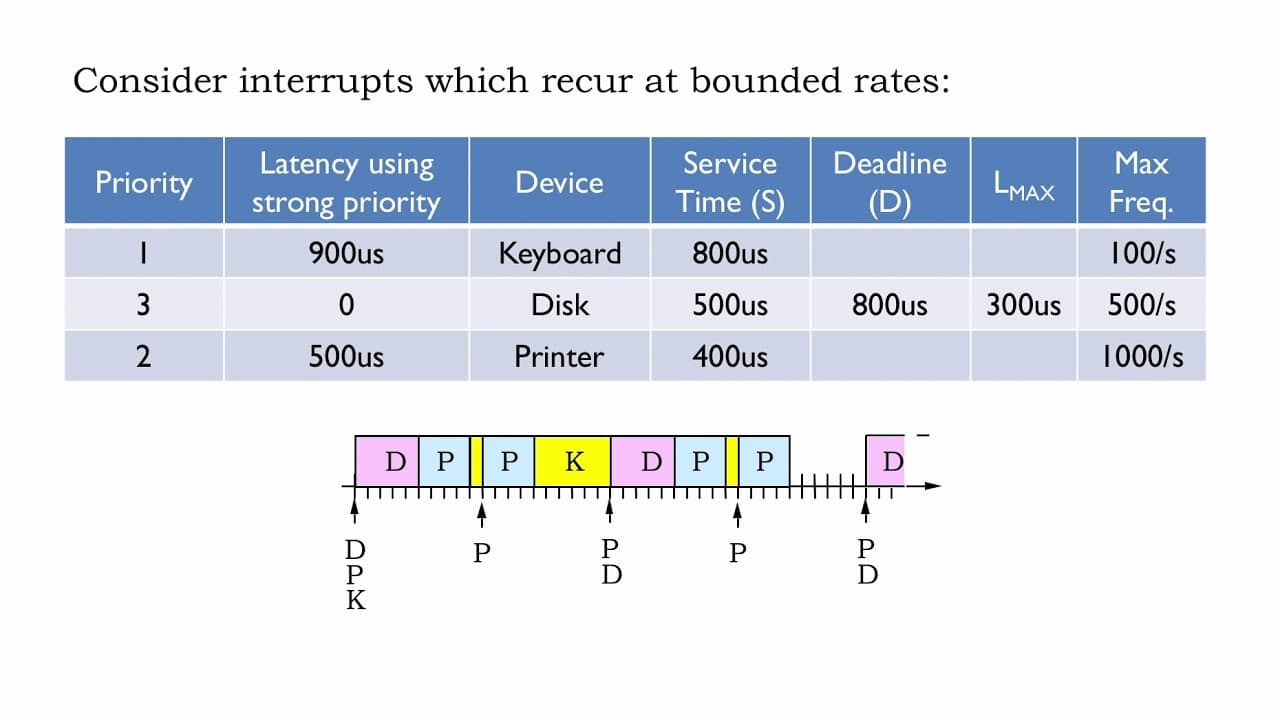
In a weak priority system the currently-running task will always run to completion before considering what to run next. This means the worst-case latency for a device always includes the worst-case service time across all the other devices, i.e., the maximum time we have to wait for the currently-running task to complete. If there's a long-running ... Read More
Key Insights
- 🎟️ Weak priority systems can result in long latencies and missed deadlines for tasks.
- 👻 Strong priority systems allow higher-priority tasks to interrupt lower-priority tasks, ensuring deadlines are met.
- 🏍️ Resource allocation and careful management of CPU cycles are crucial in meeting real-time constraints.
- ❓ Recurring interrupts from multiple devices can significantly affect CPU load and the ability to meet deadlines.
- 😑 Expressing real-time constraints in terms of deadlines rather than latencies is essential for accurate assessment.
- 💪 The proper assignment of priorities in a strong priority system enables devices with tight deadlines to be serviced promptly.
- 🏍️ CPU cycle calculations are necessary to determine the load placed by each device and ensure available cycles are sufficient to meet deadlines.
Install to Summarize YouTube Videos and Get Transcripts
Explore YouTube Video Summarizer or Get YouTube Transcript Extractor
Questions & Answers
Q: What is the difference between weak and strong priority systems?
In a weak priority system, tasks run to completion before considering the next task, leading to potential delays and missed deadlines. In a strong priority system, higher-priority tasks can interrupt lower-priority tasks, ensuring deadlines are met.
Q: What is the impact of weak priority on meeting disk deadlines?
With a weak priority system, the maximum latency for disk requests may exceed the deadline, making it impossible to guarantee timely service. Lower-priority tasks can delay disk execution.
Q: How does a strong priority system improve the worst-case latency for devices?
In a strong priority system, lower-priority tasks can be preempted by higher-priority requests. This reduces worst-case latency for high-priority devices, ensuring timely service and meeting deadlines.
Q: How can recurring interrupts affect real-time constraints?
Recurring interrupts from multiple devices can increase CPU load and make it challenging to meet tight deadlines. Insufficient CPU cycles or overlapping deadlines can lead to failed real-time constraints.
Summary & Key Takeaways
-
A weak priority system allows the currently running task to complete before considering the next task, potentially causing long wait times and missing deadlines.
-
Introducing a strong priority system allows tasks with higher priority to interrupt lower-priority tasks, reducing latency and ensuring deadlines are met.
-
Recurring interrupts from multiple devices can affect CPU load and the ability to meet deadlines, highlighting the need for careful resource allocation.
Read in Other Languages (beta)
Share This Summary 📚
Summarize YouTube Videos and Get Video Transcripts with 1-Click
Try YouTube Summary with ChatGPT & Claude or YouTube Transcript Generator
Explore More Summaries from MIT OpenCourseWare 📚



Summarize YouTube Videos and Get Video Transcripts with 1-Click
Try YouTube Summary with ChatGPT & Claude or YouTube Transcript Generator