Lecture 7.2: Josh McDermott - Introduction to Audition, Part 2
TL;DR
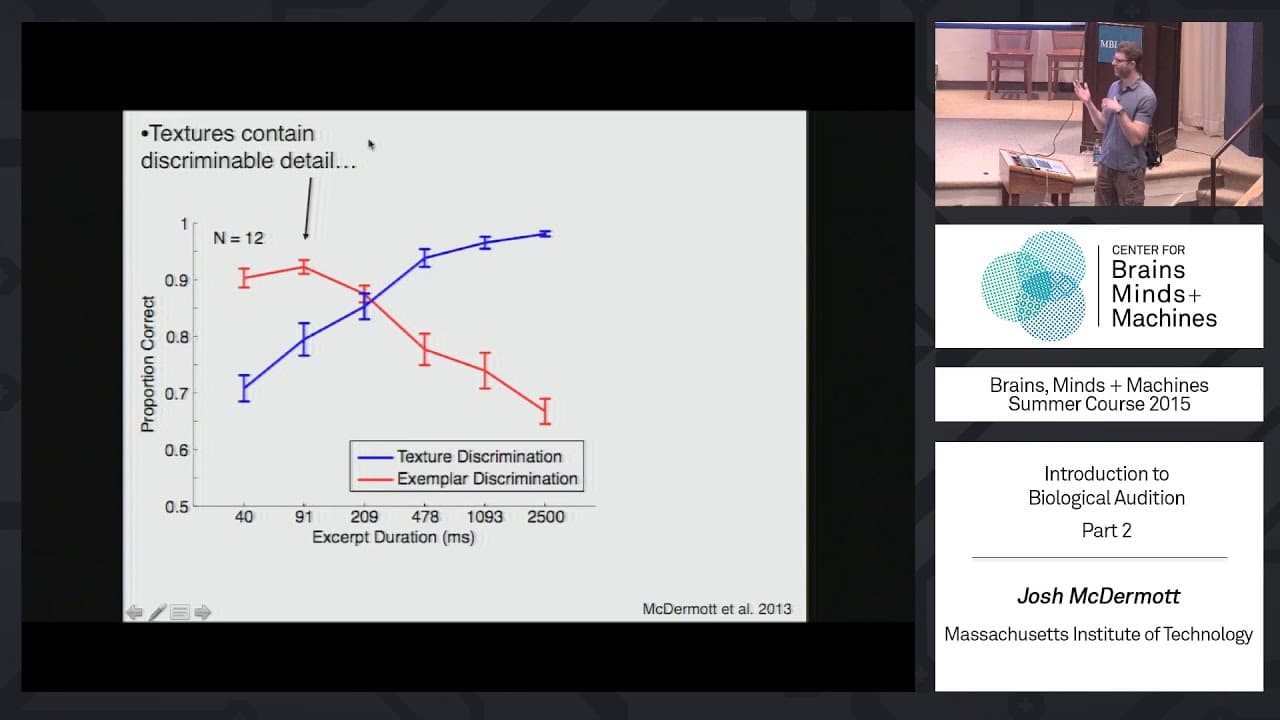
Auditory scene analysis is the process of inferring events in the world from sound, and sound texture refers to the statistical properties of sound. Harmonicity and repetition are key grouping cues used by the brain to segregate different sound sources.
Transcript
The following content is provided under a Creative Commons license. Your support will help MIT OpenCourseWare continue to offer high quality educational resources for free. To make a donation or view additional materials from hundreds of MIT courses, visit MIT OpenCourseWare at ocw.mit.edu. JOSH MCDERMOTT: We're going to get started again. So where... Read More
Key Insights
- 👂 Auditory scene analysis relies on statistical regularities in sound to infer events in the world.
- 👂 Harmonicity, repetition, and mistuning are important grouping cues used by the brain for sound source segregation and recognition.
- 👂 Sound texture refers to the statistical properties of sound and can be represented using various measurements.
- 🎑 The relationship between auditory scene analysis and visual texture analysis is an area for further exploration.
Install to Summarize YouTube Videos and Get Transcripts
Explore YouTube Video Summarizer or Get YouTube Transcript Extractor
Questions & Answers
Q: How does sound texture differ from auditory scene analysis?
Sound texture specifically refers to the statistical properties of sound, while auditory scene analysis involves the process of inferring events in the world from sound based on statistical regularities.
Q: How does harmonicity affect auditory scene analysis?
Harmonicity, where sound sources produce frequencies that are harmonics or multiples of a fundamental frequency, helps the brain segregate sound sources and infer pitch.
Q: Can sound textures be represented using statistical measurements?
Yes, sound textures can be represented using statistical measurements such as marginal moments and correlations, which capture the properties of the sound over time.
Q: How does repetition play a role in auditory scene analysis?
Repetition of certain sound patterns helps the brain segregate and recognize sound sources, as it is a statistical regularity in natural sounds.
Q: What is the significance of mistuning in auditory scene analysis?
Mistuning, or the slight deviation of a harmonic frequency from its expected value, can affect the perception of source segregation and pitch. Mistuned harmonics can be perceived as separate sound sources or cause biases in pitch perception.
Summary & Key Takeaways
-
Auditory scene analysis involves inferring events in the world from sound, relying on statistical regularities in sound sources.
-
Sound texture refers to the statistical properties of sound, including harmonicity and repetition.
-
Harmonicity is the presence of harmonic frequencies in sound, while repetition helps the brain segregate sound sources.
Read in Other Languages (beta)
Share This Summary 📚
Summarize YouTube Videos and Get Video Transcripts with 1-Click
Try YouTube Summary with ChatGPT & Claude or YouTube Transcript Generator
Explore More Summaries from MIT OpenCourseWare 📚


Summarize YouTube Videos and Get Video Transcripts with 1-Click
Try YouTube Summary with ChatGPT & Claude or YouTube Transcript Generator