Lecture 10: Time-Ordered Correlation Functions in Field Theory
TL;DR
The path integral method is used to analyze correlation functions in quantum field theory, with the Wick theorem allowing for the calculation of n-point functions.
Transcript
[SQUEAKING] [RUSTLING] [CLICKING] [SIDE CONVERSATIONS] PROFESSOR: OK, let us start. So, last time, we discussed how to calculate such a correlation function, say Gn, in a single particle theory, so using path integral. So the goal is to calculate this time-ordered product correlation function, the vacuum correlation function, of this time-ordered p... Read More
Key Insights
- 👻 The path integral method allows for the calculation of correlation functions in quantum field theory.
- 😥 The Wick theorem simplifies the calculation of n-point functions by summing over all possible contractions.
Install to Summarize YouTube Videos and Get Transcripts
Explore YouTube Video Summarizer or Get YouTube Transcript Extractor
Questions & Answers
Q: How are correlation functions in quantum field theory computed using the path integral method?
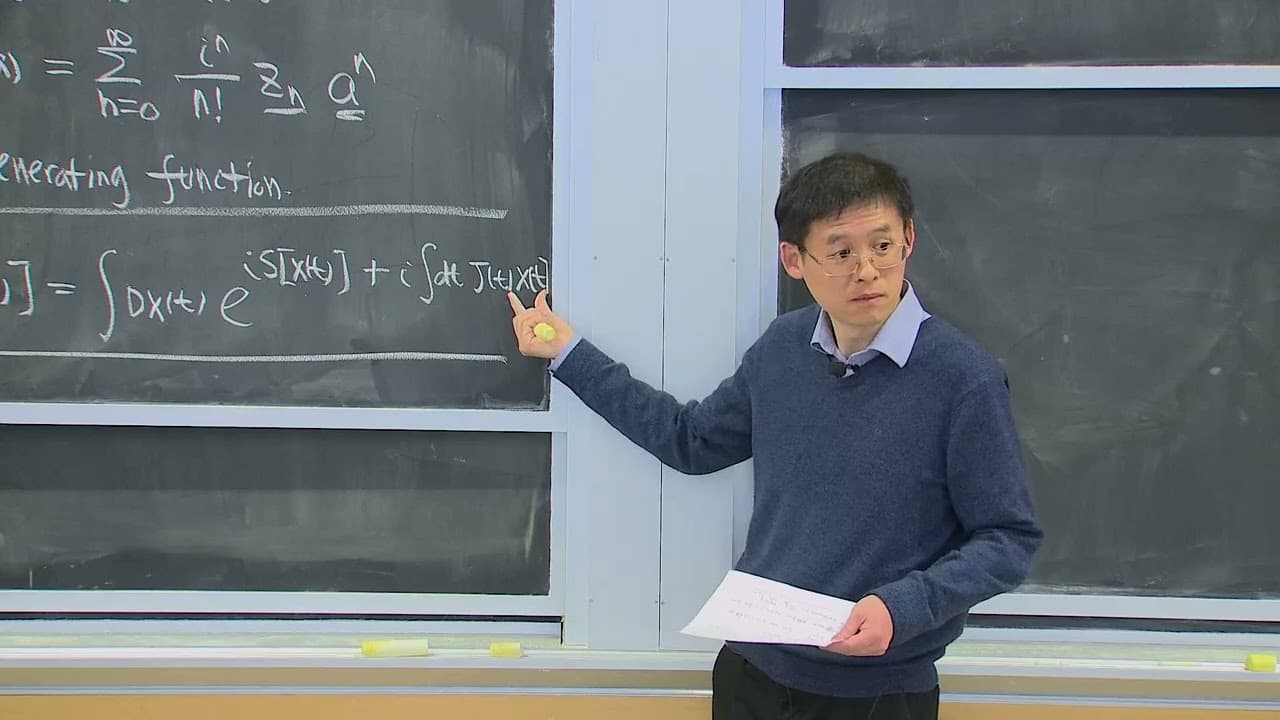
Correlation functions in field theory are computed using the path integral method by calculating the ratio of two path integrals - the generating functional divided by the vacuum generating functional.
Q: What is the significance of the Wick theorem in quantum field theory?
The Wick theorem is significant in quantum field theory as it allows for the calculation of n-point functions by summing over all possible contractions, making the computation of correlation functions more manageable.
Q: How are correlation functions calculated in interacting field theories?
In interacting field theories, correlation functions are calculated by expanding the interaction term in the Lagrangian into a power series and summing over all possible contractions between field variables.
Summary & Key Takeaways
-
The path integral technique is used to compute correlation functions in quantum field theory by calculating the ratio of two path integrals.
-
The Wick theorem states that the n-point function in quantum field theory can be computed by summing over all possible contractions.
-
In field theory, the generating functional is used to calculate correlation functions, with the ratio of the generating functional to the vacuum generating functional giving the correlation functions.
Read in Other Languages (beta)
Share This Summary 📚
Summarize YouTube Videos and Get Video Transcripts with 1-Click
Try YouTube Summary with ChatGPT & Claude or YouTube Transcript Generator
Explore More Summaries from MIT OpenCourseWare 📚



Summarize YouTube Videos and Get Video Transcripts with 1-Click
Try YouTube Summary with ChatGPT & Claude or YouTube Transcript Generator