Can Location Data Be Truly Anonymous?
TL;DR
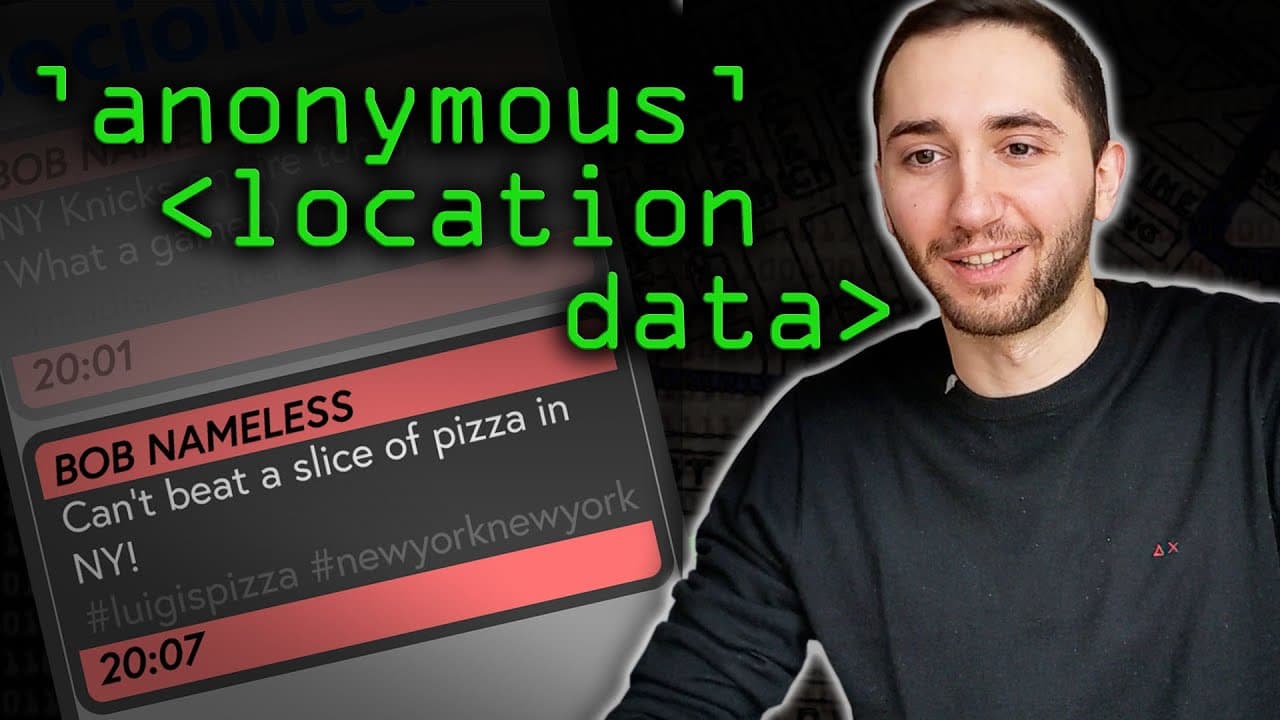
Location data that is marketed as anonymous can often be re-identified, exposing privacy risks. A notable study demonstrated that just a few data points are typically sufficient to uniquely identify individuals, even without their names attached. This highlights the critical vulnerabilities surrounding supposedly anonymous datasets.
Transcript
i think that everybody has been asked at least once to share their data with a company under the promise that the data is anonymous so the problem is that the data that is collected is very rarely truly anonymous and this is what i'm gonna explain today first of all the intuition of why this is true is that data that is supposedly anonymous... Read More
Key Insights
- ❓ Data collected under the promise of anonymity can often be re-identified, compromising privacy.
- 😫 Background information about individuals can be used to match against records and trajectories in data sets.
- 🔺 Unicity metrics show that a small number of points can be enough to uniquely identify individuals.
- 😫 Complex attack settings, such as combining multiple data sets, can increase the chances of reidentification.
Install to Summarize YouTube Videos and Get Transcripts
Explore YouTube Video Summarizer or Get YouTube Transcript Extractor
Questions & Answers
Q: How was The New York Times able to reidentify individuals from the anonymous location data set?
The journalists used background information about the target individuals to match it against the records and trajectories in the data set, allowing them to reidentify specific people.
Q: How is unicity measured and what does it reveal?
Unicity is a metric that measures the fraction of users in a data set that are unique given a certain number of points. For example, a study found that 95% of the time, only four points were necessary to uniquely identify an individual in the location data set.
Q: Can more complex attack settings be used to reidentify individuals?
Yes, by using background information from a different time period or combining data sets with different levels of anonymity, attackers can still match users and reidentify individuals. Matching based on similarity scores and computing maximum weight maximum matching algorithms can aid in these more complex attacks.
Q: Are there solutions to analyze data without compromising privacy?
Yes, researchers and cryptographers are developing technologies that allow for data analysis without compromising individual privacy. These technologies aim to protect the privacy of individuals while still enabling data analysis for purposes such as medical research.
Summary & Key Takeaways
-
Data that is collected under the promise of anonymity is rarely truly anonymous.
-
An article by The New York Times showed that a large location data set, even without names, could be used to reidentify individuals, including collaborators of the U.S. president.
-
Researchers have defined a metric called unicity, which measures the fraction of users in a data set that can be uniquely identified with only a few points of information.
Read in Other Languages (beta)
Share This Summary 📚
Summarize YouTube Videos and Get Video Transcripts with 1-Click
Try YouTube Summary with ChatGPT & Claude or YouTube Transcript Generator
Explore More Summaries from Computerphile 📚






Summarize YouTube Videos and Get Video Transcripts with 1-Click
Try YouTube Summary with ChatGPT & Claude or YouTube Transcript Generator