How do we Estimate the Scale of a Graph? | Don't Memorise
TL;DR
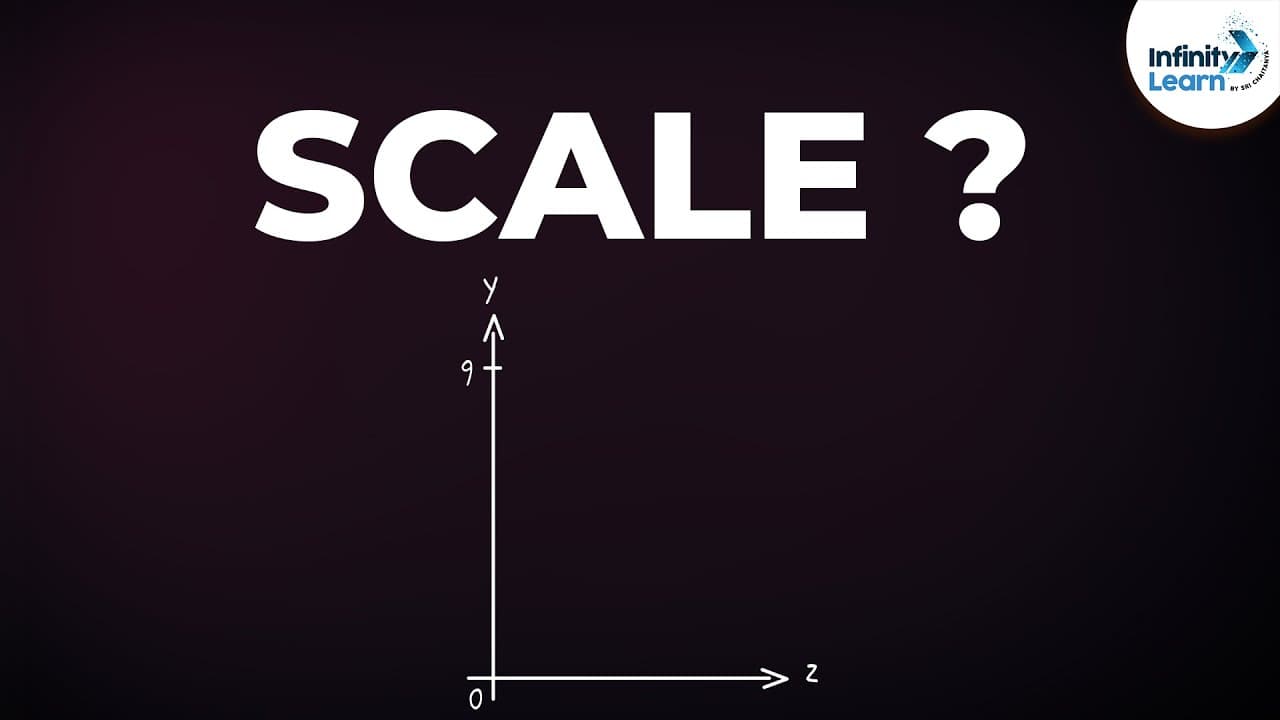
Learn how to choose the appropriate scale for drawing graphs, taking into consideration the data range and number of grid lines.
Transcript
this is the graph paper we usually draw our graphs on every unit horizontally as well as vertically is 1 cm long every cm is divided into 10 mm by these thin lines let's try to draw a graph of the example we had seen previously Zen used to receive a weekly allowance of 100 rupees per week to convince his dad to increase his monthly allowance he pre... Read More
Key Insights
- 🫥 The range of the data and number of grid lines impact the choice of scale for the Y-axis.
- 🫥 A scale that fits within six to eight grid lines is generally recommended.
- 😥 Choosing a scale that results in evenly spaced points on the Y-axis enhances readability.
- 🪘 Different scales can be chosen as long as they accurately represent the data and fit within the graph paper.
Install to Summarize YouTube Videos and Get Transcripts
Explore YouTube Video Summarizer or Get YouTube Transcript Extractor
Questions & Answers
Q: How does the range of the data affect the scale choice for the Y-axis?
The range, which is the difference between the highest and lowest values, helps to determine how many centimeters should represent that range on the Y-axis. A larger range may require a larger scale to fit all the data points.
Q: How many grid lines should be used when choosing a scale for the Y-axis?
The maximum number of grid lines that should be used is eight. A graph paper typically has around ten grid lines, so choosing a scale that fits within this limit ensures the graph can be accurately represented.
Q: Can any scale be chosen for the Y-axis?
Yes, different scales can be chosen as long as they fit within the graph paper and accurately represent the data points. However, it is recommended to choose a scale that results in nice, evenly spaced points on the Y-axis.
Q: Is the chosen scale the only possible option?
No, the chosen scale is an estimation. Other scales could also be used as long as they fit within the graph paper and accurately represent the data. The video provides an alternative scale of 1 cm equal to 45 rupees as an example.
Summary & Key Takeaways
-
The video discusses how to choose the scale for drawing graphs, focusing on the vertical axis.
-
Zen wants to represent weekly allowances graphically, and the first step is determining the scale for the Y-axis.
-
The video explains how to find the data range, calculate the number of grid lines needed, and choose a scale that fits within the graph paper.
Read in Other Languages (beta)
Share This Summary 📚
Summarize YouTube Videos and Get Video Transcripts with 1-Click
Try YouTube Summary with ChatGPT & Claude or YouTube Transcript Generator
Explore More Summaries from Infinity Learn NEET 📚

Summarize YouTube Videos and Get Video Transcripts with 1-Click
Try YouTube Summary with ChatGPT & Claude or YouTube Transcript Generator