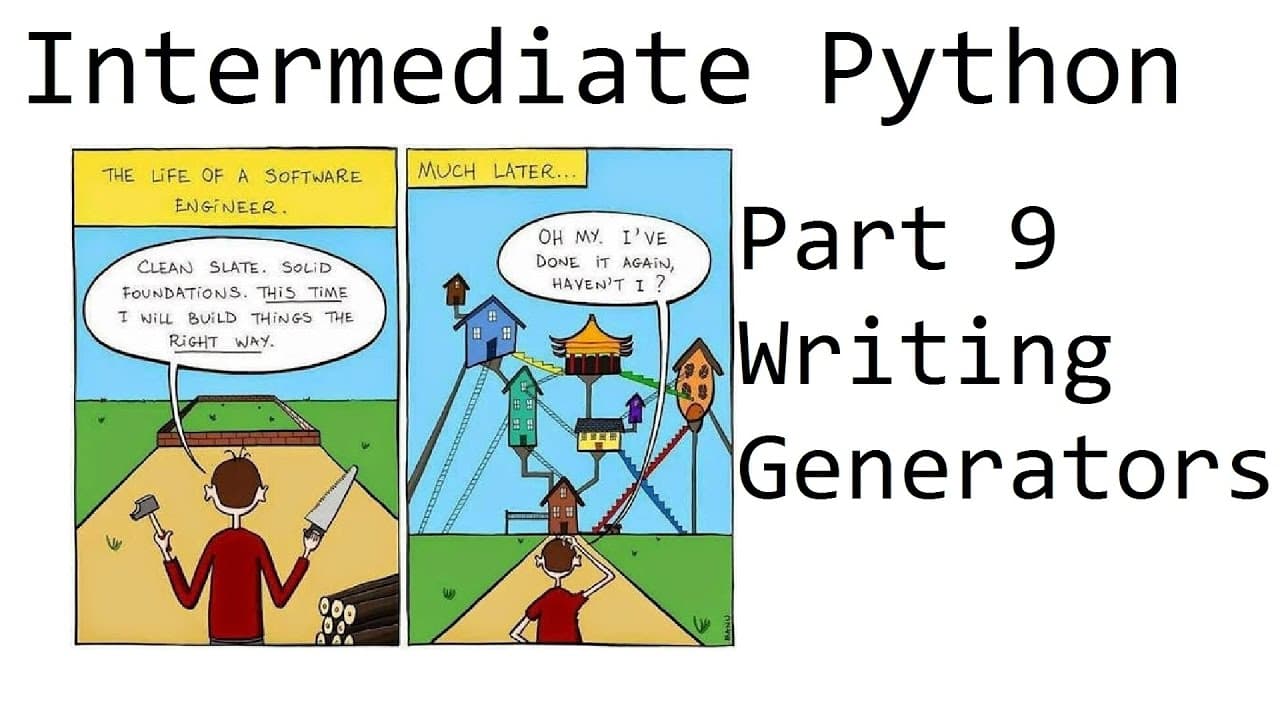
Writing our own Generator - Intermediate Python Programming p.9
TL;DR
This tutorial explains the concept of generators in Python and demonstrates how to create and use them effectively.
Transcript
welcome everybody to part 9 of our intermediate Python programming tutorial series in this tutorial what we're going to be talking about is more on generators so a few tutorials ago we talked about list comprehension and generators but actually really just generator expressions so if you remember back back in the day we had a tutorial where I showe... Read More
Key Insights
- 😒 Generators in Python are created using generator functions, which use the "yield" keyword to generate values one at a time.
- 👂 Generators are memory-efficient compared to lists, as they only yield values when needed instead of storing the entire sequence.
- ❓ Generator functions can be used to create complex sequence generators by utilizing nested generators.
- 🌥️ Generators are particularly useful for tasks that involve generating and iterating over large or infinite sequences.
- 😒 The use of generators can result in cleaner and more concise code compared to using for loops or list comprehension.
- 🔨 Generators can be a powerful tool for solving problems that involve combinations or permutations.
- 💨 Using generators can significantly reduce the memory footprint of a program, making it more efficient and faster.
Install to Summarize YouTube Videos and Get Transcripts
Explore YouTube Video Summarizer or Get YouTube Transcript Extractor
Questions & Answers
Q: What is the difference between a list comprehension and a generator?
List comprehension builds a list in memory, while a generator yields values one at a time, not storing the entire sequence in memory. Generators are more memory-efficient.
Q: How do you create your own generator function?
To create a generator function, use the "yield" keyword instead of "return" to generate values. The function can have multiple "yield" statements.
Q: In what situations are generators more useful than for loops or list comprehension?
Generators are useful when dealing with large or infinite sequences that would consume too much memory if stored in a list. They are also handy for tasks that require generating values on the fly.
Q: Can generators be nested within other generators?
Yes, generators can be nested within other generators, allowing for the creation of complex sequence generators based on specific logic or conditions.
Summary & Key Takeaways
-
Generators are an alternative to list comprehension and can save memory by yielding results instead of returning them.
-
Generator functions use the yield keyword to generate values one at a time instead of building a list.
-
Generators are useful for tasks that require generating and iterating over large or infinite sequences.
Read in Other Languages (beta)
Share This Summary 📚
Summarize YouTube Videos and Get Video Transcripts with 1-Click
Try YouTube Summary with ChatGPT & Claude or YouTube Transcript Generator
Explore More Summaries from sentdex 📚
Summarize YouTube Videos and Get Video Transcripts with 1-Click
Try YouTube Summary with ChatGPT & Claude or YouTube Transcript Generator