Jupiter’s 3D Atmosphere Revealed by NASA’s Juno Spacecraft (Media Briefing)
TL;DR
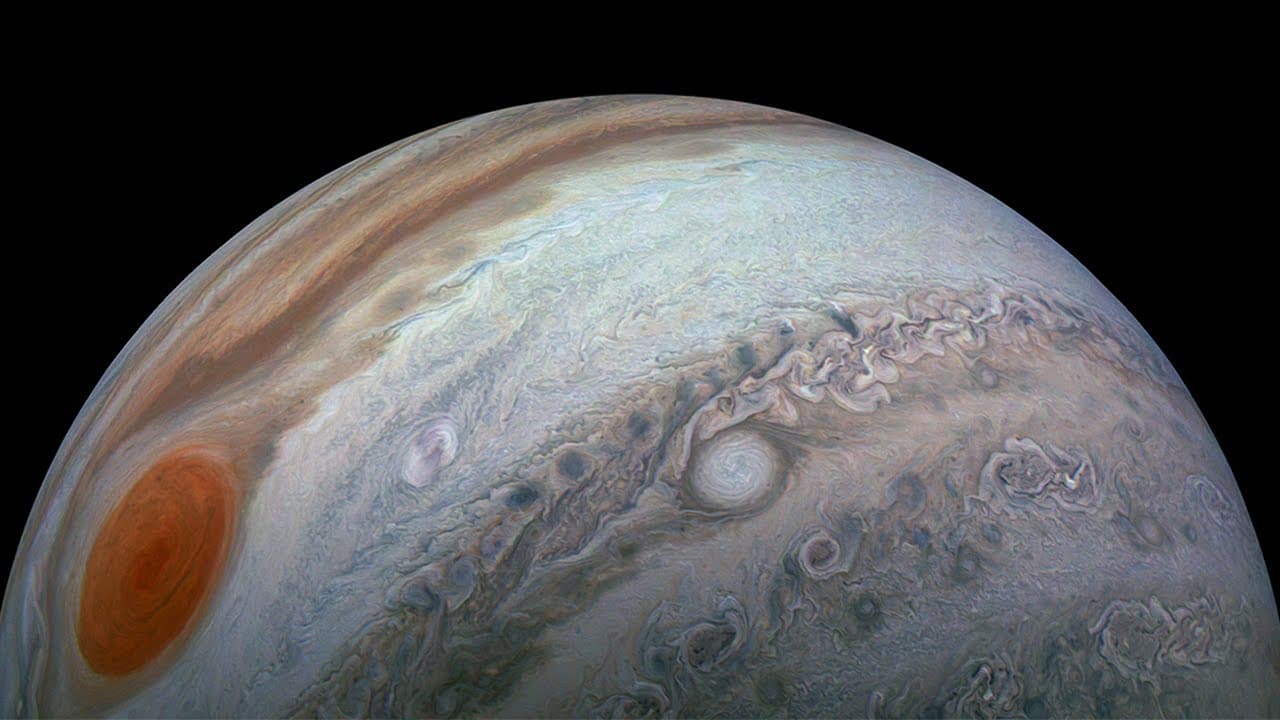
NASA's Juno spacecraft has provided new insights into Jupiter's atmosphere, including the depth and behavior of the Great Red Spot, the circulation cells, and the polar cyclones.
Transcript
welcome to today's discussion on the latest findings from nasa's juno spacecraft which has been orbiting and monitoring jupiter since 2016. the juno science team will give us a new glimpse into how jupiter's atmosphere operates underneath the top layer of clouds and what this could tell us about other giant planets in the universe i'm required of n... Read More
Key Insights
- 😀 The Great Red Spot extends about 300 miles below Jupiter's cloud tops and is one of the deepest known storms on the planet.
- 👻 The microwave instrument on Juno allows scientists to peer deeper into Jupiter's atmosphere and observe the different layers, revealing insights into the circulation cells and the jovicline.
- 💁 The polar cyclones in Jupiter's atmosphere are stable and exhibit symmetrical patterns, but their exact mechanisms of formation and stability are still being investigated.
Install to Summarize YouTube Videos and Get Transcripts
Explore YouTube Video Summarizer or Get YouTube Transcript Extractor
Questions & Answers
Q: Why is Jupiter of high interest to scientists?
Jupiter is the largest and most massive planet in our solar system, and studying it provides insights into the formation of our solar system and other giant planets.
Q: How deep is the Great Red Spot?
Using microwave data, scientists have determined that the Great Red Spot extends about 300 miles below Jupiter's cloud tops.
Q: Are the cyclones in Jupiter's polar regions stable?
Yes, the polar cyclones have been observed to be exceptionally stable, with only minor changes in position over time. Their symmetry and regularity are still being studied.
Q: How does Jupiter's atmosphere compare to Earth's?
Jupiter's atmosphere has circulation cells similar to Earth's, but they are much larger and extend to greater depths due to Jupiter's size and rotation.
Q: How many storms are on Jupiter at any given time?
It is difficult to determine the exact number, but there are likely thousands of storms on Jupiter at any given time, ranging in size and intensity.
Summary & Key Takeaways
-
Juno's mission, part of NASA's New Frontiers program, has made exciting discoveries about Jupiter, including insights into its composition, cyclones, and atmospheric layers.
-
The spacecraft is equipped with instruments that allow scientists to see through the top clouds and study the planet's interior in ways not possible before.
-
The extended phase of the mission will continue to provide new observations and address new questions, including investigations of the Galilean moons Europa and Ganymede.
Read in Other Languages (beta)
Share This Summary 📚
Summarize YouTube Videos and Get Video Transcripts with 1-Click
Try YouTube Summary with ChatGPT & Claude or YouTube Transcript Generator
Explore More Summaries from NASA 📚

Summarize YouTube Videos and Get Video Transcripts with 1-Click
Try YouTube Summary with ChatGPT & Claude or YouTube Transcript Generator