Circular wave Guide | TM mode analysis | Microwave Engineering | Lec-33
TL;DR
This video explains the TM mode analysis for circular waveguides, focusing on wave equations and Bessel functions.
Transcript
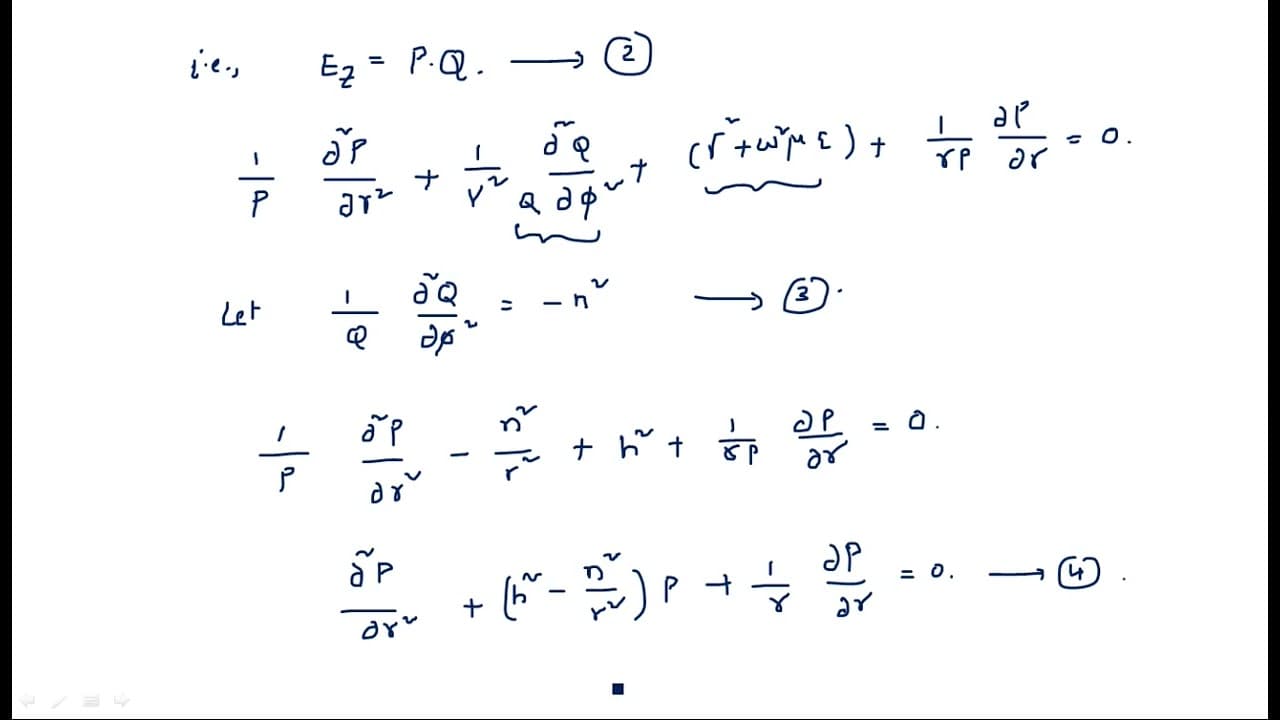
hi everyone in this video I am going to explain about TM mode analysis of circle waveglade TM TM means transverse magnetic so TM stands for transverse magnetic so transverse magnetic field transverse magnetic nothing but what do you mean by transverse magnetic field the magnetic field is not existed and the electric field is existed so e z is not e... Read More
Key Insights
- 📳 TM mode analysis is fundamentally different from TE mode analysis, focusing solely on electric field behavior.
- 😑 The electric field component in TM modes can be expressed using Bessel functions, reflecting the circular geometry's influence.
- 👋 The propagation of waves in circular waveguides is mathematically represented through the separation of variables technique.
- 👻 Boundary conditions significantly shape the solutions for allowed electromagnetic modes in waveguides.
- 👋 Solutions to wave equations require careful application of mathematical techniques, including calculus and differential equations.
- ❓ The unique properties of circular waveguides necessitate specific analytical methods compared to rectangular counterparts.
- 💿 Understanding TM modes is essential for various applications, including telecommunications and optical systems.
Install to Summarize YouTube Videos and Get Transcripts
Explore YouTube Video Summarizer or Get YouTube Transcript Extractor
Questions & Answers
Q: What is TM mode in the context of circular waveguides?
TM mode, or Transverse Magnetic mode, refers to a configuration where the magnetic field component (H) is zero, while the electric field component (E) persists. This means the electromagnetic wave propagates with an electric field oriented in the transverse direction relative to the axis of wave propagation, making it crucial in understanding wave behavior in circular waveguides.
Q: How are the wave equations derived for TM modes in circular waveguides?
The wave equations for TM modes in circular waveguides are derived using the Laplacian operator expressed in cylindrical coordinates (R, Phi, Z). By separating variables, we can express the electric field as a product of functions dependent on R and Phi, ultimately leading to the Bessel equation that governs the radial dependence of electric field distributions.
Q: What role do boundary conditions play in the analysis?
Boundary conditions are critical in solutions for wave equations, particularly in circular waveguides where there is only one boundary. The condition that the electric field must be zero at the radius of the waveguide leads to specific constraints on the modes and helps determine the allowable frequency and structural characteristics of the waves that can propagate within the guide.
Q: What are Bessel functions and why are they important in this analysis?
Bessel functions arise as solutions to the Bessel equation, which emerges in the analysis of wave propagation in cylindrical geometries, including circular waveguides. They describe the amplitude distribution of electromagnetic waves in the radial direction, forming the basis for deriving specific electric field components in the TM mode analysis.
Q: How does the complexity of circular waveguide analysis compare to rectangular waveguide analysis?
Circular waveguide analysis is generally more complex than rectangular waveguide analysis due to the incorporation of Bessel functions and the single boundary condition unique to cylindrical geometries. The mathematical treatment involves more intricate assumptions and derivations, reflecting the differences in geometric configurations that influence electromagnetic field distributions.
Summary & Key Takeaways
-
The video details the characteristics of the Transverse Magnetic (TM) mode, where the magnetic field component is zero while the electric field is non-zero.
-
It elaborates on the mathematical formulations for wave equations in circular waveguides, using spherical coordinates and Bessel functions to describe the electric field.
-
The process and complexity of solving these equations are emphasized, particularly the application of boundary conditions and the use of separation of variables.
Read in Other Languages (beta)
Share This Summary 📚
Summarize YouTube Videos and Get Video Transcripts with 1-Click
Try YouTube Summary with ChatGPT & Claude or YouTube Transcript Generator