How to Evaluate Expressions Using One Address Instructions
TL;DR
To evaluate expressions using one address instructions in a single accumulator organization, you must load values into the accumulator and perform operations one at a time. Specifically, after loading a variable, use 'add' to combine values, and store intermediate results as needed before final calculations. The outcome is stored in the designated variable, completing the evaluation.
Transcript
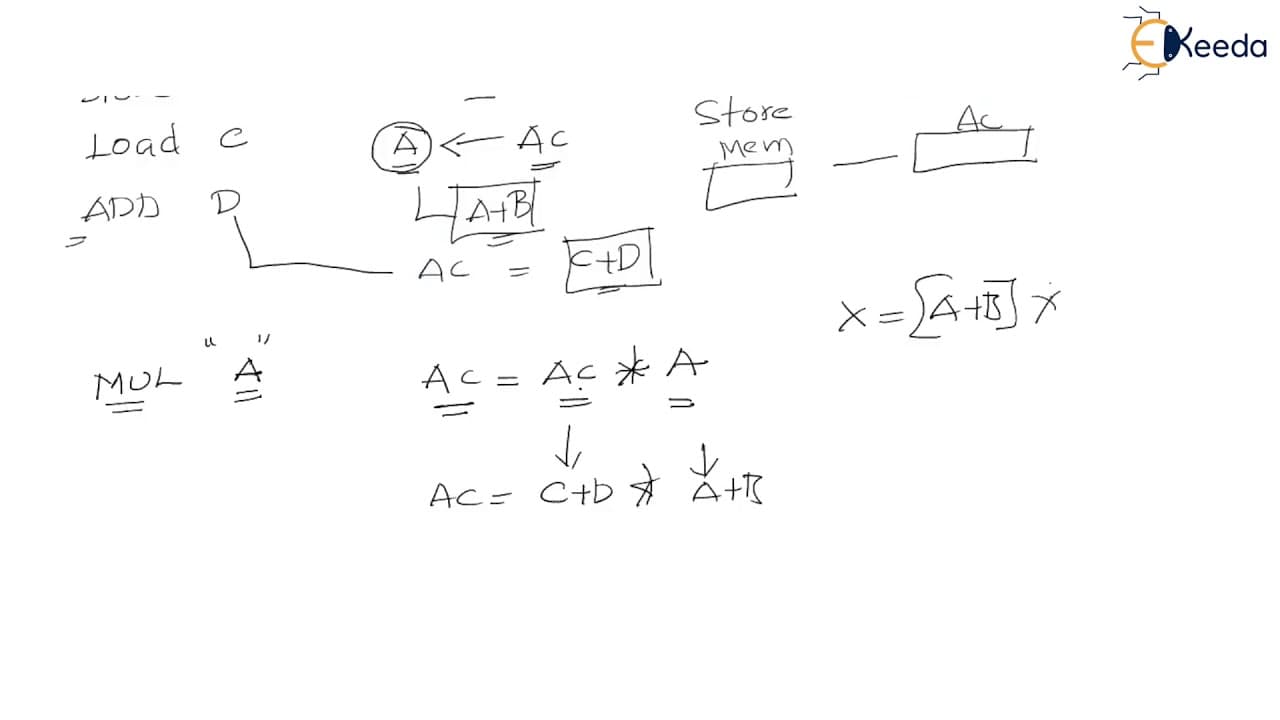
hello everyone let us evaluate the same expression by using one address instructions x is equal to a plus b into c plus d you know one address instructions you can find in single accumulator organization in single accumulator organization it is essential to understand that we have no local registers no general purpose registers we do have only one ... Read More
Key Insights
- 🔂 Single accumulator organizations have no local or general purpose registers.
- 🎭 Updates to variables are performed on the accumulator.
- 🏪 Load and store instructions are used to transfer values to and from the accumulator.
- 😑 The accumulator holds the intermediate results of expression evaluations.
- 🏪 To perform multiple operations using the accumulator, the contents can be stored in memory.
- ❓ One address instructions require at least two operands.
Install to Summarize YouTube Videos and Get Transcripts
Explore YouTube Video Summarizer or Get YouTube Transcript Extractor
Questions & Answers
Q: What are one address instructions?
One address instructions can be found in single accumulator organizations, where there is only one general purpose register, the accumulator. Updates to variables are performed on the accumulator.
Q: How are updates to variables performed in single accumulator organizations?
Updates to variables require transferring the variable value to the accumulator. This ensures that the update is performed on the accumulator.
Q: How can expressions be evaluated using one address instructions?
Expressions can be evaluated by using load and store instructions to transfer values to and from the accumulator. The accumulator holds the intermediate results of the expression evaluation.
Q: What happens when the accumulator needs to be used for multiple operations?
If the accumulator is needed for multiple operations, the contents of the accumulator can be stored in a memory location using a store instruction to free up the accumulator for the next operation.
Summary & Key Takeaways
-
One address instructions are found in single accumulator organizations, where there are no local or general purpose registers.
-
Updates to variables must be performed on the accumulator, which requires transferring the variable to the accumulator.
-
To evaluate an expression, load and store instructions are used to transfer values to and from the accumulator.
Read in Other Languages (beta)
Share This Summary 📚
Summarize YouTube Videos and Get Video Transcripts with 1-Click
Try YouTube Summary with ChatGPT & Claude or YouTube Transcript Generator
Explore More Summaries from Ekeeda 📚






Summarize YouTube Videos and Get Video Transcripts with 1-Click
Try YouTube Summary with ChatGPT & Claude or YouTube Transcript Generator