L11.6 The Monotonic Case
TL;DR
The PDF of a monotonic function of a random variable can be calculated by taking the derivative of the CDF and the derivative of the inverse function.
Transcript
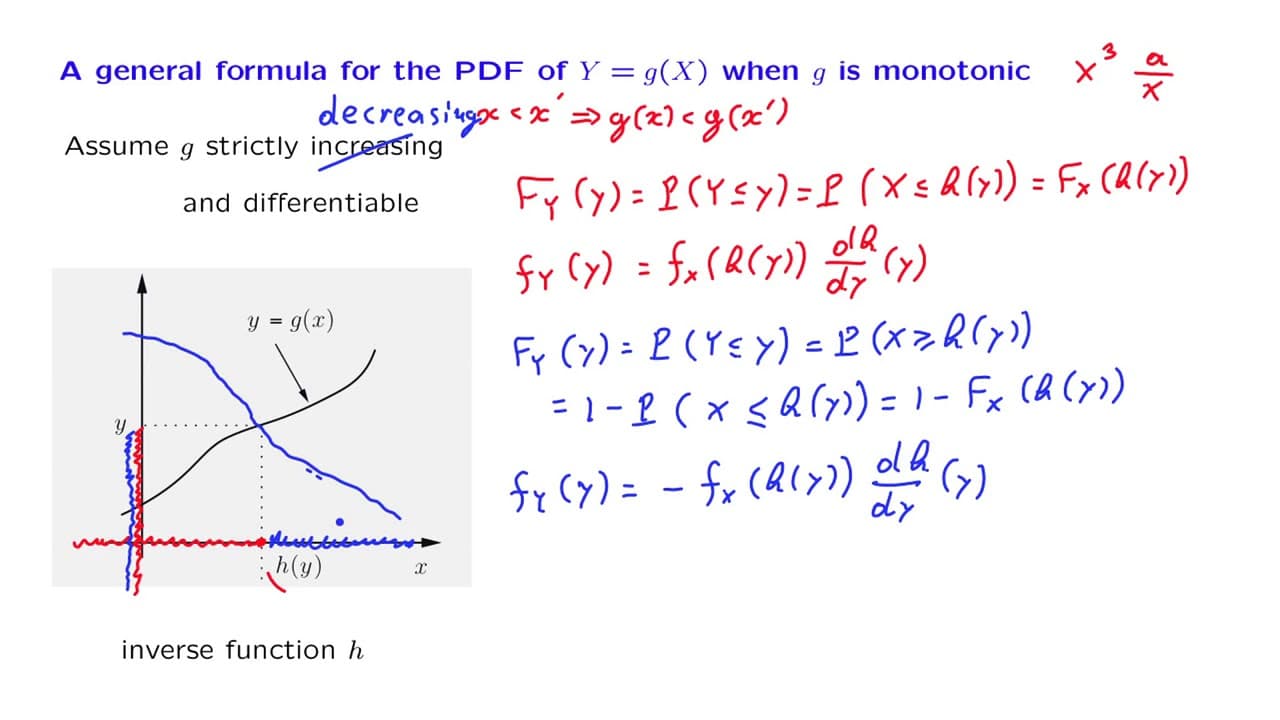
We have already worked through some examples in which X was a random variable with a given PDF, and we considered the problem of finding the PDF of Y for the case where Y was the function x cubed or the function of the form a/X. What both of these examples have in common is that Y is a monotonic function of X. In this case, Y is increasing with X. ... Read More
Key Insights
- ❓ A general formula can be used to find the PDF of a monotonic function of a random variable.
- 🥡 The formula involves taking the derivative of the CDF and the derivative of the inverse function.
- 🇾🇪 The inverse function represents the mapping from the values of Y to the corresponding values of X.
- 🇾🇪 When the function g is strictly increasing, the PDF of Y is determined by the PDF of X and the derivative of the inverse function.
- 🤘 When the function g is strictly decreasing, the PDF of Y is determined by the PDF of X, the absolute value of the derivative of the inverse function, and a change of sign.
- 💦 The formula simplifies the calculation of the PDF compared to working with CDFs.
- ❓ The assumptions of monotonicity and smoothness (differentiability) are necessary for the formula to apply.
Install to Summarize YouTube Videos and Get Transcripts
Explore YouTube Video Summarizer or Get YouTube Transcript Extractor
Questions & Answers
Q: What is the key assumption for applying the general formula to find the PDF of Y?
The key assumption is that the function g is a strictly increasing or strictly decreasing function of X. This means that as X increases, Y also increases (in the case of an increasing function), or as X increases, Y decreases (in the case of a decreasing function).
Q: What does the inverse function h represent in the context of finding the PDF of Y?
The inverse function h represents the mapping from Y to X. Given a value of Y, h can determine the corresponding value of X that produces that specific Y. It is the function that takes us from Y's to X's.
Q: How can the formula for finding the PDF of Y be simplified when g is a decreasing function?
When g is a decreasing function, the derivative of the inverse function h will be either 0 or negative. To remove the negative sign, the derivative is expressed as the absolute value. The final formula for the PDF of Y becomes the PDF of X times the absolute value of the derivative of the inverse function.
Q: What are the advantages of using the derivative of the inverse function to calculate the PDF of Y?
Using the derivative of the inverse function simplifies the calculations involved compared to working with CDFs. It allows for a direct calculation of the PDF and avoids the need for integration or extensive manipulation of probability functions.
Summary & Key Takeaways
-
When a random variable Y is a monotonic function of X, there is a general formula to calculate the PDF of Y based on the PDF of X.
-
If the function g is strictly increasing, the PDF of Y is given by the PDF of X times the derivative of the inverse function.
-
If the function g is strictly decreasing, the PDF of Y is given by the PDF of X times the absolute value of the derivative of the inverse function.
-
Calculating the PDF using the derivative of the inverse function is simpler than working with CDFs.
Read in Other Languages (beta)
Share This Summary 📚
Summarize YouTube Videos and Get Video Transcripts with 1-Click
Try YouTube Summary with ChatGPT & Claude or YouTube Transcript Generator
Explore More Summaries from MIT OpenCourseWare 📚



Summarize YouTube Videos and Get Video Transcripts with 1-Click
Try YouTube Summary with ChatGPT & Claude or YouTube Transcript Generator