Genetics: It's Written On Your Face
TL;DR
Researchers analyze the traits of the face and identify principal components that affect appearance, such as round vs. tall face, protrusion of the face, nose projection, and lips and lower face features.
Transcript
now can you explain the breakdown between the varying traits of the face and and how it is that different people look different yeah that's that's that's a major question you know and and we we wanted to go about this without having too many presuppositions without knowing or expecting to find something so we're looking at the entire face as a unit... Read More
Key Insights
- 🤕 The face is influenced by various factors, including sex, ancestry, age, body size, and individual genes.
- 😘 The first five principal components explain a significant portion of the variation in facial traits, including face shape, convexity and concavity, nose projection, and lip and lower face characteristics.
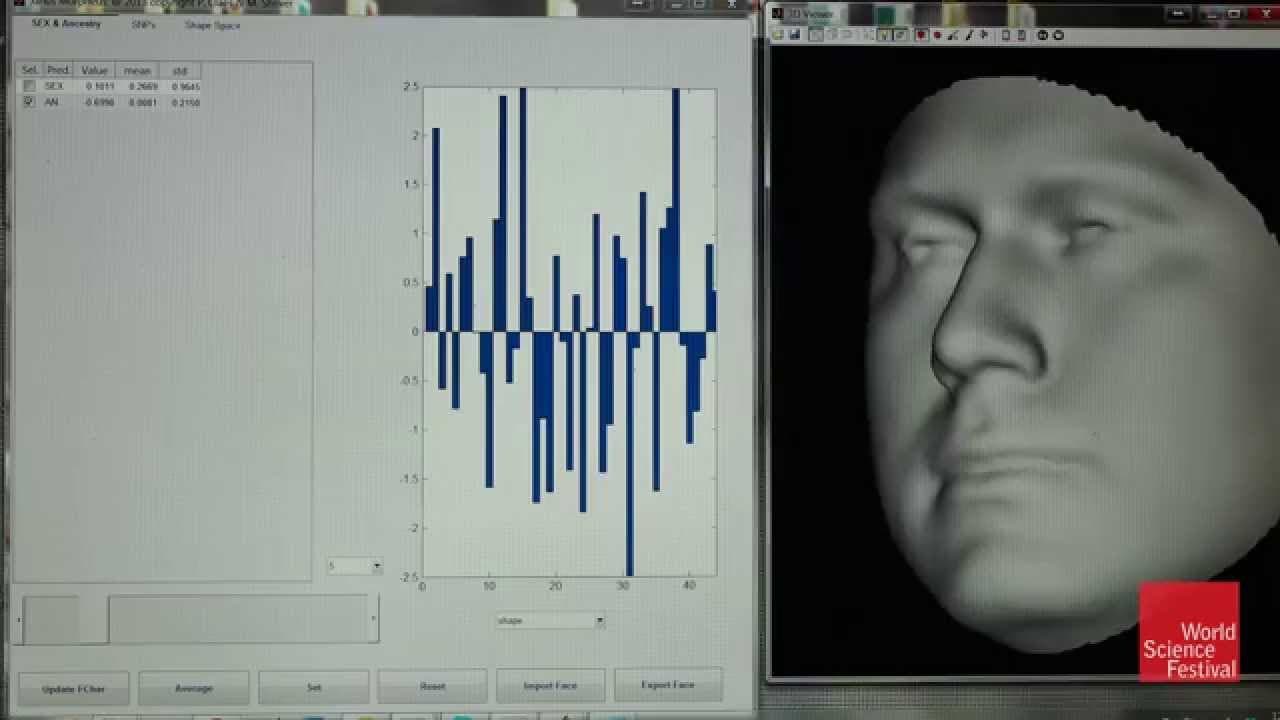
- 😀 The software developed by the researchers allows for the visualization and manipulation of these principal components to transform and analyze individual and average faces.
- 😀 The face space database includes 4,000 people from different populations and can be expanded to include more diversity.
- 😀 The composite face can be created by averaging the principal components of multiple faces, providing an approximate representation of what their offspring might look like.
- 🏑 The analysis of facial traits has practical applications in fields such as forensics, medicine, and understanding human evolution.
- 🐵 The study challenges the assumption that the face is too complex to study comprehensively, demonstrating that data reduction techniques can reveal key features and patterns.
Install to Summarize YouTube Videos and Get Transcripts
Explore YouTube Video Summarizer or Get YouTube Transcript Extractor
Questions & Answers
Q: How did the researchers approach the study of facial traits and appearance?
The researchers analyzed the face as a whole and considered various factors like sex, ancestry, age, body size, and individual genes to understand why people look different.
Q: What are the first five principal components identified by the researchers?
The first principal component represents the difference between a round face (more feminine) and a tall face (more masculine). The following components affect protrusion of the face, overall face convexity and concavity, nose projection, and lip and lower face features.
Q: How did the researchers visualize the results of their analysis?
The researchers developed a software package that allows users to visualize the effects of different principal components on the face. They can also adjust these components and observe the changes in real-time.
Q: How can ancestry and individual faces be transformed using the software?
By changing the principal components related to ancestry in the software, users can transform the face to have a more African or European profile. Individual faces can be loaded into the software to compare them with the average face and make transformations accordingly.
Summary & Key Takeaways
-
The researchers studied the entire face as a unit and discovered that factors like sex, ancestry, age, body size, and individual genes can affect different traits of the face.
-
Using a data reduction technique, the researchers identified the first five principal components that explain the most variation in facial features.
-
These components include round vs. tall face, overall face convexity and concavity, nose projection, and lip and lower face characteristics.
Read in Other Languages (beta)
Share This Summary 📚
Summarize YouTube Videos and Get Video Transcripts with 1-Click
Try YouTube Summary with ChatGPT & Claude or YouTube Transcript Generator
Explore More Summaries from World Science Festival 📚




Summarize YouTube Videos and Get Video Transcripts with 1-Click
Try YouTube Summary with ChatGPT & Claude or YouTube Transcript Generator