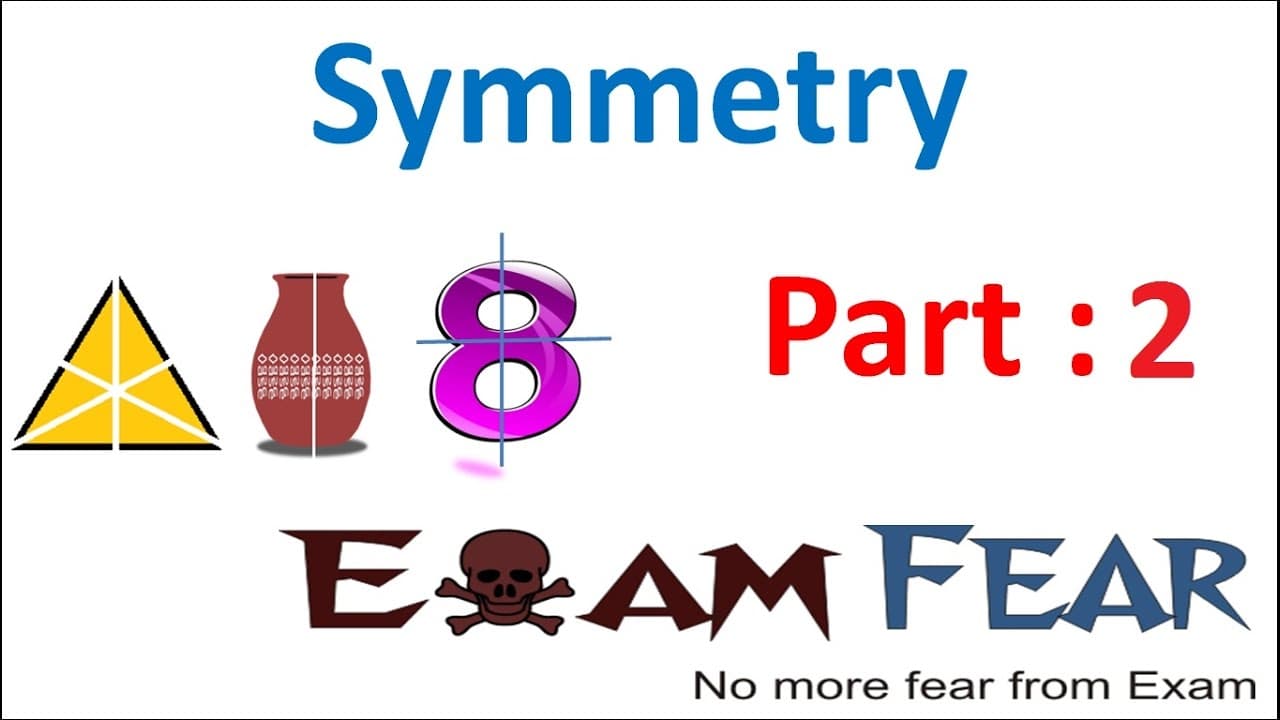
Maths Symmetry part 2 (Symmetrical Figures) CBSE Class 7 Mathematics VII
TL;DR
Symmetry refers to objects that have identical halves that can overlap, while asymmetrical objects do not have identical parts.
Transcript
hello friends this video on symmetry part 2 is brought to you by example.com no more fear from exam now when we talk about symmetry we talk about symmetrical objects asymmetrical objects so why do we talk about that that's because not every object possess symmetry within it some objects are symmetrical some objects are not so when we talk about sym... Read More
Key Insights
- 🥳 Symmetrical figures have identical parts and can be divided into two equal halves.
- 🥳 Asymmetrical figures do not have identical parts and cannot be divided into equal halves that overlap.
- 🫥 The presence of symmetry in an object can be determined by imagining a line dividing it into two equal halves that overlap completely.
- ❓ Not all objects possess symmetry, and it is a distinguishing characteristic between different figures.
- 💠 Symmetry is an important concept to understand in relation to object shapes and structures.
- 💠 The concept of symmetry applies to various objects, including circular and rectangular shapes.
- 〰️ Symmetry can be observed in both plain and wavy boundaries of objects.
Install to Summarize YouTube Videos and Get Transcripts
Explore YouTube Video Summarizer or Get YouTube Transcript Extractor
Questions & Answers
Q: What is the difference between symmetrical and asymmetrical figures?
Symmetrical figures have identical parts that can be divided into two equal halves, while asymmetrical figures do not have identical parts and cannot be divided into equal halves.
Q: How can we determine if an object possesses symmetry?
To determine if an object possesses symmetry, imagine a line dividing it into two equal halves. If the halves overlap completely, the object is symmetrical.
Q: Can all objects be symmetrical?
No, not all objects are symmetrical. Some objects have identical parts and can be divided into equal halves, while others do not possess symmetry.
Q: What are some examples of symmetrical figures?
Examples of symmetrical figures include a circular sheet of paper with a wavy circle boundary and a rectangular sheet of paper.
Summary & Key Takeaways
-
Symmetrical figures have identical parts within them, allowing them to be divided into two equal halves that overlap.
-
Asymmetrical figures do not have identical parts and cannot be divided into two equal halves that overlap.
-
To determine if an object is symmetrical, imagine a line dividing it into two halves and see if they overlap completely.
Read in Other Languages (beta)
Share This Summary 📚
Summarize YouTube Videos and Get Video Transcripts with 1-Click
Try YouTube Summary with ChatGPT & Claude or YouTube Transcript Generator
Explore More Summaries from LearnoHub - Class 11, 12 📚




Summarize YouTube Videos and Get Video Transcripts with 1-Click
Try YouTube Summary with ChatGPT & Claude or YouTube Transcript Generator