IUPAC Nomenclature of Organic Chemistry
TL;DR
Learn how to name organic compounds using IUPAC rules with simple tips and tricks, ensuring better performance in exams.
Transcript
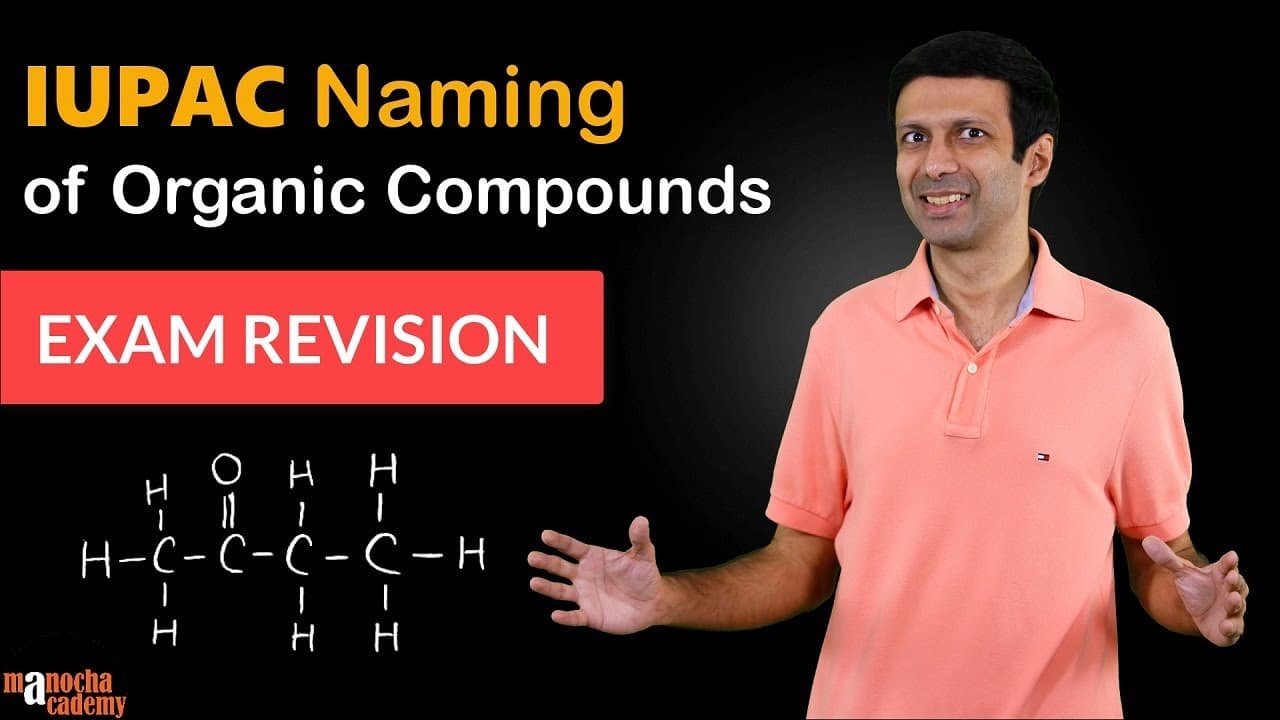
hi friends in this video I'm going to make our upse naming of organic compounds really easy for you questions on naming of organic compounds always comes in exams so I'm going to share some tips and tricks of how to write the IU pack name I hope after this video you will find the IU pack name as easy as writing your own name and if you like this vi... Read More
Key Insights
- 📏 Naming organic compounds using IUPAC rules can be made easier by following specific guidelines.
- 🪘 The longest continuous carbon chain should be identified, numbered forward and backward, and considered for naming purposes.
- 👥 Different functional groups, such as alkanes, alkenes, alkynes, cyclic compounds, aldehydes, ketones, alcohols, carboxylic acids, and halogens, have distinct naming conventions.
- 👂 The priority list for functional groups helps determine the naming order and position numbers in compound names.
Install to Summarize YouTube Videos and Get Transcripts
Explore YouTube Video Summarizer or Get YouTube Transcript Extractor
Questions & Answers
Q: What are some important rules to follow for IUPAC naming of organic compounds?
Important rules include finding the longest continuous carbon chain, numbering it forward and backward, and considering the functional groups present in the compound.
Q: How do you name an alkane compound with two carbon atoms and single bonds?
To name an alkane compound with two carbon atoms and single bonds, start with the prefix "eth" and add the suffix "-ane." The name of the compound would be "ethane."
Q: How do you name a cyclic compound with five carbon atoms and only single bonds?
To name a cyclic compound with five carbon atoms and only single bonds, start with the prefix "cyclo" and add the suffix "-pentane." The name of the compound would be "cyclopentane."
Q: What is the IUPAC name for a compound with a functional group of aldehyde and five carbon atoms in the longest continuous carbon chain?
The IUPAC name for a compound with an aldehyde functional group and five carbon atoms in the longest continuous carbon chain would be "pentanal."
Q: How do you name a compound with a carboxylic acid functional group and seven carbon atoms?
To name a compound with a carboxylic acid functional group and seven carbon atoms, start with the prefix "hept," add the suffix "-oic acid," and indicate the position of the functional group. The name of the compound would be "heptanoic acid."
Q: What is the priority list for functional groups in IUPAC naming?
The priority list for functional groups in IUPAC naming is as follows: carboxylic acids, aldehydes, ketones, alcohols, triple bonds, double bonds, halogens, and alkyl groups.
Q: How do you determine the position of a functional group in IUPAC naming?
The position of a functional group is determined by numbering the longest continuous carbon chain, starting from the end closest to the functional group. The position number with the smallest value is used in the compound's name.
Q: Is 2-chloropentanoic acid a correct IUPAC name?
No, it is not correct. The correct IUPAC name for 2-chloropentanoic acid is 4-chloropentanoic acid, as the numbering should prioritize the presence of functional groups.
Key Insights:
- Naming organic compounds using IUPAC rules can be made easier by following specific guidelines.
- The longest continuous carbon chain should be identified, numbered forward and backward, and considered for naming purposes.
- Different functional groups, such as alkanes, alkenes, alkynes, cyclic compounds, aldehydes, ketones, alcohols, carboxylic acids, and halogens, have distinct naming conventions.
- The priority list for functional groups helps determine the naming order and position numbers in compound names.
- Using prefixes and suffixes correctly is essential for accurately naming organic compounds according to IUPAC rules.
Summary & Key Takeaways
-
The video provides tips and tricks for naming organic compounds using IUPAC rules.
-
It emphasizes finding the longest continuous carbon chain, numbering it forward and backward, and considering the functional groups present.
-
Examples are given for different types of compounds, including alkanes, alkenes, alkynes, cyclic compounds, and compounds with functional groups such as aldehydes, ketones, alcohols, carboxylic acids, and halogens.
Read in Other Languages (beta)
Share This Summary 📚
Summarize YouTube Videos and Get Video Transcripts with 1-Click
Try YouTube Summary with ChatGPT & Claude or YouTube Transcript Generator
Explore More Summaries from Manocha Academy 📚




Summarize YouTube Videos and Get Video Transcripts with 1-Click
Try YouTube Summary with ChatGPT & Claude or YouTube Transcript Generator