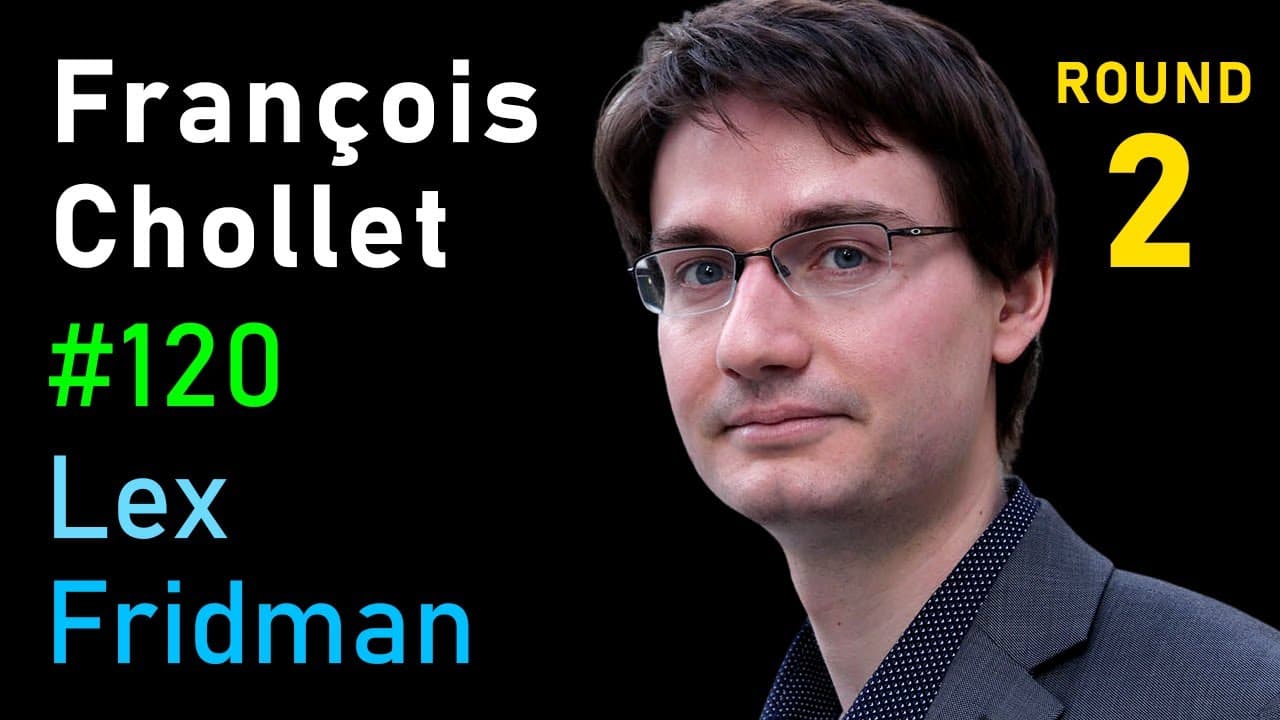
François Chollet: Measures of Intelligence | Lex Fridman Podcast #120
TL;DR
Intelligence in AI is defined as the efficiency of acquiring new skills in unfamiliar tasks. This measure distinguishes between task-specific skills and the ability to adapt, emphasizing that true intelligence lies in learning and improvisation. The paper aims to clarify misconceptions in AI measurement by advocating for a focus on general intelligence.
Transcript
the following is a conversation with francois chalet his second time in the podcast he's both a world-class engineer and a philosopher in the realm of deep learning and artificial intelligence this time we talk a lot about his paper titled on the measure of intelligence that discusses how we might define and measure general intelligence in our comp... Read More
Key Insights
- ❓ The mainstream AI community focuses on narrow AI with specific benchmarks, whereas the AGI community explores approaches with broader philosophical and literary implications.
- 😌 The measure of intelligence lies in the efficiency of skill acquisition and adaptation to new situations.
- 🖤 Deep learning models excel at perception and intuition but lack explicit reasoning abilities.
- 🪡 To achieve true general intelligence, systems need both efficient learning mechanisms and the ability to reason and adapt in novel situations.
- ✋ The scale of training data is a bottleneck for deep learning models, and using high-quality data with explicit models can enhance generalization.
- 🖤 Current deep learning models, such as GPT-3, are proficient at generating plausible text but lack the ability to reason or handle novel situations effectively.
- ❓ Achieving true general intelligence requires models to go beyond memorization and pattern recognition and incorporate reasoning capabilities.
Install to Summarize YouTube Videos and Get Transcripts
Explore YouTube Video Summarizer or Get YouTube Transcript Extractor
Questions & Answers
Q: What are the two contrasting views of intelligence discussed in the paper?
The paper explores the evolutionary psychology view of intelligence as a collection of static, special-purpose mechanisms, and the blank slate view of intelligence as the ability to acquire knowledge and skills from experience.
Q: What is the difference between skill acquisition and general learning ability?
Skill acquisition refers to acquiring specific skills through training or practice, while general learning ability refers to the capacity to efficiently learn new skills and adapt to novel situations.
Q: How does the paper define intelligence in computing machinery?
Intelligence is defined as the efficiency with which a system can acquire new skills and adapt to new situations, going beyond mere skill acquisition.
Q: What are the limitations of current deep learning models discussed in the paper?
The paper highlights that deep learning models, such as GPT-3, excel at generating plausible text but lack constraints on factualness, consistency, and reasoning ability. They are not capable of true generalization or reasoning beyond the patterns they have seen in their training data.
Key Insights:
- The mainstream AI community focuses on narrow AI with specific benchmarks, whereas the AGI community explores approaches with broader philosophical and literary implications.
- The measure of intelligence lies in the efficiency of skill acquisition and adaptation to new situations.
- Deep learning models excel at perception and intuition but lack explicit reasoning abilities.
- To achieve true general intelligence, systems need both efficient learning mechanisms and the ability to reason and adapt in novel situations.
- The scale of training data is a bottleneck for deep learning models, and using high-quality data with explicit models can enhance generalization.
- Current deep learning models, such as GPT-3, are proficient at generating plausible text but lack the ability to reason or handle novel situations effectively.
- Achieving true general intelligence requires models to go beyond memorization and pattern recognition and incorporate reasoning capabilities.
- The measure of intelligence in AI should not be limited to skill acquisition but should encompass the ability to adapt and generalize to novel tasks and situations.
Summary
In this conversation, Francois Chollet discusses his paper titled "On the Measure of Intelligence," which explores the definition and measurement of general intelligence in computing machinery. He delves into different views of intelligence, the role of learning in intelligence, and the implications of current AI systems like GPT-3.
Questions & Answers
Q: What impact did authors like Jean Piaget and Jeff Hawkins have on your thinking about intelligence?
One author who had a big impact on me was Jean Piaget, a Swiss psychologist known as the father of developmental psychology. His work on how intelligence develops in children shaped my early thinking about the mind and intelligence. Another book that influenced me was "On Intelligence" by Jeff Hawkins, which presents a vision of the mind as a hierarchical structure of temporal prediction modules.
Q: How does language play a role in memory and cognitive processes?
Language is a tool we use to store and retrieve thoughts in our own minds. It acts as an operating system for the mind, allowing us to store, organize, and access our memories and thoughts. Language enables us to introspect and ask ourselves questions, retrieving specific experiences or concepts by using words as keys. It is the way we store thoughts both externally through writing and internally in our own minds. Language also allows us to program and change our own memory.
Q: Is language the fundamental aspect of cognition?
No, language is not the fundamental aspect of cognition, but it is a layer on top of cognition. It acts as the operating system of the brain, making it useful and allowing us to express and manipulate our thoughts. Language is messy and complex, making it difficult to inspect and understand, but it serves as a powerful tool for storing, retrieving, and interacting with our thoughts. It plays an important role in cognition, but it is not the foundation of all thinking.
Q: What is the definition of intelligence according to Francois Chalet?
Intelligence, according to my definition, is the efficiency with which an entity acquires new skills at tasks it did not previously know or prepare for. It is the ability to learn and adapt to new environments, improvise, and generalize from past experiences. Intelligence is not the skills themselves, but the process of acquiring and mastering those skills. It is the ability to adapt and learn efficiently.
Q: What is the goal of the "On the Measure of Intelligence" paper?
The goal of the paper is to clarify misconceptions about intelligence and its evaluation in AI. It aims to provide a precise definition of general intelligence and a reliable measure to assess how much intelligence a system possesses. The measure of intelligence should be actionable and provide insights for building more intelligent systems. It should go beyond a binary indicator of intelligence and have explanatory power.
Q: How does the paper differentiate between task-specific skills and general learning ability?
The paper highlights the distinction between two views of intelligence: one that sees intelligence as a collection of task-specific skills and another that focuses on general learning ability. The former view considers the mind as a collection of static, special-purpose mechanisms, while the latter sees it as a blank slate that acquires skills and knowledge through experience. General learning ability refers to the efficiency with which an entity can acquire new skills and adapt to new tasks, while task-specific skills are the output of that process.
Q: What are your thoughts on GPT-3 and its abilities?
GPT-3 is fascinating in its ability to generate plausible text in various contexts. However, its limitations lie in the fact that it lacks constraints other than plausibility. It is not constrained by factualness or consistency, leading to the generation of factually untrue or self-contradictory statements. While increasing the size and training data of models like GPT-3 may improve their plausibility, it does not address these fundamental flaws. Generating plausible text is not enough for true intelligence.
Q: Can neural networks like GPT-3 eventually achieve reasoning abilities?
While neural networks have shown impressive results, the ability to reason is not a guaranteed outcome of scaling up these models. While a neural network may improve in generating more plausible text, it does not inherently possess reasoning abilities. Scaling up size and training data may enhance certain capabilities, but it does not address the limitations in reasoning, such as factualness and consistency. Neural networks alone may not reach the level of general intelligence that includes reasoning.
Takeaways
The "On the Measure of Intelligence" paper by Francois Chalet provides a clear definition of intelligence as the efficiency with which an entity acquires new skills at unfamiliar tasks. It differentiates between task-specific skills and general learning ability, emphasizing the importance of adaptation, improvisation, and generalization. While models like GPT-3 demonstrate progress in generating plausible text, they lack constraints and reasoning abilities. Intelligence is more than mere skill acquisition and requires the ability to reason, be factual, and demonstrate consistency. Scaling up models alone may improve certain features but does not guarantee true intelligence.
Summary & Key Takeaways
-
The paper aims to redefine the concept of intelligence in computing machinery, focusing on general intelligence rather than task-specific skills.
-
It identifies two contrasting views of intelligence: a collection of task-specific skills and a general learning ability.
-
The paper argues that true intelligence lies in the ability to efficiently acquire new skills and adapt to new situations.
Read in Other Languages (beta)
Share This Summary 📚
Summarize YouTube Videos and Get Video Transcripts with 1-Click
Try YouTube Summary with ChatGPT & Claude or YouTube Transcript Generator
Explore More Summaries from Lex Fridman Podcast 📚
Summarize YouTube Videos and Get Video Transcripts with 1-Click
Try YouTube Summary with ChatGPT & Claude or YouTube Transcript Generator