Construction of DC Machines | Magnetic frame / yoke | Lec-07
TL;DR
Discusses key concepts of MMF and construction in DC machines.
Transcript
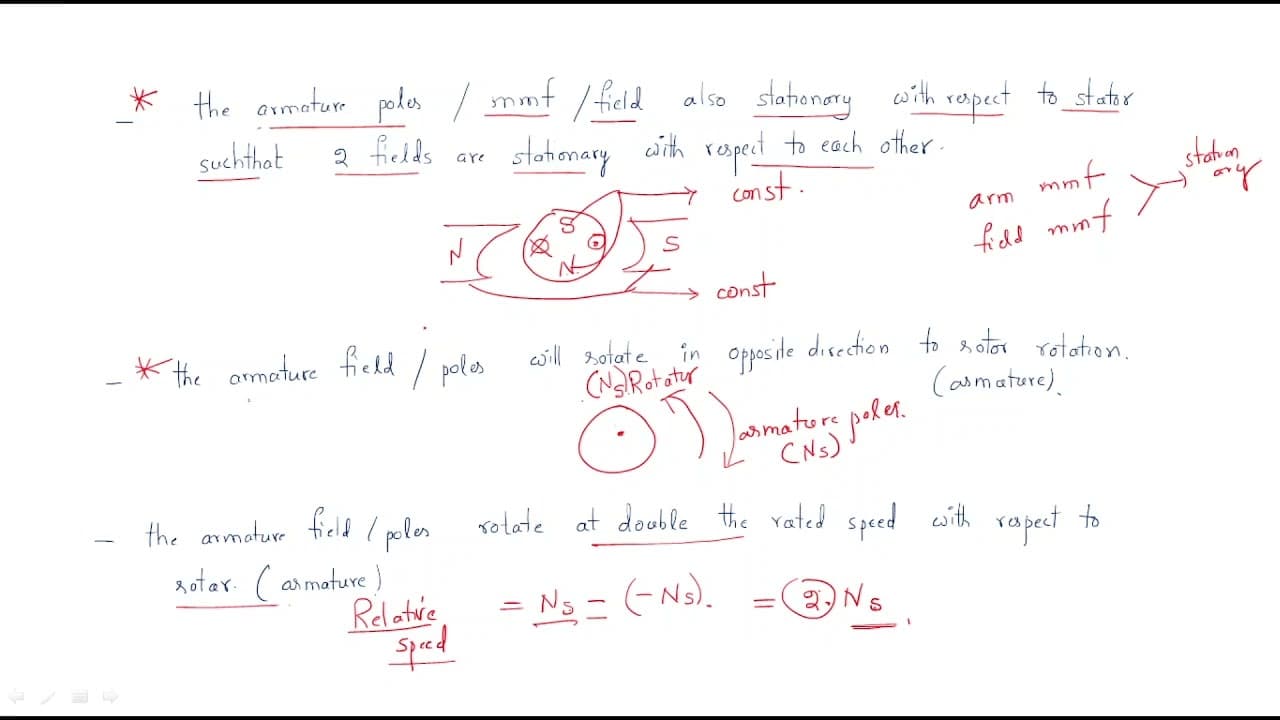
hello everyone last session we discussed about the the load angles and and direct axis and quadrature axis so some relation we discussed about that but we should discuss some depth about the mmfs so here just look at here the armature poles and mmf are filled all are same the armature poles and armature mmf and armature fail as also stationary with... Read More
Key Insights
- 🏑 The main field poles in a DC machine remain stationary, facilitating a stable magnetic field that is critical for reliable operation.
- 💈 Armature poles must rotate in the opposite direction to the rotor, ensuring that the system maintains effective electromagnetic induction and energy conversion.
- 🐎 Understanding the relationship between rotor speed and armature pole speed is essential for predicting machine performance and adjusting operational parameters.
- 🌸 The construction components of DC machines, such as the yoke, play a substantial role in ensuring effective magnetic flux flow and reducing energy losses.
- 😓 The choice of materials for key components impacts efficiency; for instance, cast steel offers distinct advantages over cast iron in larger machines.
- 🎰 Commutators are unique to DC machines and essential for maintaining consistent torque by reversing current direction as the rotor spins.
- 🏑 Armature MMF and field flux interactions are vital to the operational effectiveness of DC machines, directly affecting their efficiency and output.
Install to Summarize YouTube Videos and Get Transcripts
Explore YouTube Video Summarizer or Get YouTube Transcript Extractor
Questions & Answers
Q: What is the significance of the main field poles being stationary with respect to the stator in a DC machine?
The stationary nature of the main field poles ensures a constant magnetic field during operation. This stability allows for consistent electromagnetic interactions, crucial for efficient energy conversion in both generators and motors. It stabilizes the performance of the machine under varying load conditions.
Q: How do the armature poles’ rotations relate to the rotor in DC machines?
The armature poles rotate in the opposite direction to the rotor and do so at double the synchronous speed of the rotor. This dynamic allows the machine to achieve effective electromagnetic induction, essential for both generating electricity and converting electrical energy into mechanical motion.
Q: What is the role of the magnetic frame or yoke in a DC machine?
The magnetic frame or yoke acts as a return path for magnetic flux in a DC machine. It is typically made from cast iron or cast steel, depending on the machine's size. For larger machines, cast steel is preferred due to its lower reluctance and ability to handle greater flux, enhancing overall efficiency.
Q: Why is the commutator important in DC machines, and how does it function?
The commutator is pivotal in DC machines as it reverses the direction of current in the armature winding, ensuring that the torque direction remains consistent as the rotor turns. This mechanism prevents the machine from losing functionality as it transitions between polarities during rotation.
Q: What advantages do cast steel frames provide over cast iron in large DC machines?
Cast steel frames generally exhibit lower reluctance, enabling more efficient magnetic flux flow. Although cast iron is used in smaller machines, cast steel frames allow for higher power ratings in smaller physical sizes, resulting in a more compact and efficient machine design.
Q: Can you explain the relationship between armature MMF and field flux?
The armature magnetomotive force (MMF) and field flux are closely tied; when the armature MMF is established, it interacts with the main field flux to induce current. The interaction is fundamental for converting electrical energy into mechanical work in DC machines.
Q: What materials are typically used for the armature winding in DC machines, and why?
Armature windings in DC machines are commonly made from copper or aluminum due to their excellent conductivity and low resistance. These materials help minimize energy losses, allowing for efficient operation and better performance under varying load conditions.
Summary & Key Takeaways
-
The content explores the principles of armature magnetic field (MMF) in DC machines, highlighting the stationary nature of main field poles with respect to the stator during operation.
-
It emphasizes the relationship between the armature poles and rotor rotations, noting that the armature poles rotate in opposition to rotor movement at double the speed.
-
The discussion includes the construction elements of DC machines, such as the magnetic frame (yoke) made from different materials, and the role of various components like the commutator and brushes.
Read in Other Languages (beta)
Share This Summary 📚
Summarize YouTube Videos and Get Video Transcripts with 1-Click
Try YouTube Summary with ChatGPT & Claude or YouTube Transcript Generator