Equivalent Capacitance - Capacitors In Series and Parallel
TL;DR
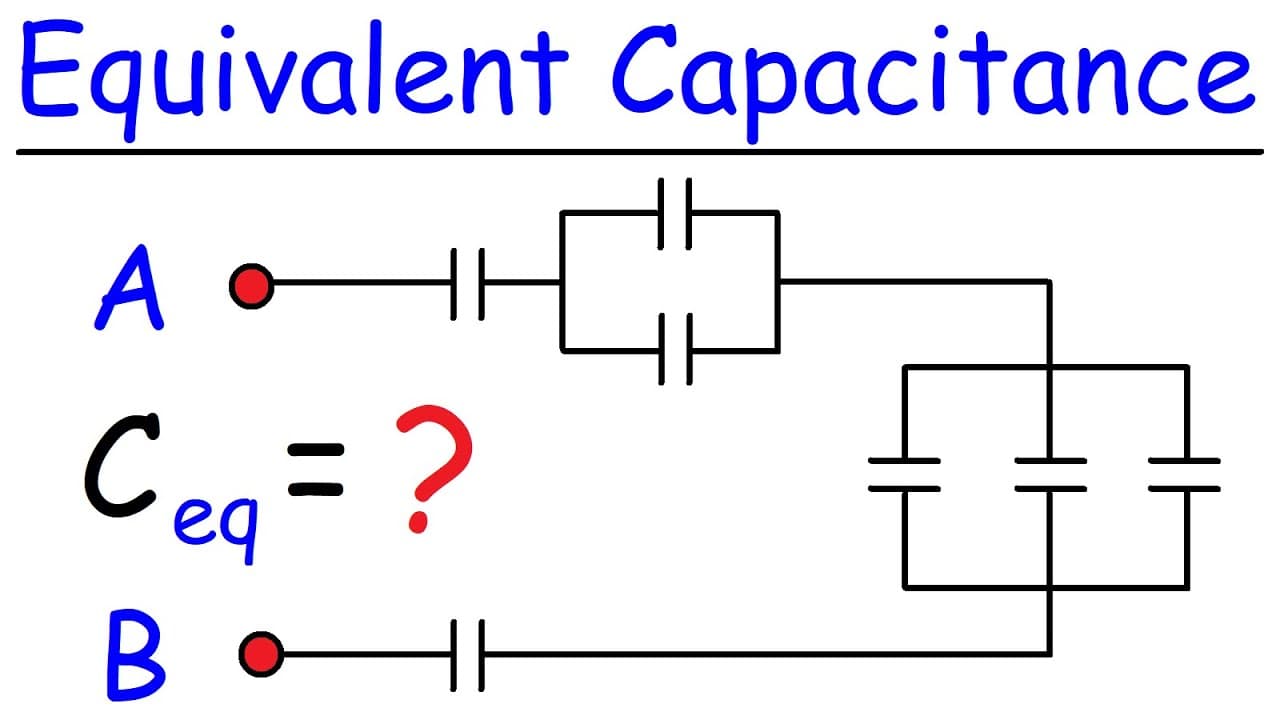
This video explains how to calculate the equivalent capacitance in circuits using parallel and series configurations.
Transcript
in this video we're going to talk about equivalent capacitance and how we could find it so let's start with our first example let's say if we have a circuit that contains two capacitors in parallel what is the equivalent capacitance so let's say the first capacitor has a value of 10 microfarads and the second capacitor has a value of 20 micro frats... Read More
Key Insights
- 🍹 In parallel circuits, the equivalent capacitance is the sum of the capacitance values.
- 🍹 In series circuits, the reciprocal of the equivalent capacitance is the sum of the reciprocals of the individual capacitance values.
- ❓ Capacitors in parallel increase the equivalent capacitance, while capacitors in series decrease it.
- 👱 DC current does not pass through capacitors as air is an insulator.
- ❓ Simplify complex circuits by calculating the equivalent capacitance within each configuration separately.
- ❓ The equivalent capacitance can be calculated mentally for capacitors with the same value in series or parallel.
- ❓ Scientific calculators can be used to solve the equations for more complex circuits.
Install to Summarize YouTube Videos and Get Transcripts
Explore YouTube Video Summarizer or Get YouTube Transcript Extractor
Questions & Answers
Q: How do you calculate the equivalent capacitance in parallel circuits?
In parallel circuits, the equivalent capacitance is simply the sum of the capacitance values of the individual capacitors.
Q: What formula is used to calculate the equivalent capacitance in series circuits?
In series circuits, the formula is 1/c_eq = 1/c1 + 1/c2 + 1/c3 + ... + 1/cn, where the values of c1, c2, c3, etc. are the capacitance values of the individual capacitors.
Q: What happens to the equivalent capacitance as more capacitors are added in parallel?
As more capacitors are added in parallel, the equivalent capacitance increases, as it is the sum of the individual capacitances.
Q: What happens to the equivalent capacitance as more capacitors are added in series?
As more capacitors are added in series, the equivalent capacitance decreases. If the capacitors have the same value, the equivalent capacitance will be half of that value.
Summary & Key Takeaways
-
Capacitors in parallel can be calculated by summing their capacitance values.
-
Capacitors in series can be calculated using the equation 1/c_eq = 1/c1 + 1/c2, and if the values are the same, the equivalent capacitance is half.
-
For more complex circuits with both parallel and series components, simplify by calculating the equivalent capacitance within each configuration separately.
Read in Other Languages (beta)
Share This Summary 📚
Summarize YouTube Videos and Get Video Transcripts with 1-Click
Try YouTube Summary with ChatGPT & Claude or YouTube Transcript Generator
Explore More Summaries from The Organic Chemistry Tutor 📚




Summarize YouTube Videos and Get Video Transcripts with 1-Click
Try YouTube Summary with ChatGPT & Claude or YouTube Transcript Generator