2. Reasoning: Goal Trees and Problem Solving
TL;DR
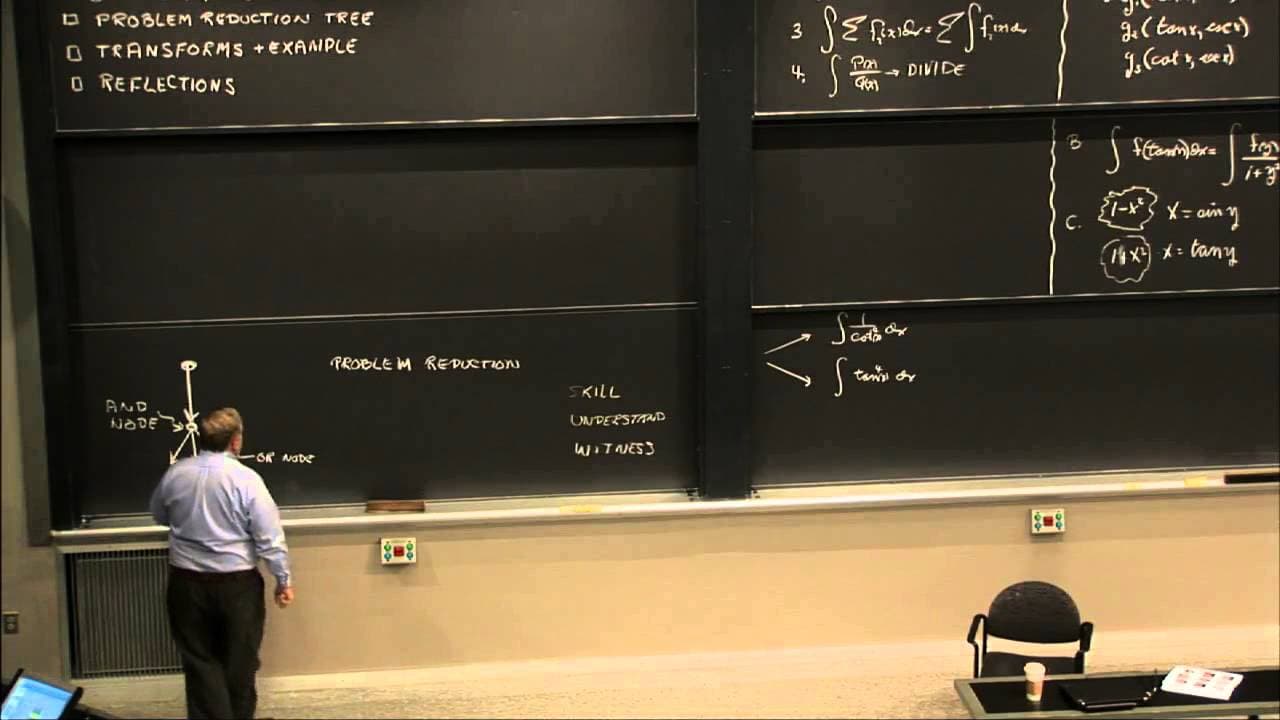
A program that can perform symbolic integration does not seem intelligent once its problem-solving process is understood.
Transcript
What we're going to talk about today, is goals. So just by way of a little warm up exercise, I'd like you to look at that integration problem over there. The one that's disappeared. So the question is, can you do it in your head? Probably not. The question is, if a program can do that, is a program, in any sense of the word, intelligent? That's a b... Read More
Key Insights
- 🥡 The program's problem-solving process involves applying safe transformations, such as taking constants out or using the sum of integrals rule, to simplify integration problems.
- 💁 Heuristic transformations, like trigonometric substitutions or converting functions to rational form, provide additional problem-solving approaches.
- ☠️ The program's success rate and small knowledge base demonstrate that efficient problem-solving can be achieved with limited knowledge and specific transformation techniques.
- ❓ Understanding how a program solves complex problems often diminishes the perception of its intelligence.
Install to Summarize YouTube Videos and Get Transcripts
Explore YouTube Video Summarizer or Get YouTube Transcript Extractor
Questions & Answers
Q: How does the program simplify integration problems?
The program applies safe transformations to simplify integrals, such as taking constants out or using the sum of integrals rule. It also uses heuristic transformations, like trigonometric substitutions or converting functions to rational form, to further simplify the problems.
Q: What type of knowledge is involved in the program?
The program relies on knowledge about mathematical transformations and their application in integration. It also utilizes a table of integrals to look up known integration results. Additionally, the program uses goal tree structures to guide its problem-solving process.
Q: How successful is the program in solving integration problems?
The program achieves a high success rate, solving 54 out of 56 difficult integration problems. The two failures were due to missing specific transformations needed for those particular problems.
Q: How much knowledge is required for the program?
The program's knowledge base consists of approximately 12 safe transformations, 12 heuristic transformations, and a table of only 26 integrals. This shows that a relatively small amount of knowledge is sufficient to solve a wide range of integration problems.
Summary & Key Takeaways
-
The program demonstrates problem-solving techniques in symbolic integration.
-
It uses safe transformations and heuristic transformations to simplify integration problems.
-
The program relies on a knowledge base of transformations and a table of integrals to guide its problem-solving process.
Read in Other Languages (beta)
Share This Summary 📚
Summarize YouTube Videos and Get Video Transcripts with 1-Click
Try YouTube Summary with ChatGPT & Claude or YouTube Transcript Generator
Explore More Summaries from MIT OpenCourseWare 📚



Summarize YouTube Videos and Get Video Transcripts with 1-Click
Try YouTube Summary with ChatGPT & Claude or YouTube Transcript Generator