Permutations and Combinations | Aptitude | Part- 02 | Bharath Kumar
TL;DR
This session covers key concepts and formulas related to permutations and combinations.
Transcript
hi everyone welcome to the session in this session i am continuing introduction part of permutations and combinations uh let's see the uh continuation of last session that's the uh that is uh see in the last session i have explained about what is permutation and what is combination and here in permutation order is very important uh whereas coming t... Read More
Key Insights
- 🪈 Permutations require consideration of order, while combinations are about selection without regard to order.
- 📁 Linear arrangements can be calculated using factorials, providing a direct method to count distinct sequences.
- 🧘 Circular arrangements reduce total outcomes by fixing one position and simplifying the calculation process.
- 😒 Repetition in arrangements changes the formula; without repetition, use nPr and with it, use n^r for calculations.
- ❓ The principle of combinations includes selecting at least one object and leverages exponential counting to derive total outcomes.
- 💹 Understanding relationships between nCr and nPr enriches problem-solving abilities in combinatorial contexts.
- 🛟 Zero and maximal selections reinforce combinatorial logic, serving as cornerstone examples of the counting principles.
Install to Summarize YouTube Videos and Get Transcripts
Explore YouTube Video Summarizer or Get YouTube Transcript Extractor
Questions & Answers
Q: What is the main difference between permutations and combinations?
The primary difference lies in the order of arrangement. Permutations consider the order to be important, meaning different arrangements of the same items count as distinct outcomes. In contrast, combinations focus solely on selection, where the order does not affect the outcome. For example, choosing items A, B, and C in any order counts as the same combination but counts as different permutations.
Q: How do you calculate permutations for linear arrangements?
Linear arrangements can be calculated using the formula nPn or n!, which represents the factorial of n. For instance, if you have four distinct objects, you can arrange them in 4P4, which equals 4! or 24 different ways. If arranging only a subset, use nPr where r is the number of objects being arranged.
Q: What is the significance of the equation n-1! in circular arrangements?
In circular arrangements, the equation is n-1! because fixing one position in a circle allows for the remaining positions to be rearranged without duplicating arrangements due to rotation. This accounts for the cyclical nature of circles, ensuring that arrangements like A-B-C-D and B-C-D-A are not counted multiple times.
Q: Can you explain the relationship between nPr and nCr?
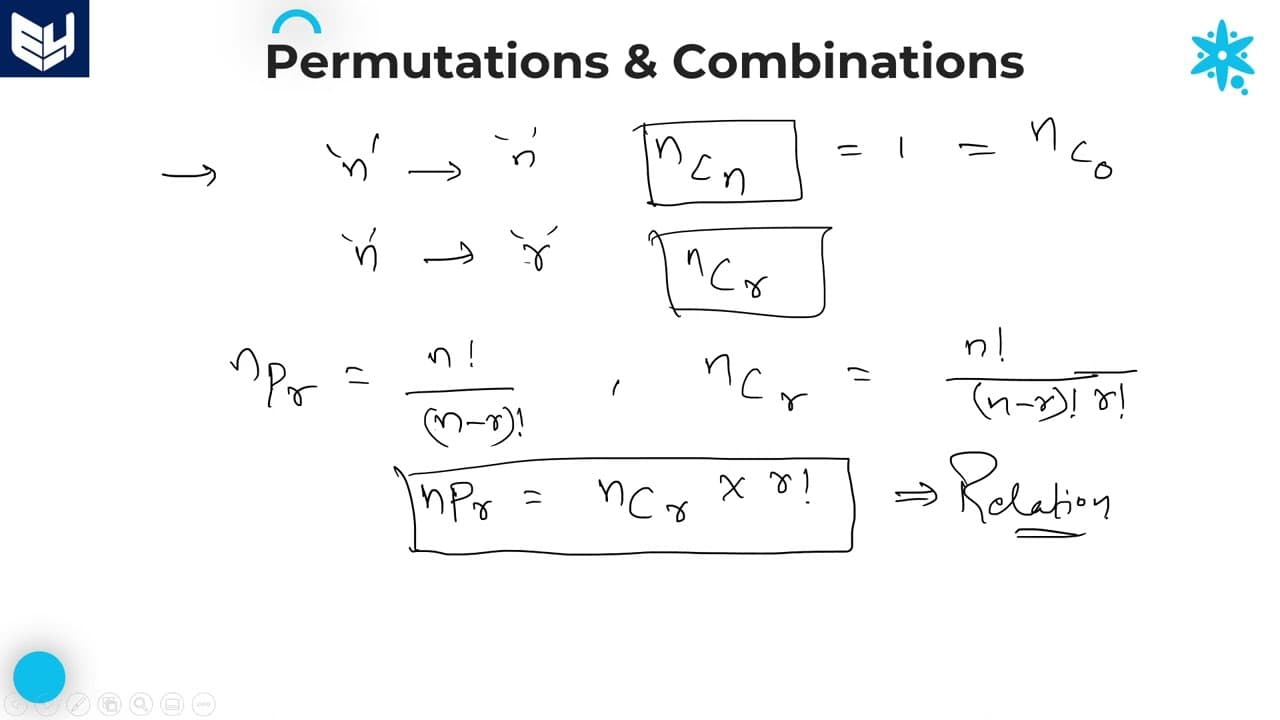
The relationship between permutations nPr and combinations nCr is given by the formula nPr = nCr × r!. This means that the number of ways to arrange r objects from n (nPr) is equal to the number of ways to choose those r objects (nCr) multiplied by the number of ways to arrange r objects (r!).
Q: How is the concept of at least one object selected out of n important in combinations?
The idea of selecting at least one object out of n is critical as it allows for a broader range of possible selections. The number of ways to choose at least one object is expressed as 2^n - 1, derived from the total combinations of including or excluding each object, excluding the case where no objects are selected.
Q: What are the implications of nC0 and nCn always equaling 1?
The implications are that when you choose none or all of a set, there is only one way to do so. nC0 signifies the empty selection, while nCn indicates that if you select everything, there's only one complete selection possible, reinforcing foundational principles in combinatorial mathematics.
Q: When do you apply the formula nC(n-r)?
The formula nC(n-r) is useful when it is easier to determine how many ways to exclude an r number of elements from n, rather than selecting r elements directly. This is based on the combinatorial principle that choosing r objects is identical to excluding n-r objects.
Q: What should be noted regarding distinct arrangements in circular permutations?
When dealing with circular permutations, it’s essential to recognize whether clockwise and anti-clockwise arrangements matter. If they do, use n-1!; if they don't, divide by 2 (resulting in (n-1)!/2) to avoid duplication across mirrored arrangements, impacting the total count of unique arrangements.
Summary & Key Takeaways
-
The session explains what permutations and combinations are, highlighting the importance of order in permutations and selection in combinations.
-
It introduces linear and circular arrangements, detailing how to calculate permutations in both contexts, including scenarios with and without repetition.
-
The speaker outlines key formulas for permutations (nPr) and combinations (nCr), emphasizing their applications and relationships in problem-solving.
Read in Other Languages (beta)
Share This Summary 📚
Summarize YouTube Videos and Get Video Transcripts with 1-Click
Try YouTube Summary with ChatGPT & Claude or YouTube Transcript Generator