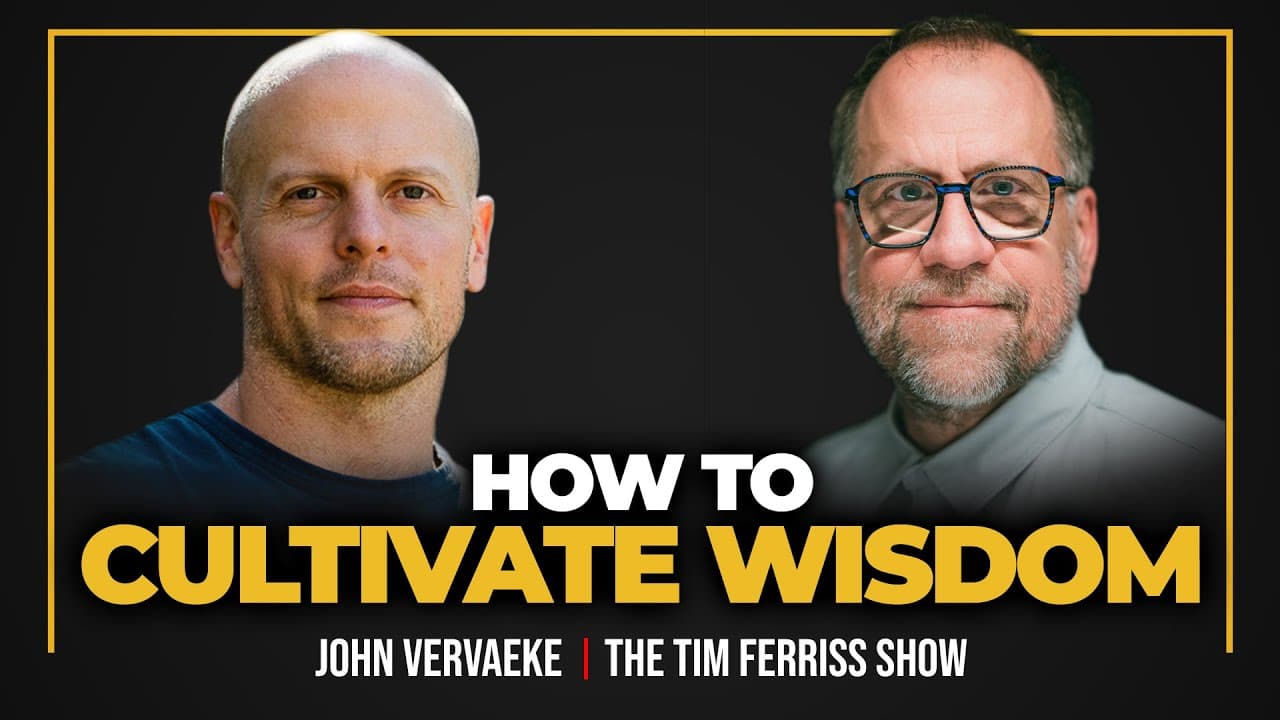
John Vervaeke — How to Build a Life of Wisdom, Flow, and Contemplation | The Tim Ferriss Show
TL;DR
John Vervaeke, a professor at the University of Toronto, discusses the importance of various forms of knowing and their role in cultivating wisdom.
Transcript
Tim Ferriss: Hello, ladies and germs. This is Tim Ferriss. Welcome to another episode of The Tim Ferriss Show. I'm going to keep my preamble short because I would like to get into the meat and potatoes of this conversation that I've been looking forward to. My guest today is John Vervaeke on Twitter. You can find him @Vervaeke_John. He is a profess... Read More
Key Insights
- 🖐️ Different forms of knowing play a vital role in cultivating wisdom and understanding cognitive processes.
- 🔬 Taxonomy of knowledge helps establish clear distinctions and systematic understanding in cognitive science.
- 🤳 Practices like meditation, contemplation, and philosophical fellowship can facilitate self-awareness, critical reflection, and internalization of philosophical principles for wisdom cultivation.
- 🤗 It's essential to challenge biases, engage in active open-mindedness, and self-dialogue to address risks of intuition and implicit learning in decision-making processes.
Install to Summarize YouTube Videos and Get Transcripts
Explore YouTube Video Summarizer or Get YouTube Transcript Extractor
Questions & Answers
Q: How does Vervaeke differentiate between propositional and procedural knowing?
Vervaeke explains that propositional knowing involves knowing that something is true, resulting in beliefs, while procedural knowing is about knowing how to perform certain actions or skills, which do not result in beliefs but rather skills.
Q: What is the significance of participatory knowing in the context of wisdom cultivation?
Participatory knowing focuses on knowing by being and emphasizes the co-shaping of oneself and reality to understand affordances and connections between self and environment, contributing to a deeper sense of belonging and agency.
Q: How does Vervaeke address the potential risks of intuition and implicit learning in pattern recognition?
Vervaeke advocates for active open-mindedness, self-dialogue, and internalizing Socratic practices to challenge biases and actively counteract them, promoting discernment and critical self-reflection in decision-making.
Q: Can you explain the difference between meditation and contemplation in the context of mental framing?
Meditation involves stepping back and looking at mental framing, like taking off glasses to see them, while contemplation focuses on becoming aware of and critically examining one's mental processes and perspectives from a detached perspective.
Summary & Key Takeaways
-
John Vervaeke introduces the concept of four ways of knowing: propositional, procedural, perspectival, and participatory, highlighting the importance of understanding different forms of knowledge.
-
He emphasizes the need for principled taxonomy in cognitive science, discussing how different kinds of knowing have specific vehicles, results, standards, and forms of memory.
-
Vervaeke explains how practices like meditation, contemplation, circling, paraphrasing, and philosophical fellowship can help individuals cultivate wisdom and challenge their mental framing.
Read in Other Languages (beta)
Share This Summary 📚
Summarize YouTube Videos and Get Video Transcripts with 1-Click
Try YouTube Summary with ChatGPT & Claude or YouTube Transcript Generator
Explore More Summaries from The Tim Ferriss Show 📚
Summarize YouTube Videos and Get Video Transcripts with 1-Click
Try YouTube Summary with ChatGPT & Claude or YouTube Transcript Generator