How to Understand Your Family Tree Relationships
TL;DR
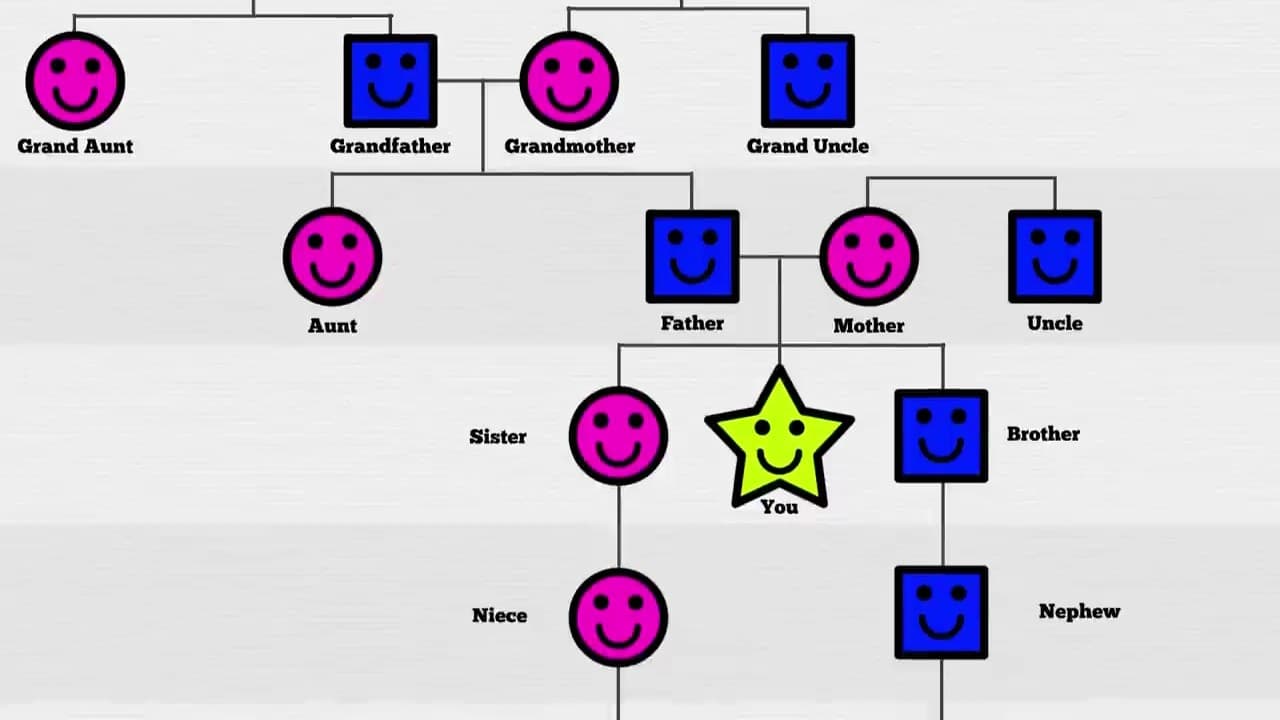
Understanding your family tree involves recognizing that each 'G' in a relative's title indicates a generation between you and that person. For instance, your first cousins share a grandparent, while second cousins share a great-grandparent. The term 'once removed' describes individuals who are separated by generations within the same cousin level.
Transcript
This is you, this is your family tree and this is Your Family Tree Explained. You have parents, and your parents have parents. These are your grandparents, who also have parents - your great grandparents. Keep adding parents, keep adding "greats". For every "G" in the name there is one generation in between you and that person. Grandparents? One "G... Read More
Key Insights
- 👨👩👧 The family tree consists of different generations, with each "G" representing a generation in between.
- 👪 Siblings of your parents are your aunts and uncles, while siblings of your grandparents are your grand aunts and uncles.
- 👶 Your nieces and nephews are the children of your siblings, and their children are your grand nieces and nephews.
- 👪 Cousins are the children of your aunts and uncles, and their position on the family tree is determined by the number of "G"s.
- 🍉 The term "once removed" is used to describe the number of generations that separate cousins.
- 👪 Understanding your family tree can be complicated, but there are charts available to make it easier.
- 👪 The complexity of family relationships increases with more generations and extended family members.
Install to Summarize YouTube Videos and Get Transcripts
Explore YouTube Video Summarizer or Get YouTube Transcript Extractor
Questions & Answers
Q: How do you determine the number of in-betweeners in your family tree?
The number of in-betweeners is determined by the number of "G"s in the title. For example, great grandparents have four in-betweeners.
Q: What is the relationship between your siblings-in-law and your siblings-in-law's spouses?
Your siblings-in-law are the siblings of your spouse, but it is unclear whether their spouses should be referred to as siblings-in-law.
Q: How are cousins determined in a family tree?
Cousins are the children of your aunts and uncles. The number of in-betweeners determines the cousin number, following the same rule as the "G" rule.
Q: What does it mean for cousins to be "once removed"?
The term "once removed" refers to the number of generations that separate cousins. For example, first cousins once removed are one generation apart.
Summary & Key Takeaways
-
Your family tree consists of generations, with each "G" representing one generation between you and that person.
-
Siblings of your parents are your aunts and uncles, and siblings of your grandparents are your grand aunts and uncles.
-
Your nieces and nephews are the children of your siblings, and their children are your grand nieces and nephews.
Read in Other Languages (beta)
Share This Summary 📚
Summarize YouTube Videos and Get Video Transcripts with 1-Click
Try YouTube Summary with ChatGPT & Claude or YouTube Transcript Generator
Explore More Summaries from CGP Grey 📚






Summarize YouTube Videos and Get Video Transcripts with 1-Click
Try YouTube Summary with ChatGPT & Claude or YouTube Transcript Generator