What Is Gradient Descent and How Does It Work?
TL;DR
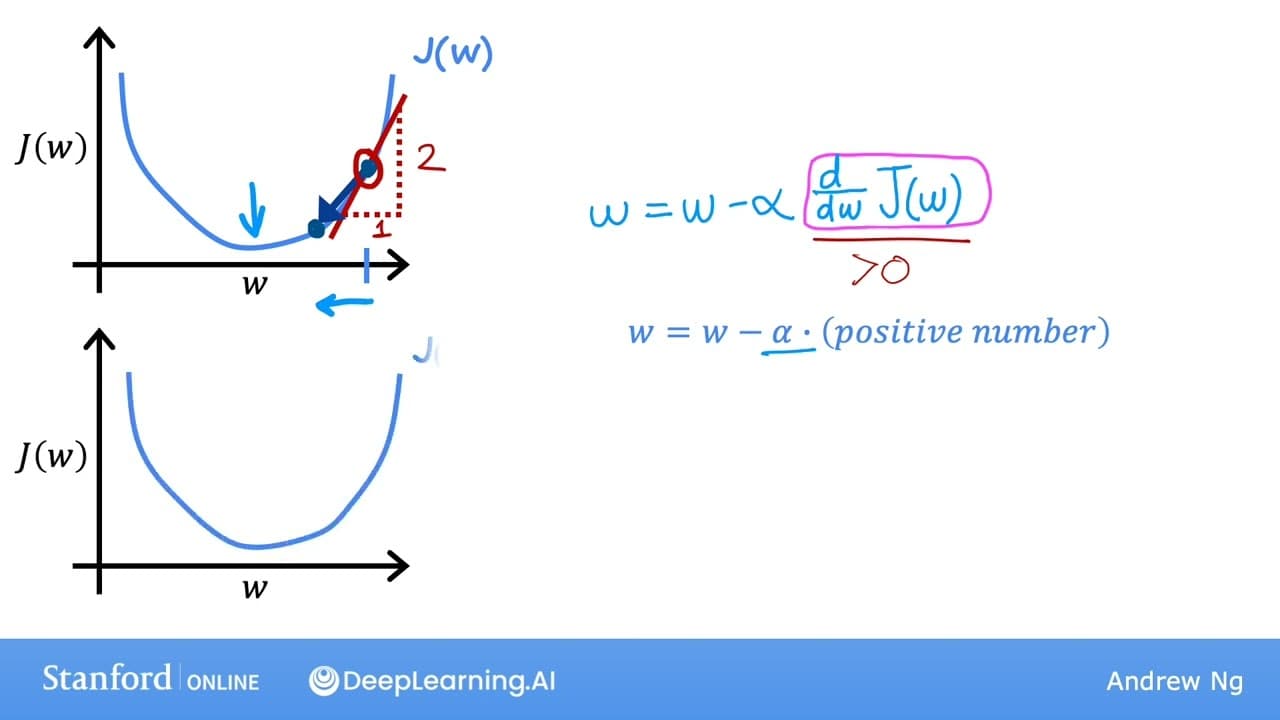
Gradient descent is an optimization algorithm used in machine learning to update model parameters in order to minimize the cost function. The learning rate controls the step size of these updates, and the derivative determines the direction of the changes. Selecting the right learning rate is crucial for effective convergence to the minimum of the cost function.
Transcript
now let's dive more deeply into gradient descent to gain better intuition about what it's doing and why it might make sense here's the gradient descent algorithm that you saw in the previous video and as a reminder this variable this Greek symbol Alpha is the learning rate and the learning rate controls how big of a step you take when updating the ... Read More
Key Insights
- ☠️ The learning rate controls the step size in gradient descent and influences the algorithm's convergence.
- 😥 The derivative in gradient descent represents the slope of the cost function at a given point and determines the direction of parameter updates.
- ☠️ Gradient descent updates parameters by subtracting the learning rate multiplied by the derivative, ensuring that the algorithm moves towards the minimum of the cost function.
- 😥 The choice of learning rate is essential and can affect the algorithm's convergence, preventing it from either converging or overshooting the minimum point.
- 😥 Different starting points in gradient descent can result in varying convergence rates and paths towards the minimum of the cost function.
- ☠️ Understanding the intuition behind the derivative and learning rate helps in selecting appropriate parameters for gradient descent.
- 🎰 Gradient descent is a powerful optimization algorithm widely used in machine learning for parameter updating.
Install to Summarize YouTube Videos and Get Transcripts
Explore YouTube Video Summarizer or Get YouTube Transcript Extractor
Questions & Answers
Q: What is the role of the learning rate in gradient descent?
The learning rate determines the step size taken when updating model parameters. A small learning rate may result in slow convergence, while a large learning rate can prevent the algorithm from converging or overshoot the minimum point.
Q: How does gradient descent minimize the cost function?
Gradient descent calculates the derivative of the cost function with respect to the parameters and updates the parameters in the direction that decreases the cost. By iteratively updating the parameters, the algorithm converges towards the minimum of the cost function.
Q: What happens if the derivative is positive or negative in gradient descent?
If the derivative is positive, the algorithm decreases the parameter value, leading to a decrease in the cost. If the derivative is negative, the parameter value increases, bringing it closer to the minimum of the cost function.
Q: How does the starting point affect gradient descent?
The starting point determines the initial parameter value for gradient descent. Depending on the slope of the cost function at the starting point, the algorithm may converge quickly or take longer to reach the minimum.
Summary & Key Takeaways
-
Gradient descent is an algorithm used to update model parameters in machine learning, with the learning rate controlling the step size.
-
By adjusting the learning rate and derivative (partial derivative for multivariate calculus), the algorithm updates the parameters to minimize the cost function.
-
When the learning rate and derivative are multiplied together, it determines the direction and magnitude of the parameter updates.
Read in Other Languages (beta)
Share This Summary 📚
Summarize YouTube Videos and Get Video Transcripts with 1-Click
Try YouTube Summary with ChatGPT & Claude or YouTube Transcript Generator
Explore More Summaries from DeepLearningAI 📚



Summarize YouTube Videos and Get Video Transcripts with 1-Click
Try YouTube Summary with ChatGPT & Claude or YouTube Transcript Generator