Arc Length (formula explained)
TL;DR
The video explains how to calculate the length of a curve using calculus by approximating the curve with tangent lines and integrating the results.
Transcript
the post I want to find the length of this curve from here to here how can we do it of course it's a curve so I can I just use it over hmm we can use the daughter along with calculus then attack you okay let me show you because imagine this is a daughter you have to just place the loot right here and what you get a tangent line excellent so here's ... Read More
Key Insights
- 🫥 The length of a curve can be approximated by dividing it into small segments and approximating each segment with a tangent line.
- ☺️ Two scenarios are considered: when the curve is defined as a function of x and when it is defined as a function of y.
- ❓ Formulas for calculating the length of the curve in each scenario are derived and explained.
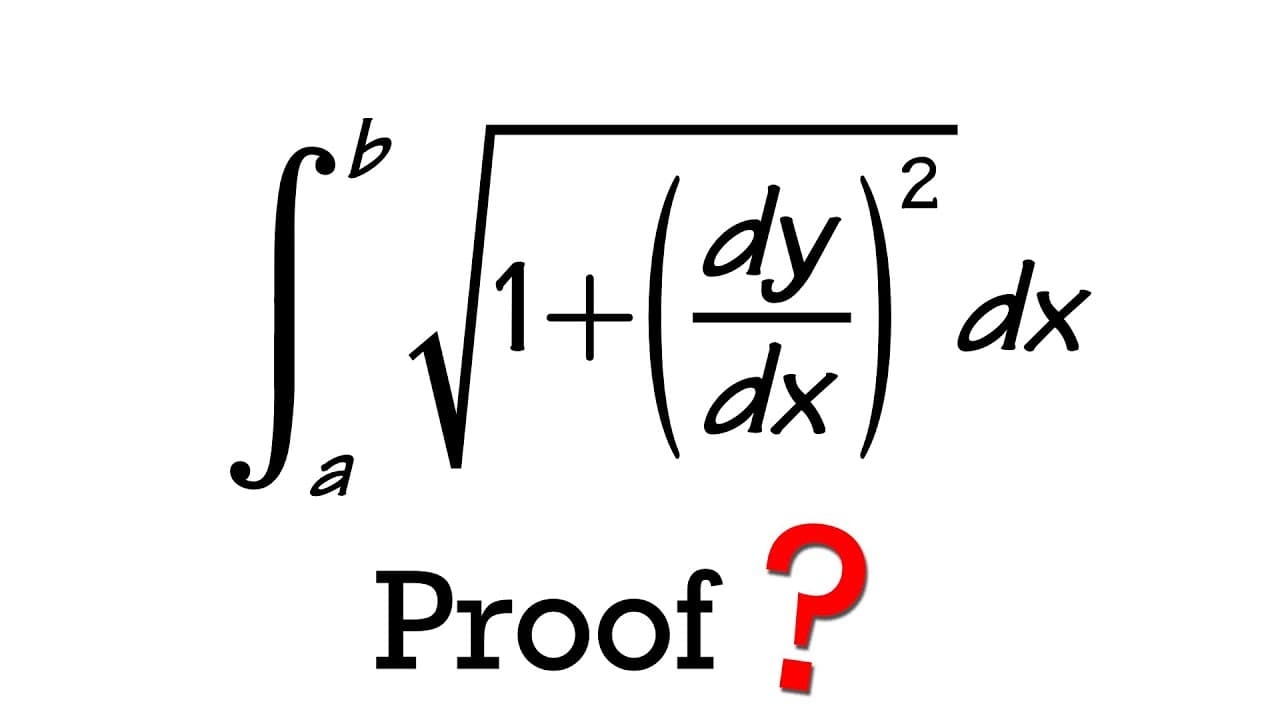
- 🥡 The formulas involve taking the square root of 1+ (dy/dx)^2 or 1+ (dx/dy)^2 and integrating with respect to x or y.
- ❣️ In situations where the curve cannot be easily defined as a function of x or y, alternative methods may be required.
- 0️⃣ The accuracy of the approximation increases as the length of each segment approaches zero.
Install to Summarize YouTube Videos and Get Transcripts
Explore YouTube Video Summarizer or Get YouTube Transcript Extractor
Questions & Answers
Q: How is the length of a curve approximated using tangent lines?
The length of a curve is approximated by breaking it into small segments and approximating each segment with a straight line (tangent line) that connects two points on the curve. By summing up the lengths of these line segments, we can approximate the length of the entire curve.
Q: How are the formulas for calculating the length of a curve derived?
The formulas for calculating the length of a curve depend on whether the curve is defined as a function of x or y. When the curve is defined as y=f(x), the formula involves taking the square root of 1+ (dy/dx)^2 and integrating it with respect to x. When the curve is defined as x=g(y), the formula involves taking the square root of 1+ (dx/dy)^2 and integrating it with respect to y.
Q: What happens when the curve cannot be easily defined as a function of x or y?
If the curve cannot be easily defined as a function of x or y, finding the length of the curve becomes more challenging. In such cases, alternative methods or numerical approximation techniques may be required.
Q: Are there any limitations or assumptions when using calculus to find the length of a curve?
The method described in the video assumes that the lengths of the tangent lines provide a good approximation for the length of the curve. However, this approximation becomes more accurate as the length of each segment approaches zero. Additionally, the method relies on the curve being continuous and smooth.
Summary & Key Takeaways
-
The video demonstrates how to calculate the length of a curve by approximating it with tangent lines and summing up the lengths of these segments.
-
Two scenarios are considered: when the curve is defined as a function of x, and when the curve is defined as a function of y.
-
For both scenarios, formulas for calculating the length of the curve are derived and explained.
Read in Other Languages (beta)
Share This Summary 📚
Summarize YouTube Videos and Get Video Transcripts with 1-Click
Try YouTube Summary with ChatGPT & Claude or YouTube Transcript Generator
Explore More Summaries from blackpenredpen 📚
Summarize YouTube Videos and Get Video Transcripts with 1-Click
Try YouTube Summary with ChatGPT & Claude or YouTube Transcript Generator