L22.3 Applications of the Poisson Process
TL;DR
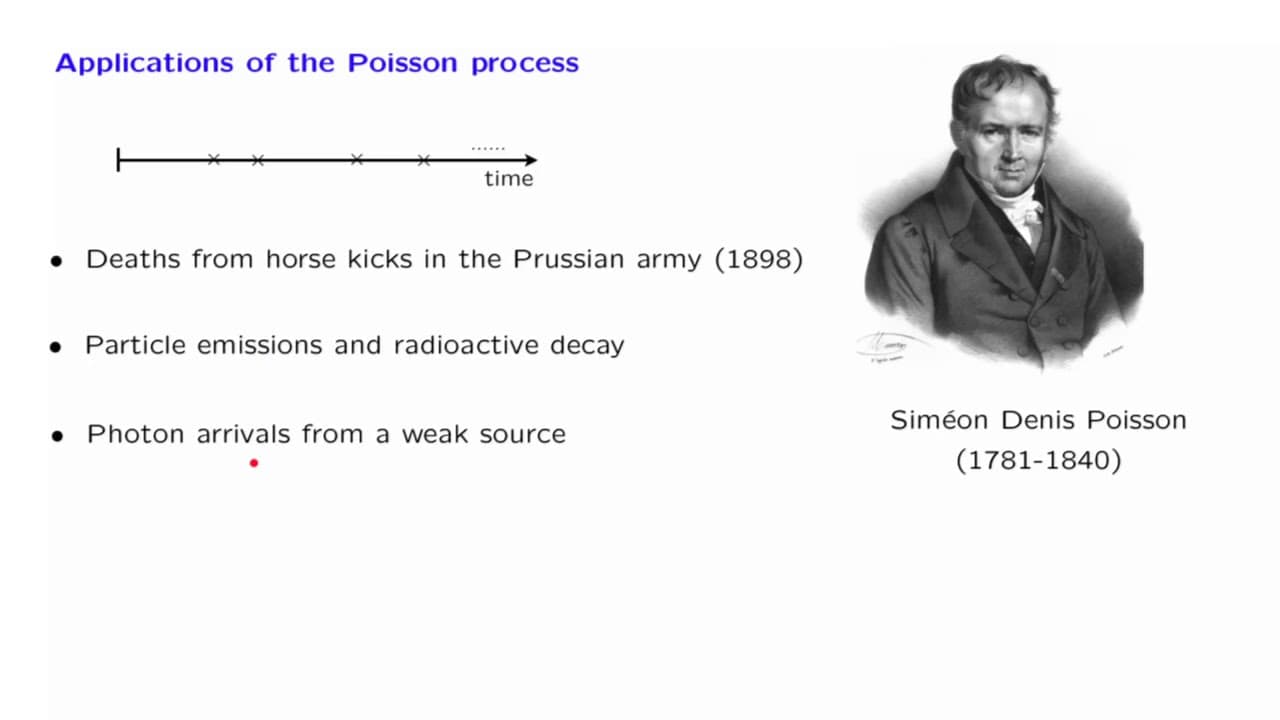
The Poisson process is a distribution that describes random and uncoordinated events like arrivals, deaths from accidents, radioactive decay, photon arrivals, market shocks, and service operations.
Transcript
In what kind of situations does the Poisson process arise? In general, it arises whenever we have events like arrivals that are somewhat rare, and which happen in a completely uncoordinated manner, so that they can show up at any particular time. In such situations, the number of arrivals will be often described by a certain distribution called the... Read More
Key Insights
- 🍟 The Poisson process is named after French mathematician Simon Denis Poisson, who first studied situations where random events occur independently.
- 🏇 Examples of phenomena that obey the Poisson process include deaths from horse kicks in the Prussian army and radioactive decay.
- 🛬 Photon arrivals in weak light sources can also be well-modeled by the Poisson process.
- 🫢 The Poisson process is commonly used as a model for certain market shocks in financial markets.
Install to Summarize YouTube Videos and Get Transcripts
Explore YouTube Video Summarizer or Get YouTube Transcript Extractor
Questions & Answers
Q: What is the Poisson process primarily used for?
The Poisson process is primarily used to model situations where events occur randomly and independently, such as arrivals, deaths from accidents, radioactive decay, photon arrivals, market shocks, and service operations.
Q: Why is the Poisson process a suitable model for phone calls to a phone company?
The Poisson process is suitable for modeling phone calls to a phone company because it assumes that calls are placed randomly and independently, with no coordination between the callers.
Q: Can the Poisson process accurately model market shocks?
While the Poisson process may not provide a completely accurate model for market shocks, it is commonly employed in financial markets as a first approximation to understand the occurrence of unexpected events.
Q: What are some examples of modern applications of the Poisson process?
Modern applications of the Poisson process include modeling service operations like service requests to web servers, phone companies, or any other company where random and uncoordinated events occur.
Summary & Key Takeaways
-
The Poisson process arises in situations where events like arrivals occur randomly and independently, such as deaths from accidents and phone calls to a phone company.
-
It is also observed in physical phenomena like radioactive decay and photon arrivals, as well as modeling market shocks in financial markets.
-
Many modern applications of the Poisson process are focused on service operations, where random and uncoordinated events occur, such as service requests to web servers or companies.
Read in Other Languages (beta)
Share This Summary 📚
Summarize YouTube Videos and Get Video Transcripts with 1-Click
Try YouTube Summary with ChatGPT & Claude or YouTube Transcript Generator
Explore More Summaries from MIT OpenCourseWare 📚



Summarize YouTube Videos and Get Video Transcripts with 1-Click
Try YouTube Summary with ChatGPT & Claude or YouTube Transcript Generator