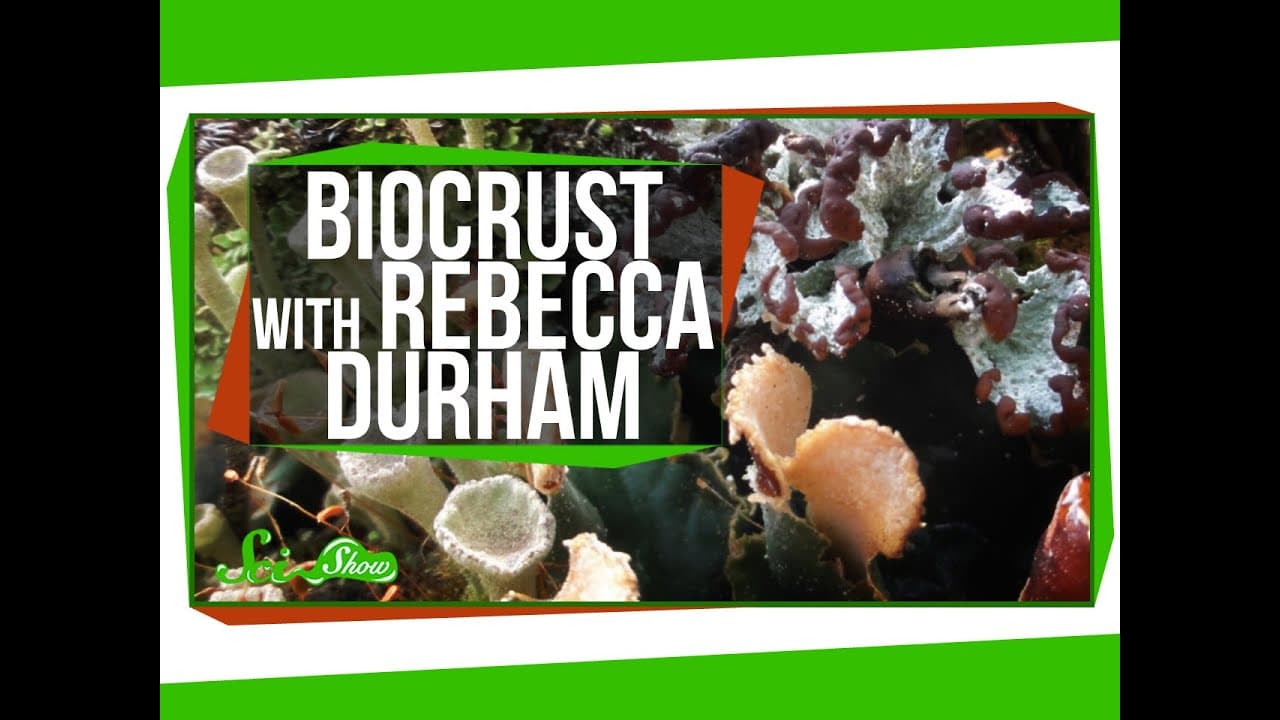
SciShow Talk Show: Biocrust with Rebecca Durham
TL;DR
Botanist Rebecca Durham discusses the importance of biological soil crusts, which are symbiotic communities of lichens, fungi, algae, and cyanobacteria found in arid environments.
Transcript
hello welcome to the scishow talk show that day on scishow where we talk to interesting people about interesting stuff today our interesting person is Rebecca Durham a botanist who studies plants and also fungi and also algae and also know lichens like it's what I what is a lichen a lichen is a symbiosis between a fungi and an algae and or cyanobac... Read More
Key Insights
- ♻️ Biological soil crusts, composed of lichens, mosses, fungi, and cyanobacteria, are important in arid environments for soil stability and nutrient cycling.
- 🖐️ In regions like Montana, biological soil crusts are present and play a significant role in grasslands and sage steppe areas.
- 🚶 Grazing animals like elk can walk on biological soil crusts without damaging them, making them less fragile compared to those in the southwestern U.S.
- 🍉 The term "bio crust" is used as a shorthand for biological soil crusts, which comprise various species of lichens and mosses.
- 😀 Aspect, or the direction a slope faces, influences the diversity and coverage of biological soil crusts.
- 😒 Biological soil crusts can be easily disturbed by human activities such as recreational vehicle use, emphasizing the need for conservation efforts.
- 💗 Lichens can grow on various surfaces, including soil, rocks, and trees, depending on the species and habitat preferences.
Install to Summarize YouTube Videos and Get Transcripts
Explore YouTube Video Summarizer or Get YouTube Transcript Extractor
Questions & Answers
Q: What is a biological soil crust?
A biological soil crust is a symbiosis between fungi and algae and/or cyanobacteria that plays a crucial role in soil stabilization and nutrient cycling.
Q: Where can biological soil crusts be found?
Biological soil crusts are found in grasslands, sage steppe areas, and other regions with minimal disturbance. They are especially diverse on north-facing aspects and in areas with some shade and moisture.
Q: How did the study of lichens and biological soil crusts become your area of focus?
Rebecca Durham initially had an interest in lichens and studied them in grad school. Her fascination with mosses and lichens led to a collaboration with a PhD student, sparking her interest in biological soil crusts.
Q: How do lichens and mosses contribute to the composition of biological soil crusts?
Lichens and mosses are the macroscopic components of biological soil crusts. They grow in interspersed patterns and contribute to stability, nutrient cycling, and moisture retention in the crust.
Summary & Key Takeaways
-
Biological soil crusts, made up of lichens, fungi, algae, and cyanobacteria, are vital components of ecosystems in arid and semi-arid environments.
-
These living soil matrices play roles in reducing erosion, stabilizing soil, and nutrient cycling.
-
While commonly associated with the southwestern United States, biological soil crusts are also present in other regions, such as Montana.
Read in Other Languages (beta)
Share This Summary 📚
Summarize YouTube Videos and Get Video Transcripts with 1-Click
Try YouTube Summary with ChatGPT & Claude or YouTube Transcript Generator
Explore More Summaries from SciShow 📚


Summarize YouTube Videos and Get Video Transcripts with 1-Click
Try YouTube Summary with ChatGPT & Claude or YouTube Transcript Generator