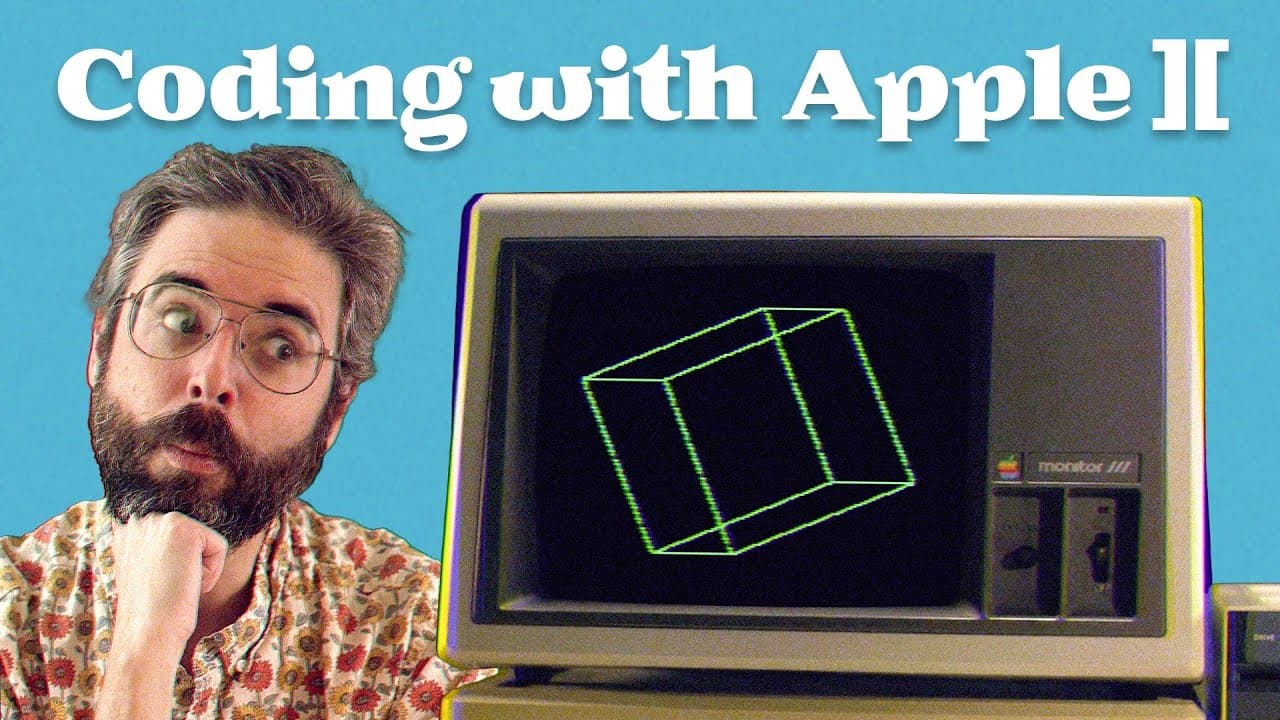
Coding Challenge: 3D on Apple II
TL;DR
Coding 3D rotating cube graphics in BASIC on Apple II+ with viewer interactions.
Transcript
hi there on today's episode of coding together the future of computer graphics I am going to attempt to render a three-dimensional rotating cube right here on the screen of this apple two plus computer I'm gonna see if I can program it all in basic but before I get started I would love to highlight some of the wonderful messages I've been receiving... Read More
Key Insights
- 🦾 Exploring the limitations and mechanics of variable naming in Apple II+ BASIC.
- ❓ Beagle Brothers BASIC enhancements like the swap command are highlighted for improved programming efficiency.
- 🧑🦽 The implementation of double-buffered animation manual on Apple II+ showcases the complexity of rendering smoother graphics.
- 💨 Suggestions for optimizing code performance include exploring Assembly Language and precomputing trigonometric values for faster execution.
- 🪜 Future enhancements like adding perspective projection for more realistic 3D graphics are proposed to expand graphics capabilities beyond orthographic projection.
- 💾 Challenges like disk space limitations are encountered when saving code, suggesting the need for modern storage solutions like SD cards for efficient file management.
- 🫵 The importance of viewer interaction in coding discussions is emphasized, shaping content and future topics based on user feedback.
Install to Summarize YouTube Videos and Get Transcripts
Explore YouTube Video Summarizer or Get YouTube Transcript Extractor
Questions & Answers
Q: How does variable naming work on the Apple II+ in BASIC?
The Apple II+ in BASIC restricts variable names to just two characters, storing only the first two characters for identification.
Q: What are some enhancements introduced by Beagle Brothers BASIC for Apple II+?
Beagle Brothers BASIC brought improvements like the swap command for variables, providing more flexibility in programming tasks.
Q: How can one implement double-buffered animation on an Apple II+ for smoother graphics?
By utilizing memory pages for high-resolution graphics and swapping between them, programmers can create double-buffered animation manually.
Q: What challenges and optimizations can be explored for coding 3D graphics on Apple II+?
Challenges include optimizing code for speed, potentially using Assembly Language, or precomputing trigonometric values. Optimizations may include using lookup tables for sine and cosine values for faster calculations.
Summary & Key Takeaways
-
Delving into rendering a rotating 3D cube on an Apple II+ using Apple BASIC.
-
Viewer interactions bring up topics like variable naming limitations and enhancement utilities like Beagle Brothers BASIC.
-
Exploring commands, techniques, and challenges of implementing double-buffered animation for smoother graphics rendering.
Read in Other Languages (beta)
Share This Summary 📚
Summarize YouTube Videos and Get Video Transcripts with 1-Click
Try YouTube Summary with ChatGPT & Claude or YouTube Transcript Generator
Explore More Summaries from The Coding Train 📚





Summarize YouTube Videos and Get Video Transcripts with 1-Click
Try YouTube Summary with ChatGPT & Claude or YouTube Transcript Generator