Hydrostatic force, Sect 8 3 #4
TL;DR
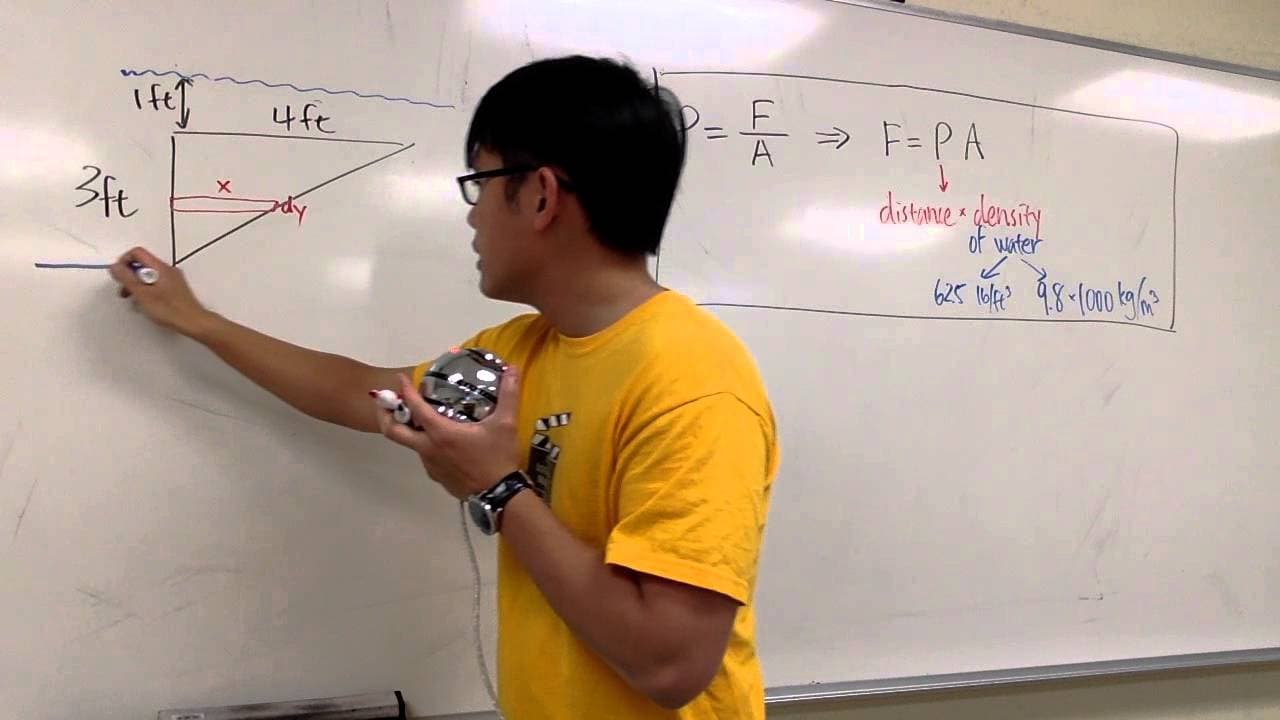
This analysis explains how to calculate the hydrostatic force acting on a vertically submerged triangular plate using integration and the equation F = P * A.
Transcript
in this question we are going to figure out the hydrostatic force that's acting on this triangular plate when we put this vertically into the water and as we can see here we have three feet four feet and here's one feet underneath the water whenever we are putting anything vertically into the water such as this one we have to use integration and th... Read More
Key Insights
- 🇵🇫 The hydrostatic force on a triangular plate can be calculated using the equation F = P * A, where P is the pressure and A is the area.
- ❓ Integration is necessary to account for the varying pressure at different depths.
- 🇦🇪 The pressure is related to the distance submerged, density of the fluid, and the chosen units.
- 🚥 The area of the rectangular slice is determined by multiplying the change in width by the horizontal distance.
- ☺️ To determine X in terms of Y, the coordinates can be chosen based on the reference frame.
- 💦 The density of water (62.5 lbs/ft^3) is typically used in calculations.
- 🔺 The depth can be determined by considering the dimensions of the triangle or the entire submerged section.
- 👻 Integrating the pressure equation from 0 to the vertical height of the triangle allows calculation of the hydrostatic force.
Install to Summarize YouTube Videos and Get Transcripts
Explore YouTube Video Summarizer or Get YouTube Transcript Extractor
Questions & Answers
Q: How is the hydrostatic force on a triangular plate calculated?
The hydrostatic force can be calculated using the equation F = P * A, where P is the pressure and A is the area of the submerged plate. The pressure P can be determined by integrating the equation P = ρgh, where ρ is the density of water, g is the acceleration due to gravity, and h is the depth.
Q: Why is integration used to determine the pressure and force?
Integration is used because the pressure varies with depth. By considering small rectangular slices and using integration to sum up the contributions from each slice, we can determine the pressure at different depths and calculate the overall force.
Q: How is the area of the rectangular slice determined?
The area of the rectangular slice can be calculated by multiplying the change in width (dy) by the horizontal distance (X). Using integration, X is expressed in terms of Y, the vertical coordinate. The area is then given by X * dy.
Q: What are some factors that affect the hydrostatic force?
The hydrostatic force is affected by the distance submerged, which influences the pressure. The density of the fluid being considered (e.g., water, gasoline) also affects the force. Additionally, the chosen units (e.g., feet, meters) impact the constant used in the equation.
Summary & Key Takeaways
-
The hydrostatic force on a vertically submerged triangular plate can be calculated using integration and the equation F = P * A.
-
The pressure and force are related through the equation P = F / A, where P is the pressure, F is the force, and A is the area.
-
The hydrostatic force depends on the distance submerged, density of the fluid (in this case, water), and the area of the plate.
Read in Other Languages (beta)
Share This Summary 📚
Summarize YouTube Videos and Get Video Transcripts with 1-Click
Try YouTube Summary with ChatGPT & Claude or YouTube Transcript Generator
Explore More Summaries from blackpenredpen 📚



Summarize YouTube Videos and Get Video Transcripts with 1-Click
Try YouTube Summary with ChatGPT & Claude or YouTube Transcript Generator