NASA STEM Stars: Lead Project Scientist Part 2 - James Webb Space Telescope
TL;DR
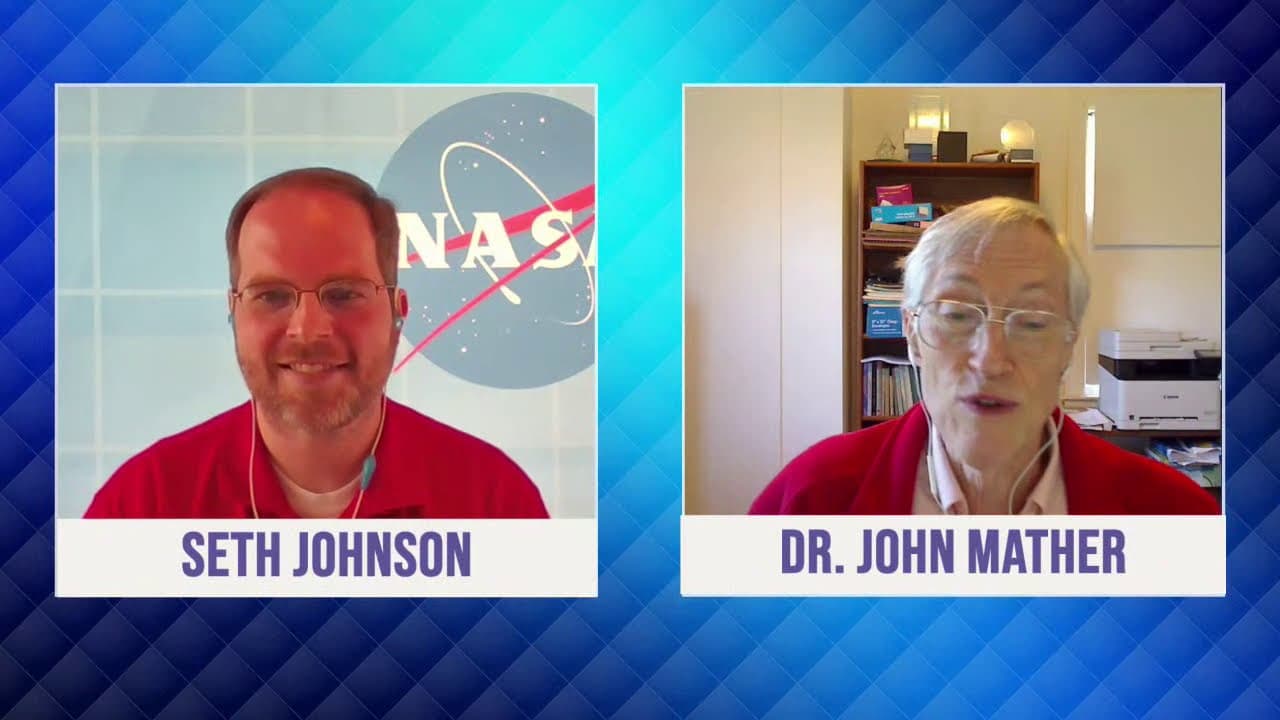
Dr. John Mather discusses his background and the James Webb Telescope, which aims to extend the discoveries of the Hubble Space Telescope by observing the distant universe in infrared light.
Transcript
stem fans are you ready let's hear it for the world class NASA stem Stars team from NASA centers across the country we present Dr John [Applause] mether hello and welcome everyone to this episode of NASA stem Stars where we connect with different NASA Personnel from across the agency and from a wide variety of career fields to discuss how their int... Read More
Key Insights
- 🙂 The James Webb Telescope aims to extend the discoveries of the Hubble Space Telescope by observing the universe in infrared light.
- 🇬🇫 The telescope will be launched in October 2021 from French Guiana and will orbit around a point called L2, approximately a million miles from Earth.
- 🙂 Its larger size allows it to collect more light and observe fainter and more distant objects, while its ability to observe infrared light enables it to study star formation and search for potentially habitable exoplanets.
- 👾 The telescope will unfold and adjust itself in space, ensuring optimal performance and the ability to capture detailed images of the universe.
- 💦 Dr. John Mather received the Nobel Prize in Physics for his work on the Cosmic Microwave Background, which provided evidence for the Big Bang theory.
- 💁 The James Webb Telescope will provide new insights into the history and formation of the universe, from the Big Bang to the formation of stars, galaxies, and planets.
- 🔭 The telescope's mission will be operated by the Space Telescope Science Institute in Baltimore, Maryland, and astronomers will soon have the opportunity to submit proposals to utilize the telescope for their research.
Install to Summarize YouTube Videos and Get Transcripts
Explore YouTube Video Summarizer or Get YouTube Transcript Extractor
Questions & Answers
Q: How did Dr. Mather become involved in the field of satellite and space telescope projects?
Dr. Mather's interest in astronomy and electronics led him to pursue a career in the field. He got involved in a project to measure the cosmic background radiation, which eventually led him to NASA.
Q: Why is the James Webb Telescope larger than the Hubble Space Telescope?
The James Webb Telescope needs to observe fainter and longer-wavelength light from more distant objects. Its larger size allows it to collect more light and observe the universe further back in time.
Q: How will the James Webb Telescope be launched when it is larger than any rocket?
The telescope will be folded up and then unfolded after launch. It will be launched from French Guiana using a rocket provided by the European space agency.
Q: Will the James Webb Telescope be able to adjust and align itself in space?
Yes, the telescope has motors on its mirrors that allow it to adjust and align itself if needed. It has redundancy systems and control mechanisms to ensure optimal performance.
Summary & Key Takeaways
-
Dr. John Mather shares his journey from being a kid fascinated with astronomy and electronics to becoming the senior project scientist for the James Webb Telescope.
-
The James Webb Telescope aims to observe the most distant objects in the universe, studying the formation of stars, galaxies, and planets, as well as searching for potential Earth-like exoplanets.
-
The telescope is larger and designed to observe infrared light, which allows it to see further back in time and penetrate dust clouds to observe star formation.
Read in Other Languages (beta)
Share This Summary 📚
Summarize YouTube Videos and Get Video Transcripts with 1-Click
Try YouTube Summary with ChatGPT & Claude or YouTube Transcript Generator
Explore More Summaries from NASA STEM 📚



Summarize YouTube Videos and Get Video Transcripts with 1-Click
Try YouTube Summary with ChatGPT & Claude or YouTube Transcript Generator