What is Acute Coronary Syndrome and Its Types?
TL;DR
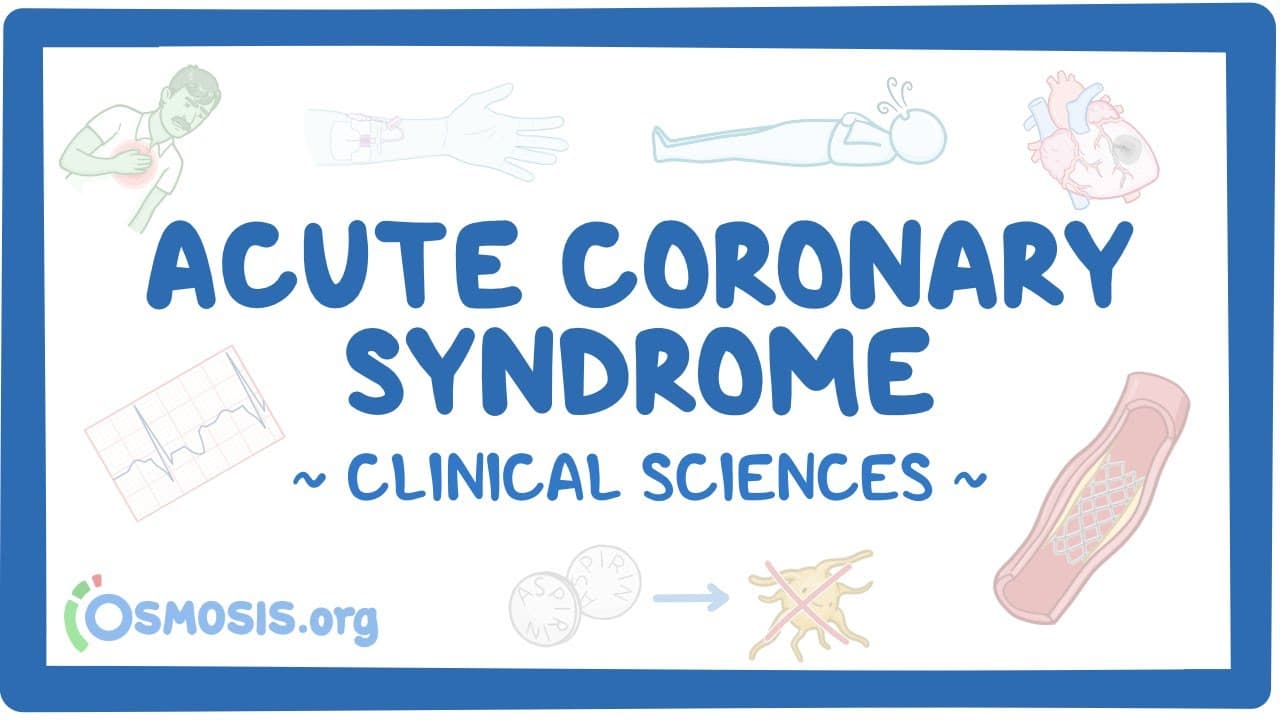
Acute coronary syndrome (ACS) is a life-threatening condition characterized by reduced blood flow to the heart, manifesting as STEMI, NSTEMI, or unstable angina. Key symptoms include chest pain that worsens with exertion and is unrelieved by rest. Initial treatment involves prompt medical management and assessment to guide further interventions, especially for STEMI where rapid reperfusion is essential.
Transcript
foreign coronary syndrome or ACS is one of the can't miss diagnoses that must be ruled out when a patient presents with acute chest pain ACS is caused by sudden decreased coronary blood flow also known as cardiac ischemia the three types are St elevation myocardial infarction or stemi non-st elevation myocardial infarction or nstemi an unst... Read More
Key Insights
- Acute coronary syndrome (ACS) is a critical condition that must be ruled out in patients presenting with acute chest pain, caused by sudden decreased coronary blood flow.
- ACS is categorized into three types: ST elevation myocardial infarction (STEMI), non-ST elevation myocardial infarction (NSTEMI), and unstable angina, with the latter two collectively known as non-ST elevation ACS (NSTEACS).
- Initial assessment of a patient with chest pain involves a focused history, physical examination, and a 12-lead ECG, which should be obtained promptly within 10 minutes of hospital arrival.
- Ischemic chest pain typically worsens with exertion, is not relieved by rest, and does not change with body positioning, often radiating to other parts of the body.
- Initial management of ACS includes MONA: Morphine, Oxygen, Nitrates, and Aspirin, followed by a high-intensity statin and a beta-blocker to stabilize the patient and reduce myocardial oxygen demand.
- For STEMI, rapid reperfusion therapy is crucial, with percutaneous coronary intervention (PCI) as the preferred treatment within 90 minutes of first medical contact, or fibrinolytics if PCI is unavailable.
- NSTEMI and unstable angina require differentiation by measuring troponin levels, followed by appropriate medical therapy, risk stratification, and possible coronary angiography.
- Serial ECG and troponin assessments are important when initial findings are non-diagnostic, with stress testing as a final step to rule out ACS if necessary.
Install to Summarize YouTube Videos and Get Transcripts
Explore YouTube Video Summarizer or Get YouTube Transcript Extractor
Questions & Answers
Q: What is the first step in assessing a patient with suspected ACS?
The first step in assessing a patient with suspected acute coronary syndrome (ACS) is to conduct an initial assessment, which includes a focused history and physical examination (H&P) along with obtaining a 12-lead ECG. This ECG should be performed promptly within 10 minutes of the patient's arrival at the hospital to ensure timely diagnosis and management.
Q: What are the typical symptoms of ischemic chest pain in ACS?
Ischemic chest pain in acute coronary syndrome (ACS) typically worsens with exertion, is not relieved by rest, and does not change with body positioning. Patients may describe the pain as discomfort, pressure, tightness, or a burning sensation. It often radiates to other parts of the body, such as the epigastrium, left shoulder and arm, neck, and lower jaw.
Q: What is the role of MONA in the management of ACS?
MONA is an acronym used in the initial management of acute coronary syndrome (ACS), standing for Morphine, Oxygen, Nitrates, and Aspirin. Morphine is administered intravenously to manage pain, oxygen is given to maintain saturation above 90%, nitrates are used for vasodilation to improve myocardial blood flow, and aspirin is given for its anti-platelet properties to prevent thrombosis.
Q: How is STEMI diagnosed and managed?
ST elevation myocardial infarction (STEMI) is diagnosed by the presence of ST segment elevation in two contiguous leads on an ECG. Management focuses on rapid reperfusion therapy to limit myocardial necrosis. The preferred treatment is percutaneous coronary intervention (PCI) within 90 minutes of first medical contact. If PCI is unavailable, fibrinolytics may be administered, provided there are no contraindications.
Q: What differentiates NSTEMI from unstable angina?
NSTEMI and unstable angina are differentiated by measuring troponin levels. In NSTEMI, there is an elevation in troponin indicating myocardial infarction, whereas in unstable angina, the ischemia is not severe enough to cause infarction, so troponin levels remain normal. Both conditions require medical therapy, but NSTEMI may need more urgent intervention based on risk assessment.
Q: What is the significance of serial ECG and troponin assessments?
Serial ECG and troponin assessments are crucial when the initial findings are non-diagnostic but there is still concern for acute coronary syndrome (ACS) based on history and physical examination. These assessments help detect any changes over time that may indicate ACS. If serial ECGs and troponin remain negative, non-invasive stress testing is performed as a final step to rule out ACS.
Q: When is PCI preferred over fibrinolytics in STEMI management?
In the management of ST elevation myocardial infarction (STEMI), percutaneous coronary intervention (PCI) is preferred over fibrinolytics when it can be performed within 90 minutes of the patient's first medical contact. PCI is the treatment of choice because it directly opens the blocked coronary artery, providing rapid reperfusion and reducing the risk of further myocardial damage.
Q: How are patients with unstable angina risk stratified?
Patients with unstable angina undergo early risk stratification using clinical scores such as the Thrombosis and Myocardial Infarction (TIMI) score or the Global Registry of Acute Coronary Events (GRACE) score. High-risk patients are typically recommended for coronary angiography within 24 hours, while low-risk patients may undergo non-invasive stress testing to guide further management.
Summary & Key Takeaways
-
Acute coronary syndrome (ACS) is a critical diagnosis for patients with acute chest pain, caused by sudden decreased coronary blood flow. It includes STEMI, NSTEMI, and unstable angina. Initial assessment involves history, physical exam, and ECG. Management includes MONA, statins, beta-blockers, and rapid reperfusion therapy for STEMI.
-
ACS presents with chest pain that worsens with exertion and does not change with rest or positioning. Initial management includes morphine, oxygen, nitrates, and aspirin, followed by statins and beta-blockers. STEMI requires rapid reperfusion therapy, while NSTEMI and unstable angina are differentiated by troponin levels.
-
For STEMI, rapid reperfusion therapy is critical, with PCI preferred within 90 minutes of medical contact. NSTEMI and unstable angina require troponin measurement, risk stratification, and possible coronary angiography. Serial ECG and troponin assessments are needed when initial findings are non-diagnostic, with stress testing as a final rule-out step.
Read in Other Languages (beta)
Share This Summary 📚
Summarize YouTube Videos and Get Video Transcripts with 1-Click
Try YouTube Summary with ChatGPT & Claude or YouTube Transcript Generator
Explore More Summaries from Osmosis from Elsevier 📚





Summarize YouTube Videos and Get Video Transcripts with 1-Click
Try YouTube Summary with ChatGPT & Claude or YouTube Transcript Generator