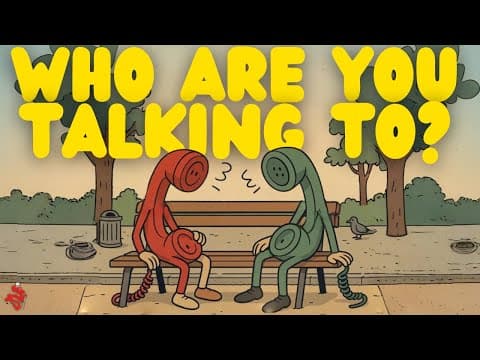
Who Is The Mind Talking To? (It's so simple, you will laugh.)

TL;DR
Meditation reveals the illusion of a separate self.
Transcript
There’s this fascinating thing about meditation: even when your thoughts slow to a trickle or vanish completely, something still lingers. This sense of "me." But what is that “me”? Is it real? The mind, clever and limited as it is, tries to make sense of something infinite—this awareness we all are. It’s like seeing a refl... Read More
Key Insights
- Meditation uncovers the persistent illusion of the 'me,' which is not the full story of our existence.
- The mind creates an identity through a narrative of thoughts, feelings, and memories, crafting a sense of self.
- The 'me' is a construct of the mind, dissolving when scrutinized, revealing pure awareness as our true nature.
- Our true self is the witnessing presence, the awareness within which all experiences occur, not the thoughts or feelings themselves.
- The mind perpetuates the illusion of a separate self by talking to itself, creating an internal dialogue with no real entity behind it.
- The ego is a master of disguise, adopting various roles, but the true self is the unchanging awareness observing these roles.
- By shifting focus to the pure awareness, we see through the mind's illusion of separateness and recognize our limitless self.
- The practice of questioning 'Who is the mind talking to?' helps dissolve the identification with a limited self and reveals the silent witness.
Install to Summarize YouTube Videos and Get Transcripts
Explore YouTube Video Summarizer or Get YouTube Transcript Extractor
Questions & Answers
Q: What is the main insight about the 'me' in meditation?
The main insight is that the 'me' is an illusion created by the mind through a narrative of thoughts and feelings. This 'me' seems solid and real but is actually a construct that dissolves upon close examination, revealing the true self as the witnessing presence.
Q: How does the mind create an illusion of a separate self?
The mind creates an illusion of a separate self by crafting a narrative composed of thoughts, feelings, and memories. This narrative weaves together an identity that feels separate and solid, but upon scrutiny, it dissolves, revealing that there is no real entity behind the mind's dialogue.
Q: What role does the ego play in the mind's narrative?
The ego plays the role of a master of disguise in the mind's narrative, constantly changing roles depending on circumstances. It can be a perfectionist or a victim, but these roles are not the true self. The true self is the stable, unchanging awareness that observes these roles without attachment.
Q: What is meant by 'pure awareness' in the context of this content?
Pure awareness refers to the constant, unchanging presence that witnesses all experiences. It is the true essence of who we are, beyond thoughts, emotions, and the body. This awareness is effortless and does not judge or interfere; it simply observes everything that arises and falls away.
Q: How can one practice recognizing the true self beyond the mind's narrative?
One can practice recognizing the true self by questioning the mind's narrative, such as asking 'Who is the mind talking to?' This inquiry helps shift attention from the mind's story of 'I' to the pure awareness itself, revealing the silent witness beyond the illusion of a separate self.
Q: What happens when we shift focus from the mind's story to pure awareness?
When we shift focus from the mind's story to pure awareness, we begin to see through the illusion of a limited self. The identification with the mind dissolves, and we recognize our true essence as the witnessing presence, leading to a sense of freedom and peace beyond mental chatter.
Q: Why is the mind unable to understand pure awareness?
The mind is unable to understand pure awareness because awareness is not a concept; it is the very thing that allows concepts to exist. The mind tries to interpret this vast awareness through its own lens, creating a limited, separate sense of self, but awareness itself is infinite and indescribable.
Q: What is the significance of the question 'Who is the mind talking to?'
The question 'Who is the mind talking to?' is significant as it reveals that the mind is talking to itself, creating an illusion of a conversational partner. This inquiry helps expose the mind's layers as ephemeral movements within witnessing, dissolving the identification with a separate self and revealing the true, silent witness.
Summary & Key Takeaways
-
Meditation reveals the illusion of the 'me,' a construct of thoughts and feelings that is not our true self. By questioning this 'me' and shifting focus to the awareness that observes, we uncover the limitless self beyond the mind's narrative.
-
The mind creates an ongoing narrative, crafting a sense of identity that feels separate and solid. However, upon close examination, this 'me' dissolves, revealing that our true nature is the witnessing presence, untouched by thoughts and emotions.
-
By recognizing that the mind talks to itself, creating an illusion of a separate self, we shift our attention to the pure awareness within. This practice helps dissolve the identification with the mind, revealing the silent witness as our true essence.
Read in Other Languages (beta)
Share This Summary 📚
Summarize YouTube Videos and Get Video Transcripts with 1-Click
Try YouTube Summary with ChatGPT & Claude or YouTube Transcript Generator
Explore More Summaries from SnakeSpeak 📚



Summarize YouTube Videos and Get Video Transcripts with 1-Click
Try YouTube Summary with ChatGPT & Claude or YouTube Transcript Generator