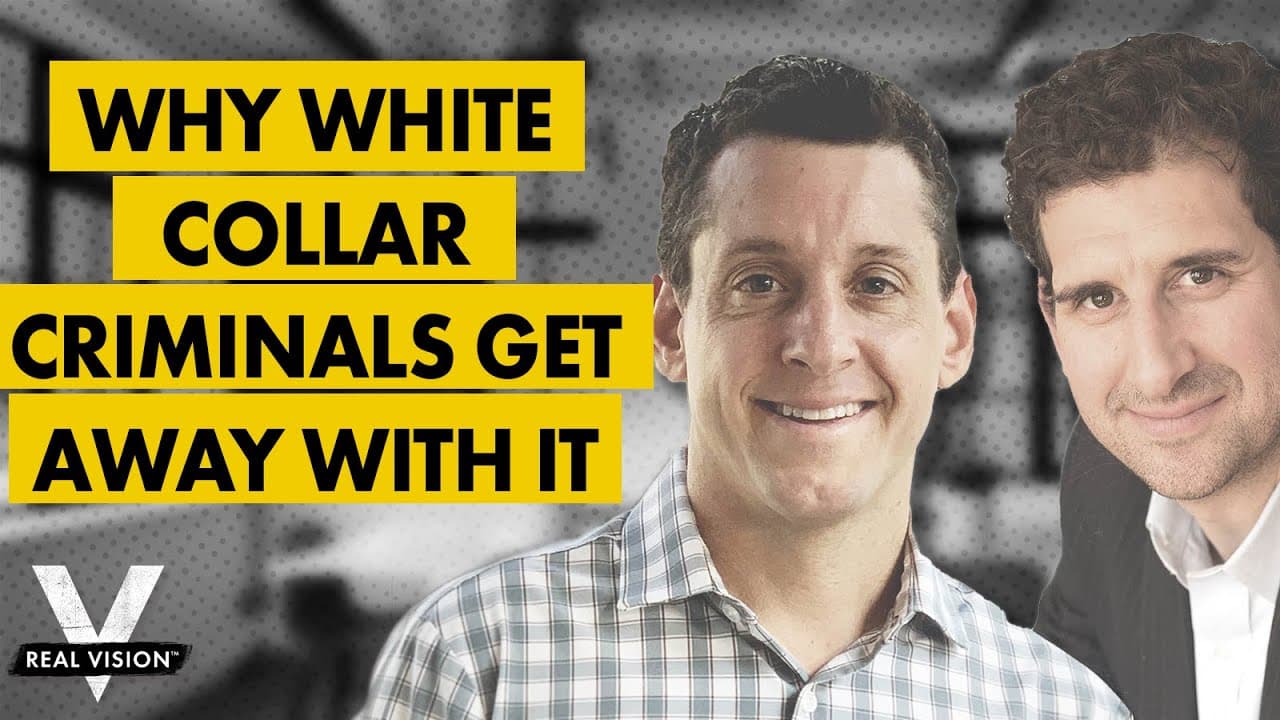
Why White Collar Criminals Get Away With It (w/Jesse Eisinger and Quinton Mathews)
TL;DR
The United States rarely prosecutes white-collar criminals, leaving shareholders to foot the bill, according to Jesse Eisinger's book, The Chickenshit Club.
Transcript
QUINTON MATHEWS: Hello, Real Vision. My name is Quinton Mathews, I am the managing member of QKM, an in-depth investigative research firm and today, I have the pleasure of speaking with Jesse Eisinger. Jesse is the author of The Chickenshit Club: Why the Justice Department Fails to Prosecute Executives. His book is a history lesson into w... Read More
Key Insights
- 🤍 The lack of white-collar crime prosecutions in the United States has led to a white-collar prosecution crisis, with crimes going unpunished in various sectors.
- 🖤 Government agencies responsible for prosecuting white-collar crimes, such as the Department of Justice and the SEC, have been criticized for their ineffectiveness and lack of focus on individuals.
Install to Summarize YouTube Videos and Get Transcripts
Explore YouTube Video Summarizer or Get YouTube Transcript Extractor
Questions & Answers
Q: Why does the United States rarely prosecute white-collar criminals?
According to Eisinger, the lack of prosecutions can be attributed to a combination of factors, including a fear of destabilizing the markets, a backlash from the white-collar defense bar, and a shift towards settlements with corporations instead of prosecuting individuals.
Q: What were some of the key cases of white-collar crime prosecution in the past?
Eisinger highlights cases such as the prosecutions of executives involved in the S&L crisis, the junk bond crisis, and the Enron scandal as examples of successful prosecutions in the past.
Q: How has the Department of Justice's approach to prosecuting white-collar crimes changed over time?
The Department of Justice's approach shifted from prosecuting individuals and bringing corporations to trial to focusing on settlements with corporations. This change was influenced by backlash from the white-collar defense bar and a belief that prosecuting corporations could have collateral consequences.
Q: How can the problem of white-collar crime prosecution be addressed?
To address the issue, Eisinger suggests investing in government agencies responsible for prosecution, recruiting a diverse range of prosecutors, reorienting towards prosecuting individuals rather than settling with corporations, and restoring powers to regulatory bodies through legislation.
Summary & Key Takeaways
-
Eisinger's book explores the history of white-collar crime prosecution in the United States, highlighting a cycle of boom, bust, and crackdowns.
-
The book argues that the 2008 financial crisis marked a turning point, where the government moved away from prosecuting executives and instead focused on settlements with corporations.
-
The lack of prosecutions has led to a white-collar prosecution crisis, with crimes in sectors like commercial real estate, taxation, and corporate lobbying going unpunished.
Read in Other Languages (beta)
Share This Summary 📚
Summarize YouTube Videos and Get Video Transcripts with 1-Click
Try YouTube Summary with ChatGPT & Claude or YouTube Transcript Generator
Explore More Summaries from Real Vision 📚



Summarize YouTube Videos and Get Video Transcripts with 1-Click
Try YouTube Summary with ChatGPT & Claude or YouTube Transcript Generator