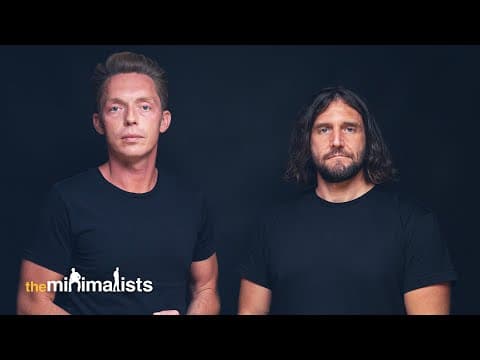
Ep. 257 | Battle Ready (with Erwin and Aaron McManus of @MOSAICLosAngeles)

TL;DR
Exploring minimalism's intersection with spirituality and personal growth.
Transcript
this episode of the minimalist is brought to you by nobody because advertisements suck non-minimalists hello everybody welcome to the minimalist podcast we discuss what it means to live a meaningful life with less my name is joshua fields milburn ryan nicodemus is on vacation today so i'm here with erwin mcmanus and aaron mcmanus our returning cham... Read More
Key Insights
- The podcast 'Battle Ready' by Erwin and Aaron McManus explores life challenges, not just leadership or parenting, as initially perceived.
- Minimalism is more about intentional living than simply reducing possessions, focusing on what truly adds value to life.
- The concept of 'free' is misleading; everything has a cost, whether it's time, attention, or another resource.
- Religion and faith are distinct; religion is often seen as a set of rules or a structure, while faith is a personal, internal journey.
- Letting go of material items or beliefs requires loosening one's grip and understanding the underlying reasons for holding on.
- Contentment is found not in material wealth but in freedom and the ability to live according to one's values.
- Pleasure should not be confused with true contentment or joy, which are deeper and more enduring states.
- Relationships, whether with people or things, should be based on love and intentionality rather than obligation or guilt.
Install to Summarize YouTube Videos and Get Transcripts
Explore YouTube Video Summarizer or Get YouTube Transcript Extractor
Questions & Answers
Q: How do I responsibly let go of expensive items that can't be reused by others?
Letting go of expensive items involves recognizing their purpose and value in your life. If they no longer serve you, consider donating them to a charity that can use them, recycling them responsibly, or finding a creative way to repurpose them. Understand that holding onto them out of guilt or obligation does not contribute to your well-being.
Q: Is anything actually ‘free’?
Nothing is truly free. Even items received without a monetary cost often require an exchange of time, attention, or other resources. It's essential to evaluate whether the cost of these resources is worth the perceived benefit of the 'free' item and to be mindful of what you're actually giving up in the process.
Q: How compatible are minimalist and Buddhist practices?
Minimalist and Buddhist practices share similarities, such as focusing on reducing attachment to material possessions and finding contentment within. Both encourage living intentionally and mindfully, emphasizing the importance of inner peace over external accumulation. However, minimalism doesn't inherently require a spiritual component, making it adaptable to various belief systems.
Q: I recently let go of religion, but I don’t know what to cling to next.
Rather than seeking something new to cling to, consider exploring your internal values and beliefs. Focus on personal growth, self-awareness, and what brings you genuine joy and fulfillment. This journey can lead to a more profound understanding of yourself and what you truly need to thrive.
Q: What is the difference between religion and faith?
Religion often involves a structured set of beliefs and practices, sometimes imposed by external institutions. Faith, on the other hand, is a personal, internal journey that reflects one's relationship with the divine or the universe. It is more about personal belief and less about following prescribed rituals or doctrines.
Q: How can I find contentment without relying on material possessions?
Contentment comes from understanding and living according to your values, fostering relationships, and finding joy in experiences rather than possessions. Practice gratitude for what you have and focus on personal growth, meaningful connections, and contributing positively to the world around you.
Q: What role does pleasure play in a minimalist lifestyle?
Pleasure is not inherently negative, but it should not overshadow the pursuit of lasting contentment or joy. Minimalism encourages finding joy in simple, meaningful experiences rather than temporary pleasures that may lead to excess or distraction from what truly matters.
Q: How can I balance freedom with financial stability?
True freedom involves living within your means while pursuing what genuinely fulfills you. Financial stability is essential, but it should not come at the cost of your values or happiness. Prioritize spending on experiences and items that align with your goals and contribute to a balanced, intentional life.
Summary & Key Takeaways
-
Joshua Fields Milburn discusses minimalism with Erwin and Aaron McManus, focusing on how minimalism intersects with spirituality and personal growth. They explore the idea that possessions and beliefs should be intentional and add value to one's life.
-
The conversation delves into the differences between religion and faith, emphasizing that faith is a personal journey, while religion often involves external structures. They argue that true freedom and contentment come from within, not from material wealth.
-
The podcast also addresses the misconception of 'free' items, highlighting that everything has a cost, whether it's time, attention, or another resource. They advocate for living intentionally and prioritizing what truly matters in life.
Read in Other Languages (beta)
Share This Summary 📚
Summarize YouTube Videos and Get Video Transcripts with 1-Click
Try YouTube Summary with ChatGPT & Claude or YouTube Transcript Generator
Explore More Summaries from The Minimalists Podcast 📚




Summarize YouTube Videos and Get Video Transcripts with 1-Click
Try YouTube Summary with ChatGPT & Claude or YouTube Transcript Generator