What Is High-Frequency Trading and How Does It Impact Markets?
TL;DR
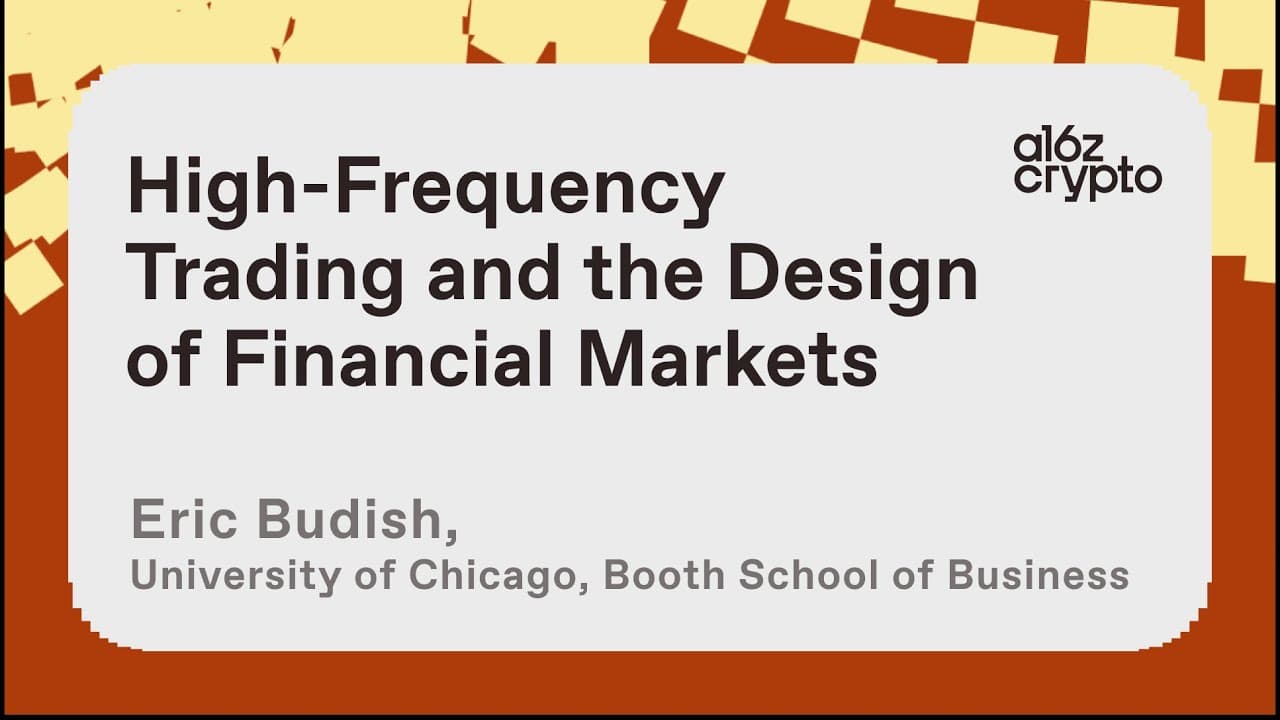
High-frequency trading has accelerated an arms race for trading speed, allowing firms to reap riskless arbitrage profits from publicly available information. This phenomenon arises from the continuous limit order book design, which can be improved by frequent batch auctions that process trades in discrete intervals, thereby reducing the advantages of speed.
Transcript
all right welcome everyone let's go ahead and get started to today's uh a16z crypto research seminar very happy to introduce Eric boodish who's a professor in the business school booth at University of Chicago um Eric's a super well-known Market designer he's worked in a lot of different application domains and matching markets financial markets wh... Read More
Key Insights
- 🐎 High-frequency trading has led to an arms race for trading speed, resulting in significant investments and riskless arbitrage profits.
- 💁 The continuous limit order book market design creates riskless arbitrage profits from symmetric public information, which challenges the efficient markets hypothesis.
- ✋ Frequent batch auctions offer a potential solution to the issues caused by high-frequency trading by treating time as discrete and processing trades in batches using an auction.
- 🎨 The adoption of frequent batch auctions by financial exchanges is influenced by private incentives, and the current market design favors selling speed technology over better market designs.
Install to Summarize YouTube Videos and Get Transcripts
Explore YouTube Video Summarizer or Get YouTube Transcript Extractor
Questions & Answers
Q: What is the efficient markets hypothesis, and how does it relate to high-frequency trading?
The efficient markets hypothesis states that prices in a market fully reflect all available information. High-frequency trading challenges this hypothesis, as it has led to riskless arbitrage profits from public symmetric information, contradicting the idea of fully reflecting information in prices.
Q: How does the arms race for trading speed impact the liquidity of financial markets?
The arms race for trading speed harms liquidity by creating a tax on liquidity. This is due to the riskless arbitrage profits earned through speed advantage, which discourage market makers from providing liquidity and increase trading costs for other market participants.
Q: What is the impact of high-frequency trading on market predictability?
High-frequency trading has shown that short-term asset prices are predictable, contradicting the consensus in the profession that short-run efficient markets theory works very well. This predictability is attributed to the exploitation of inefficiencies in financial markets through high-speed trading strategies.
Q: How do frequent batch auctions address the issues caused by high-frequency trading?
Frequent batch auctions offer a market design solution to the issues caused by high-frequency trading. By treating time as discrete and processing trades in batches using an auction, it reduces the economic relevance of tiny speed advantages and shifts competition from speed to price.
Summary & Key Takeaways
-
High-frequency trading has led to an arms race for trading speed, with firms investing significant amounts of money to gain even the slightest advantage.
-
The continuous limit order book market design, which treats time as continuous and processes trades serially, has led to riskless arbitrage profits from symmetric public information.
-
Frequent batch auctions, which treat time as discrete and process trades in batches using an auction, have been proposed as a potential solution to the issues caused by high-frequency trading.
Read in Other Languages (beta)
Share This Summary 📚
Summarize YouTube Videos and Get Video Transcripts with 1-Click
Try YouTube Summary with ChatGPT & Claude or YouTube Transcript Generator
Explore More Summaries from a16z crypto 📚



Summarize YouTube Videos and Get Video Transcripts with 1-Click
Try YouTube Summary with ChatGPT & Claude or YouTube Transcript Generator