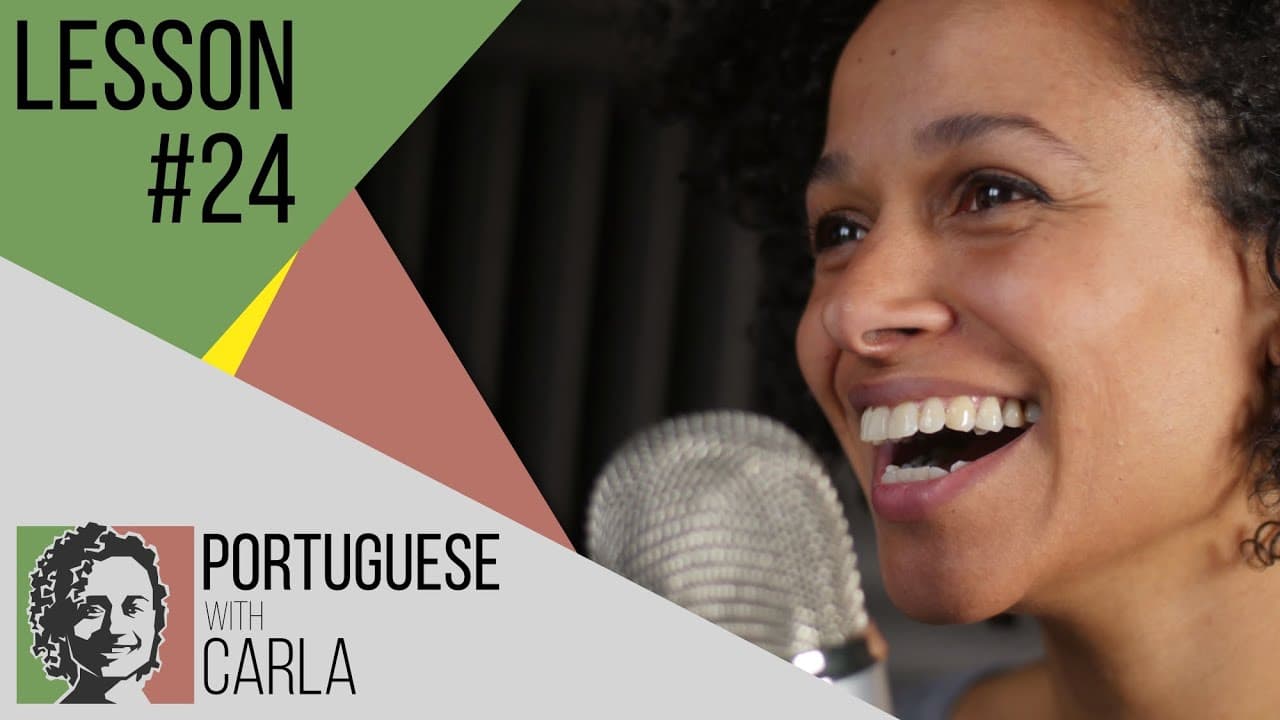
Lesson 24 - European Portuguese lesson on traditional sandwiches...kind of!
TL;DR
Learn European Portuguese grammar and sandwich culture.
Transcript
e welcome to another podcast podcast V Portuguese with kala podcast 24 my name is Cara and Yu Mar yes the hubby yes it's interesting my name does have a little diacritic m a DI just explain yes okay m a r l o n and yet most Portuguese call me Maron even I do yes but what should they say it should be Maron whatever which sounds better anyway anyway ... Read More
Key Insights
- The podcast discusses European Portuguese grammar, focusing on pronunciation and common language idiosyncrasies.
- Hosts Carla and Marlon introduce a special guest, Natalie, who participates in a role-play scenario on an airplane.
- The conversation includes practical examples of Portuguese phrases, emphasizing pronunciation and colloquial usage.
- Listeners are introduced to traditional Portuguese sandwiches such as 'bifana' and 'sandes mistas'.
- The hosts explain the difference between formal and colloquial language, with examples of phonetic spelling for learners.
- The episode highlights the importance of repetition in language learning and offers practical tips for effective practice.
- Listeners are encouraged to use flashcards and the Quizlet app for vocabulary retention.
- The podcast provides cultural insights, including the popularity of certain sandwiches in Portugal and their availability at fast-food chains.
Install to Summarize YouTube Videos and Get Transcripts
Explore YouTube Video Summarizer or Get YouTube Transcript Extractor
Questions & Answers
Q: What is the significance of phonetic spelling in learning Portuguese?
Phonetic spelling is significant in learning Portuguese as it helps learners accurately pronounce words that might be difficult to read or remember. By writing words phonetically, learners can better associate the sounds with the written form, making it easier to recall and use them in conversation. This method is particularly useful for beginners who may struggle with the nuances of Portuguese pronunciation.
Q: Who is the special guest in this podcast episode, and what role do they play?
The special guest in this podcast episode is Natalie, who is the girlfriend of Carla's brother. She participates in a role-play scenario on an airplane, where she plays the role of a stewardess. Despite having a husky voice due to illness, she contributes to the dialogue by interacting with Marlon and Carla, helping to demonstrate conversational Portuguese in a practical setting.
Q: What traditional Portuguese sandwich is discussed in the podcast?
The podcast discusses the traditional Portuguese sandwich known as 'bifana', which is a pork steak sandwich. This sandwich is so popular in Portugal that even McDonald's has adopted a version called the 'McBifana'. The hosts describe the 'bifana' as a must-try delicacy, highlighting its significance in Portuguese culinary culture.
Q: How does the podcast address the use of repetition in language learning?
The podcast addresses the use of repetition in language learning by emphasizing its importance and providing practical tips for effective practice. The hosts discuss how repetition can be both beneficial and time-wasting if not done correctly. They suggest using tools like flashcards and the Quizlet app to reinforce vocabulary and grammar, ensuring that learners retain the information they study.
Q: What cultural insights about Portugal are shared in the episode?
The episode shares cultural insights about Portugal, particularly focusing on its culinary traditions. The hosts discuss the popularity of certain sandwiches, such as the 'bifana' and 'sandes mistas', and their availability at fast-food chains like McDonald's. These discussions provide listeners with a glimpse into Portuguese food culture and its integration into everyday life.
Q: What role does the imperfect past tense play in Portuguese, according to the podcast?
According to the podcast, the imperfect past tense in Portuguese is used to describe continuous or habitual actions in the past. It is equivalent to the English past continuous tense, such as 'was doing' or 'used to do'. The hosts explain how this tense is often used colloquially in place of the conditional tense, illustrating its flexibility and importance in conversational Portuguese.
Q: What is the purpose of the role-play scenario in the podcast?
The purpose of the role-play scenario in the podcast is to provide a practical example of conversational Portuguese in a real-life setting. By acting out a scene on an airplane, the hosts and guest demonstrate how to use Portuguese phrases and vocabulary in context, helping listeners understand the language's application in everyday situations. This approach aids in reinforcing language learning through immersive practice.
Q: How does the podcast help learners with Portuguese pronunciation?
The podcast helps learners with Portuguese pronunciation by providing phonetic spellings of words and phrases, allowing listeners to focus on the correct sounds. The hosts emphasize the importance of listening and repeating, offering tips on how to overcome common pronunciation challenges. By breaking down words and explaining their sounds, the podcast serves as a valuable resource for mastering Portuguese pronunciation.
Summary & Key Takeaways
-
In this episode, Carla and Marlon discuss European Portuguese grammar, focusing on pronunciation and colloquial usage. They introduce a special guest, Natalie, who participates in a role-play scenario on an airplane. The conversation includes practical examples of Portuguese phrases and emphasizes phonetic spelling for language learners.
-
Listeners are introduced to traditional Portuguese sandwiches, such as 'bifana' and 'sandes mistas'. The hosts explain the importance of repetition in language learning and offer practical tips for effective practice. They encourage the use of flashcards and the Quizlet app for vocabulary retention.
-
The podcast provides cultural insights, including the popularity of certain sandwiches in Portugal and their availability at fast-food chains like McDonald's. It also highlights the difference between formal and colloquial language, with examples to aid learners in understanding and pronunciation.
Read in Other Languages (beta)
Share This Summary 📚
Summarize YouTube Videos and Get Video Transcripts with 1-Click
Try YouTube Summary with ChatGPT & Claude or YouTube Transcript Generator
Explore More Summaries from Portuguese With Carla 📚

Summarize YouTube Videos and Get Video Transcripts with 1-Click
Try YouTube Summary with ChatGPT & Claude or YouTube Transcript Generator