How to Solve a 3x3 Linear System Using Kramer's Rule
TL;DR
To solve a 3x3 linear system with Kramer's Rule, calculate the determinants of the coefficient matrix and modified matrices for each variable. The solution can be found by dividing the determinant of the modified matrix by the determinant of the coefficient matrix, yielding the values for x, y, and z.
Transcript
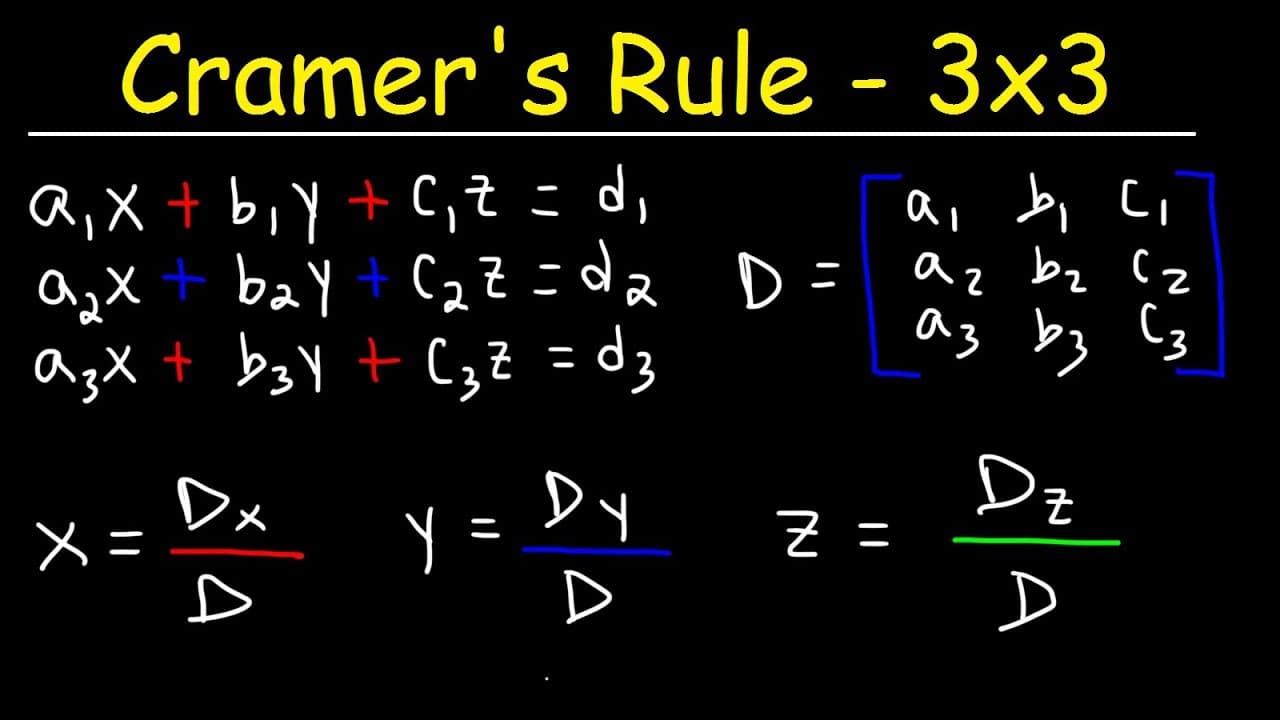
in this tutorial we're going to use kramer's rule to solve a system of linear equations with three variables so let's say we have two x plus y minus z and that's equal to one and also three x plus 2y plus 2z and that's going to be equal to 13. and then 4x minus 2y plus 3z let's say that's equal to 9. now this equation is in this form so it's a one ... Read More
Key Insights
- ❓ Kramer's Rule involves calculating determinants to solve systems of linear equations with three variables.
- 😃 The coefficients of the equations are represented by variables a, b, c, and d.
- 😵 By calculating the determinants of dx, dy, dz, and d, the solution for x, y, and z can be found.
- ❓ The solution provides the values that satisfy all equations in the system.
- ❓ The process involves evaluating determinants of 3x3 matrices and using them to find the solution.
- 🤪 The coefficients of x, y, and z in the equations are replaced by the corresponding determinants for calculations.
- 😄 The determinant of the coefficient matrix is denoted as d and is crucial for solving the system.
- 🤪 The values of dx, dy, and dz are obtained by replacing the coefficients of x, y, and z with the values from d1, d2, and d3.
Install to Summarize YouTube Videos and Get Transcripts
Explore YouTube Video Summarizer or Get YouTube Transcript Extractor
Questions & Answers
Q: What is Kramer's Rule used for?
Kramer's Rule is a method used to solve systems of linear equations with three variables by finding the determinants of the coefficient matrices.
Q: How do you calculate the determinant of a 3x3 matrix?
To calculate the determinant of a 3x3 matrix, you use the formula: (a1 * b2 * c3) + (a2 * b3 * c1) + (a3 * b1 * c2) - (c1 * b2 * a3) - (c2 * b3 * a1) - (c3 * b1 * a2).
Q: What do dx, dy, dz, and d represent in Kramer's Rule?
dx, dy, and dz are the determinants calculated by replacing the coefficients of x, y, and z with the values from d1, d2, and d3. d represents the determinant of the coefficient matrix.
Q: What does the solution to the system of equations represent?
The solution represents the values of x, y, and z that satisfy all equations in the system, providing a solution to the problem.
Summary & Key Takeaways
-
Kramer's Rule can be used to solve a system of linear equations with three variables.
-
The coefficients of the equations are represented by variables a, b, c, and d.
-
By calculating determinants, the values for dx, dy, dz, and d can be found, leading to the solution for x, y, and z.
Read in Other Languages (beta)
Share This Summary 📚
Summarize YouTube Videos and Get Video Transcripts with 1-Click
Try YouTube Summary with ChatGPT & Claude or YouTube Transcript Generator
Explore More Summaries from The Organic Chemistry Tutor 📚



Summarize YouTube Videos and Get Video Transcripts with 1-Click
Try YouTube Summary with ChatGPT & Claude or YouTube Transcript Generator