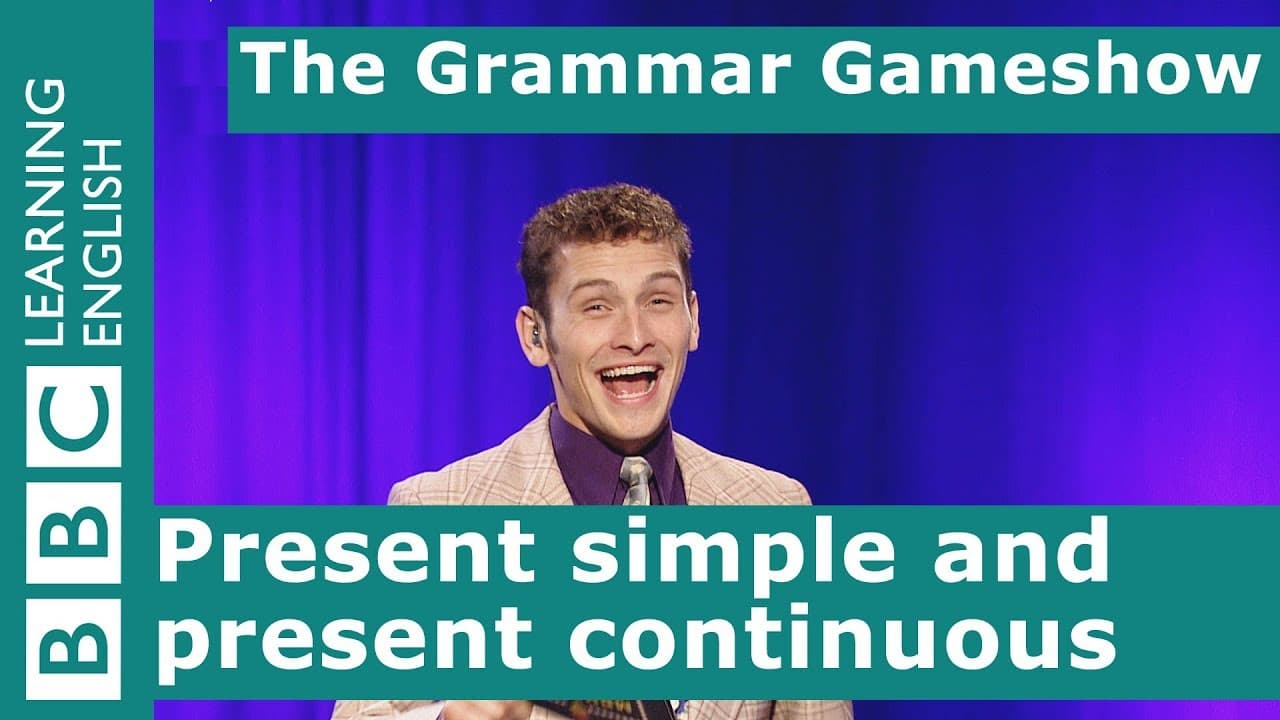
Present Simple and Present Continuous: The Grammar Gameshow Episode 1
TL;DR
Contestants compete on present simple and continuous tenses.
Transcript
Hello, and welcome to today's Grammar Gameshow I’m your host, Will – not going to! And, of course, let’s not forget Leslie, our all-knowing voice in the sky Hello, everyone! Tonight we’re going to ask three questions about… The present simple and present continuous tenses OK! Now, let’s meet our contestants! Hi, everyone. I’m Sarah! Contestant numb... Read More
Key Insights
- The present simple tense is used for habits, permanent situations, and truths, and is formed with an -s in the third person singular.
- The present continuous tense describes actions happening now or around now and is formed with 'be + ing'.
- Both present simple and present continuous can refer to future events; present continuous for arrangements and present simple for timetabled events.
- State verbs like 'need' cannot be used in continuous forms, even when describing current needs.
- The gameshow format engages contestants with quick-fire questions to distinguish between present simple and continuous tenses.
- Contestants Sarah and Jim compete, with Sarah eventually winning despite initially trailing behind Jim.
- The show incorporates humor and playful competition, enhancing the learning experience for viewers.
- The Grammar Gameshow encourages audience participation and learning through interactive questioning and immediate feedback.
Install to Summarize YouTube Videos and Get Transcripts
Explore YouTube Video Summarizer or Get YouTube Transcript Extractor
Questions & Answers
Q: What are the main uses of the present simple tense?
The present simple tense is primarily used for expressing habits, permanent situations, and universal truths. It is characterized by the use of an -s at the end of the verb in the third person singular form. Additionally, it employs 'do' or 'does' in forming questions and negatives.
Q: How is the present continuous tense formed and used?
The present continuous tense is formed using the auxiliary verb 'be' followed by the verb ending in -ing. It describes actions that are happening at the moment of speaking or around the current time. It can also be used to discuss future arrangements or plans.
Q: Can both present simple and continuous tenses refer to future events?
Yes, both tenses can refer to future events. The present continuous is used for future arrangements, such as meetings or plans, while the present simple is used for timetabled events, like flight schedules. This dual usage can sometimes confuse learners.
Q: What is a state verb and why can't it be used continuously?
State verbs describe conditions or situations that are generally static or unchanging, such as 'need', 'know', or 'believe'. These verbs cannot be used in continuous forms because they do not represent actions or processes that can be ongoing. For instance, 'I am needing' is incorrect; it should be 'I need'.
Q: How does the Grammar Gameshow format enhance learning?
The Grammar Gameshow uses a competitive quiz format to make learning engaging and interactive. Through quick-fire questions, true or false rounds, and humorous commentary, it encourages active participation and reinforces grammar concepts in a fun and memorable way.
Q: What was the outcome of the Grammar Gameshow episode?
In this episode, contestant Sarah emerged as the winner after initially trailing behind Jim. She correctly answered questions about the present simple and continuous tenses, earning enough points to win a humorous prize. The episode ended with a playful conclusion, maintaining the show's lighthearted tone.
Q: What role does humor play in the Grammar Gameshow?
Humor is integral to the Grammar Gameshow, making grammar learning enjoyable and less intimidating. The hosts' playful banter, exaggerated reactions, and humorous prizes create a relaxed atmosphere that encourages viewers to engage with the content and retain the grammar rules being taught.
Q: How does the show encourage audience participation?
The show invites viewers to play along at home, testing their knowledge with the contestants. By structuring the episode as a quiz, it encourages active engagement and self-assessment. The format, combined with immediate feedback from the hosts, helps reinforce learning and keeps the audience involved.
Summary & Key Takeaways
-
The Grammar Gameshow episode focuses on distinguishing between present simple and present continuous tenses. Contestants Sarah and Jim answer questions about the correct usage of these tenses, with Sarah emerging as the winner. The show uses humor and competition to make grammar learning engaging and interactive.
-
The present simple tense is used for habits, truths, and permanent situations, while the present continuous describes ongoing actions. Both tenses can refer to future events under certain conditions. State verbs like 'need' cannot be used in continuous forms, even if they describe current needs.
-
The episode is structured as a quiz show, with quick-fire questions and true or false rounds. Contestants earn points for correct answers, with Sarah winning a humorous prize. The show encourages viewers to test their grammar knowledge and participate actively in learning.
Read in Other Languages (beta)
Share This Summary 📚
Summarize YouTube Videos and Get Video Transcripts with 1-Click
Try YouTube Summary with ChatGPT & Claude or YouTube Transcript Generator
Explore More Summaries from BBC Learning English 📚
Summarize YouTube Videos and Get Video Transcripts with 1-Click
Try YouTube Summary with ChatGPT & Claude or YouTube Transcript Generator