Exam #3 Problem Solving
TL;DR
This content discusses the computation of eigenvalues and eigenvectors for projection, rotation, and reflection matrices.
Transcript
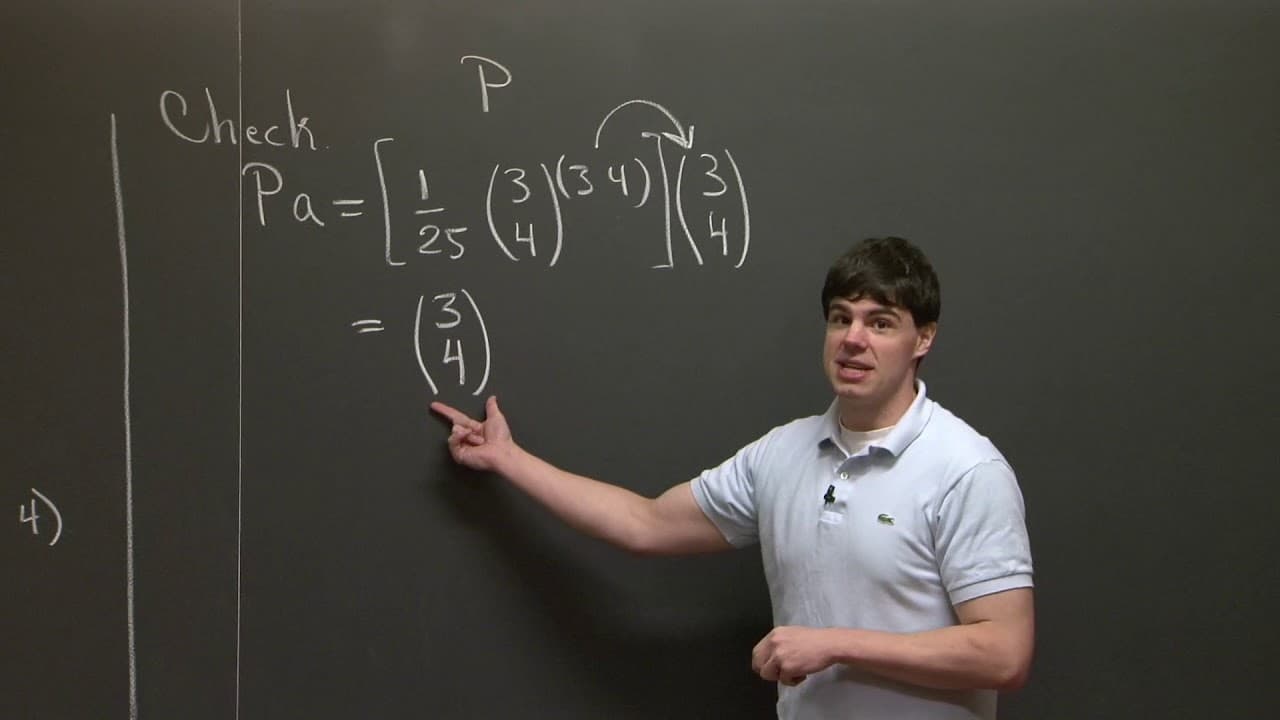
DAVID SHIROKOFF: Hi, everyone. So for this problem, we're just going to take a look at computing some eigenvalues and eigenvectors of several matrices. And this is just a review problem for exam number three. So specifically, we're given a projection matrix which has the form of a a transpose divided by a transpose a, where a is the vector 3 and 4.... Read More
Key Insights
- 👷 Eigenvalues of a projection matrix are always 0 or 1, and the vector used to construct the matrix is an eigenvector with a value of 1.
- ❓ Rotation matrices have complex conjugate eigenvalues and their corresponding eigenvectors determine the directions of rotation.
- ❓ Reflection matrices generally have eigenvalues of +1 or -1.
- 🪜 Shifting a matrix by adding or subtracting the identity matrix does not change the eigenvectors, only the eigenvalues.
Install to Summarize YouTube Videos and Get Transcripts
Explore YouTube Video Summarizer or Get YouTube Transcript Extractor
Questions & Answers
Q: What are the possible eigenvalues of a projection matrix?
The eigenvalues of a projection matrix are always either 0 or 1. This is proven by showing that P^2 = P, which implies λ^2 = λ.
Q: How can eigenvectors of a projection matrix be identified?
For a projection matrix of the form P = aa^T / (a^T a), the vector a itself is always an eigenvector with an eigenvalue of 1.
Q: What are the eigenvalues and eigenvectors of a rotation matrix?
The eigenvalues of a rotation matrix in the form of Q = [cosθ -sinθ; sinθ cosθ] are complex conjugate pairs of the form 0.6 + 0.8i and 0.6 - 0.8i. The corresponding eigenvectors can be found by solving (Q - λI)v = 0.
Q: What are the eigenvalues of a reflection matrix?
Reflection matrices typically have eigenvalues of +1 or -1. In the case of a reflection matrix R = 2P - I, the eigenvalues for the vectors a and b are both 1 and -1, respectively.
Summary & Key Takeaways
-
The first part explains that eigenvalues of a projection matrix are always either 0 or 1.
-
The second part demonstrates how to find the eigenvalues and eigenvectors of a rotation matrix.
-
The third part shows that the eigenvalues of a reflection matrix are typically +1 or -1.
Read in Other Languages (beta)
Share This Summary 📚
Summarize YouTube Videos and Get Video Transcripts with 1-Click
Try YouTube Summary with ChatGPT & Claude or YouTube Transcript Generator
Explore More Summaries from MIT OpenCourseWare 📚



Summarize YouTube Videos and Get Video Transcripts with 1-Click
Try YouTube Summary with ChatGPT & Claude or YouTube Transcript Generator