TU Wien Rendering #18 - Coming Up Next: BVH, Tone Mapping, SSS
TL;DR
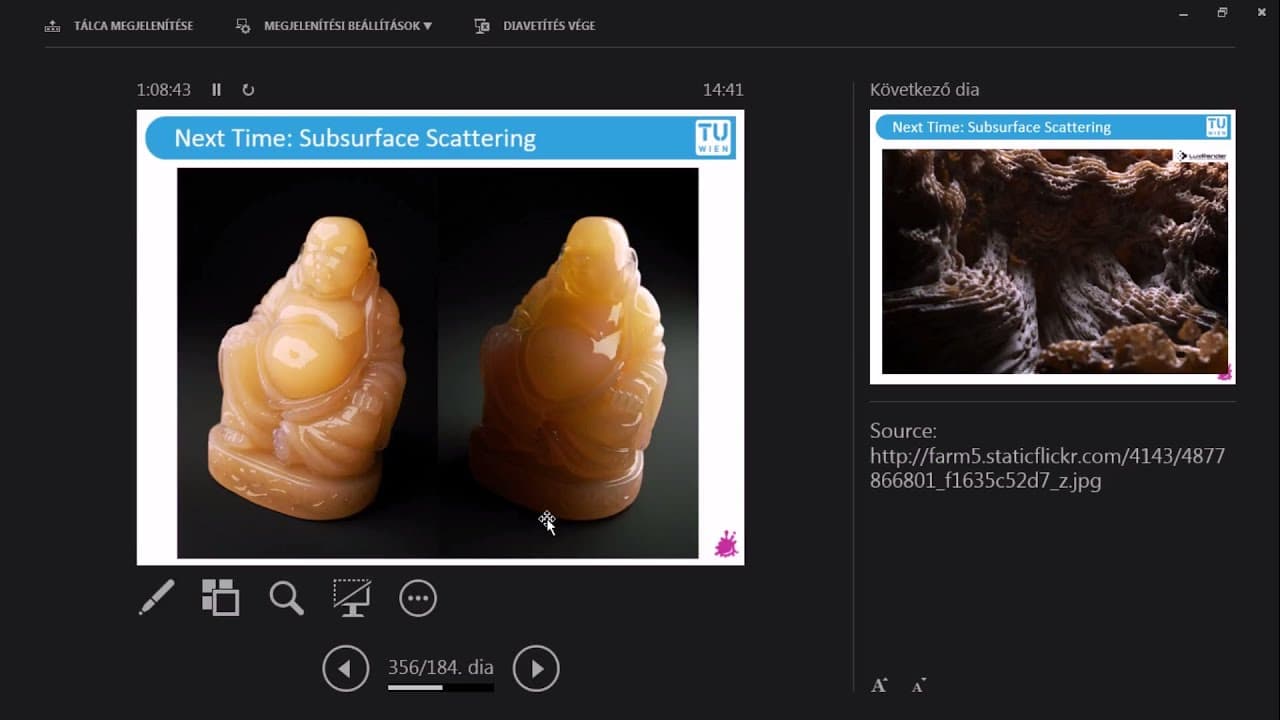
The next few lectures will cover topics such as the complexity of ray tracing algorithms, space partitioning for faster rendering, tone mapping for converting radians to RGB values, filtering for anti-aliasing, and the use of participating media for realistic effects like caustics and subsurface scattering.
Transcript
next time what you will see is something that was missing from many of the bigger mutations of many assignments what what is it what is the complexity of the ray tracing algorithm depend on well it depends on the resolution the bigger the image the longer it takes got it it is exponential with respect to the depth at least this implementation is if... Read More
Key Insights
- 🙌 The complexity of ray tracing algorithms depends on various factors such as resolution, depth, and the number of objects in the scene.
- 👾 Space partitioning techniques like kd-trees can significantly optimize ray tracing by reducing the number of intersection tests.
- 🥌 Tone mapping is essential for converting radiance values to RGB values for display on monitors, enhancing the realism of rendered images.
- 🙌 Filtering in ray tracing enables anti-aliasing and can yield different results based on the chosen method.
- 🔉 Participating media allows for the simulation of realistic effects like volumetric caustics, volume shadows, and subsurface scattering.
- 🙌 By integrating these techniques, ray tracing can produce visually stunning images in a reasonable amount of time.
- 🙌 The next lectures will delve deeper into these topics, including an examination of monte carlo integration and an understanding of the mathematics behind ray tracing algorithms.
Install to Summarize YouTube Videos and Get Transcripts
Explore YouTube Video Summarizer or Get YouTube Transcript Extractor
Questions & Answers
Q: Why does the complexity of ray tracing algorithms depend on resolution, depth, and the number of objects in the scene?
Ray tracing involves intersecting rays with objects in the scene, and the number of intersection tests increases with higher resolution and depth. Additionally, each object in the scene requires an intersection test, resulting in exponential complexity for a large number of objects.
Q: How can space partitioning optimize intersection tests in ray tracing?
Space partitioning techniques like kd-trees can be used to divide the scene into regions, allowing for efficient culling of polygons that are behind the rays' direction. By discarding unnecessary intersection tests, the complexity of ray tracing can be reduced from linear to logarithmic.
Q: What is the significance of tone mapping in ray tracing?
Tone mapping is the process of converting the high dynamic range radiance values to the limited range of RGB values for display on monitors. It ensures that the rendered images accurately represent the illuminations and details captured by the ray tracing algorithm.
Q: How does filtering play a role in ray tracing and what benefits does it provide?
Filtering is used to integrate radiances over the surface of pixels in ray tracing, allowing for the use of multiple samples per pixel. Different filtering methods can yield different results, including anti-aliasing. Correct filtering can provide anti-aliasing effects without the need for expensive super sampling techniques.
Q: What is participating media in ray tracing and what effects can it simulate?
Participating media refers to volumes like smoke and haze that light rays can scatter through. It allows for the simulation of effects such as volumetric caustics, volume shadows, and god rays, bringing more realism to rendered images.
Summary & Key Takeaways
-
Ray tracing algorithms have complexity that depends on resolution, depth, and the number of objects in the scene. Space partitioning can be used to optimize intersection tests and achieve logarithmic complexity.
-
Tone mapping is the process of converting radiance to RGB values for display on screens, and it plays a crucial role in breathing life into rendered images.
-
Filtering is essential for rendering techniques like recursive ray tracing, allowing for anti-aliasing and obtaining different results based on the chosen filtering method.
-
Participating media introduces the concept of volumes in ray tracing, enabling the simulation of effects like volumetric caustics, volume shadows, god rays, and subsurface scattering.
Read in Other Languages (beta)
Share This Summary 📚
Summarize YouTube Videos and Get Video Transcripts with 1-Click
Try YouTube Summary with ChatGPT & Claude or YouTube Transcript Generator
Explore More Summaries from Two Minute Papers 📚






Summarize YouTube Videos and Get Video Transcripts with 1-Click
Try YouTube Summary with ChatGPT & Claude or YouTube Transcript Generator