Blind speed | MTI Radar | Radar Systems | Lec-37
TL;DR
Blind speeds in MTA radar cause moving targets to appear stationary under specific frequency conditions.
Transcript
hi everyone in this video I am going to explain about blind speeds what do you mean by blind speeds and where these blind space will occur line speeds will occur in MTA radar mainly blind speeds occur in MTI radar so when we are measuring the moving Target indication indicating Radars that means with which velocity the target is moving in the movin... Read More
Key Insights
- 🙈 Blind speeds are significant challenges specifically encountered in MTA radar systems that require understanding and mitigation strategies.
- 💗 The frequency alignment of Doppler effects and pulse repetition frequencies results in situations where moving targets become undetectable or misinterpreted.
- 🫥 Delay line cancelers help in filtering out stationary echoes but can inadvertently lead to the loss of important moving target information.
- 🙈 Employing multiple pulse repetition frequencies provides a practical solution to mitigate the effects of blind speeds and improve radar accuracy.
- 📡 Blind speeds demonstrate the limitations of signal processing techniques in radar operation, emphasizing the need for heterogeneity in signal transmission.
- ❓ Accurate understanding of the relationships between frequency components is crucial when analyzing radar functionality and performance.
- 🙈 Blind speeds can impact radar operations from both a tactical and technical perspective, affecting detection accuracy and situational awareness.
Install to Summarize YouTube Videos and Get Transcripts
Explore YouTube Video Summarizer or Get YouTube Transcript Extractor
Questions & Answers
Q: What is a blind speed in MTA radar?
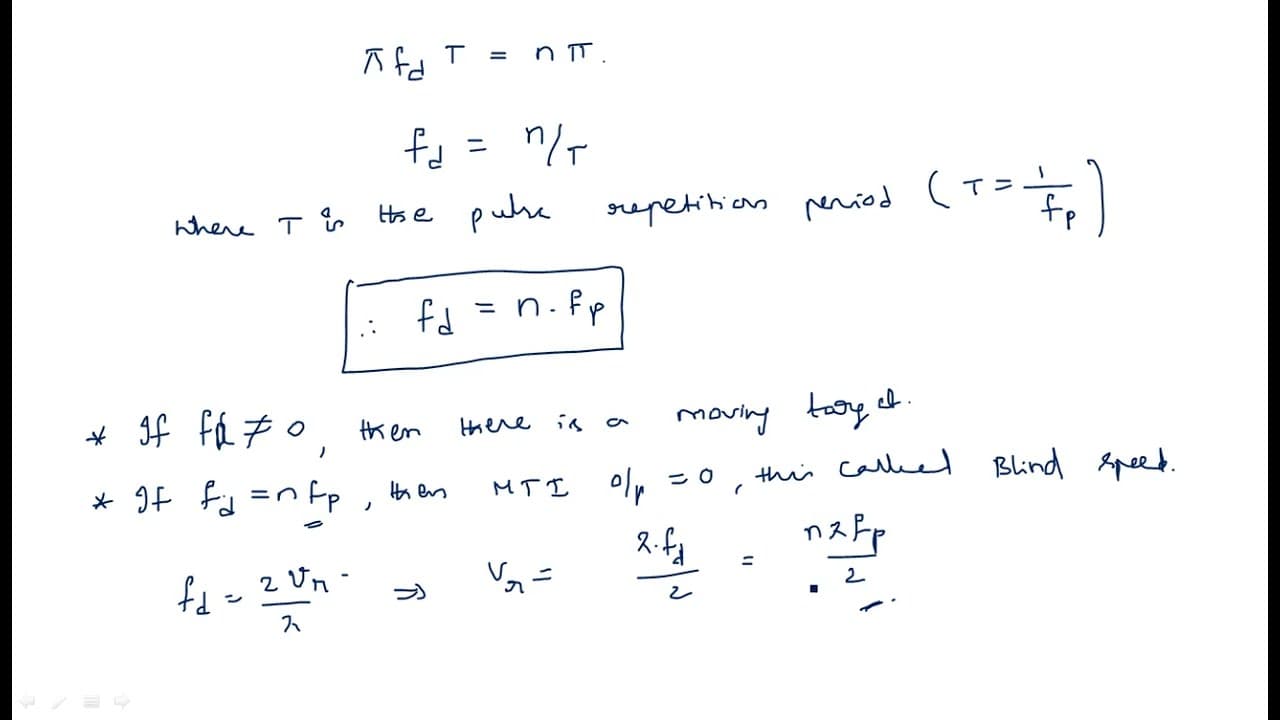
A blind speed in MTA radar refers to a phenomenon where a moving target is unable to be detected because it appears stationary. This occurs when the Doppler frequency of the moving target aligns with integral multiples of the radar's pulse repetition frequency, resulting in a zero output from the radar system, leading to the assumption that no target is present.
Q: How does Doppler frequency relate to blind speed?
Doppler frequency describes the change in frequency of a radar echo due to the movement of a target. If the Doppler frequency equals integral multiples of the pulse repetition frequency, the radar cannot detect the target's motion, causing it to be perceived as stationary. This situation creates a blind speed condition, misleading the radar operator.
Q: What role does the delay line canceler play in MTA radar?
The delay line canceler in MTA radar processes signals to convert bipolar video patterns—derived from radar outputs—into unipolar patterns. This process helps retain echoes from moving targets while eliminating stationary signals. However, it can also lead to blind speed issues when detectable target signals are removed erroneously due to frequency alignment.
Q: What is the solution to avoid blind speed in radar?
To avoid blind speed, radar systems can utilize multiple or staggered pulse repetition frequencies in their transmissions. By adjusting the pulse frequency, it ensures that the Doppler frequency is unlikely to become an integral multiple of the pulse repetition frequency, thereby allowing continuous detection of moving targets without erroneously perceiving them as stationary.
Summary & Key Takeaways
-
Blind speeds occur when a moving target is detected by an MTA radar but appears stationary due to Doppler frequency conditions aligning with pulse repetition frequencies.
-
The problem arises from specific frequency multipliers resulting in zero Doppler shift, leading to signals being discarded as non-moving, despite actual motion.
-
Solutions for blind speed include employing multiple pulse repetition frequencies to mitigate the issue and ensure accurate tracking of moving targets.
Read in Other Languages (beta)
Share This Summary 📚
Summarize YouTube Videos and Get Video Transcripts with 1-Click
Try YouTube Summary with ChatGPT & Claude or YouTube Transcript Generator